
Winter Arc 2026: Because October is the New January
While everyone else slides into holiday mode, you get 92 days to build something. 1 October through 31 December is the run-up, so January isn't a starting line. This is your Winter Arc.

What is the Winter Arc challenge?
92 days, one decision, no waiting for January
The Winter Arc grew from a simple idea: why wait for January when October is right there?
It was coined by TikTok creator @carlyupgraded and has since gone from trend to annual fixture, with mainstream coverage every autumn. The premise is straightforward. Use the last three months of the year to build something, so 1 January is a continuation rather than a starting line.
The October advantage
- Kids are back at school, so routines already exist
- Summer mode is over and the diary is calmer
- The weather suits walking and running far better than August did
- The holidays haven't started, so the excuses haven't either
- Gyms are empty, because everyone else is waiting for January
Your Winter Arc, your rules
Unlike rigid challenges such as 75 Hard, the Winter Arc is fully customisable:
- Daily movement, even 20 minutes
- A consistent sleep schedule
- Nutrition awareness, not necessarily restriction
- A skill: a language, an instrument, code
- Financial discipline
- A mindfulness practice
You decide what it means. This is not about following someone else's programme, and the full Winter Arc rules are deliberately loose for that reason.
Why the timing genuinely helps
There is no special seasonal biology at work here, whatever social media tells you. What October actually offers is more mundane and more useful: 92 days to practise a routine before the new year. You can learn what fits before deciding what to carry into January.
Habits take different amounts of time to form. Researcher Pippa Lally warns against treating 66 days as a fixed rule. Use the season to practise and adjust your routine. There is no deadline by which it must feel automatic.
What are the Winter Arc rules?
The core framework
The Winter Arc is flexible, but most people who finish it include some version of:
1. A physical component. Daily walks, the gym, yoga, home workouts. Anything that gets you moving.
2. A mental component. Reading, learning a skill, meditation, journalling, something creative.
3. Nutritional awareness. Not necessarily a diet. Could be water intake, meal prep, reducing one thing or adding one thing.
4. One non-negotiable. The single thing you do every day regardless. Most people choose movement, because it is the easiest to measure and the hardest to talk yourself out of.
Popular Winter Arc formulas
The Balanced Arc
- 30 minutes of daily movement
- Eight hours of sleep
- Two litres of water
- Ten pages of reading
The Fitness Arc
- Gym five times a week
- A daily step goal
- A protein target
- Sunday meal prep
The Wellness Arc
- Morning yoga
- Meditation
- Journalling
- No phone before 9am
- An evening walk
The Glow-Up Arc
- A skincare routine
- A workout plan
- Nutrition focus
- Confidence building
The only real rule
Consistency beats intensity. Twenty minutes daily for 92 days beats two hours once a week, every time. The Winter Arc is about building something that survives the holidays, not about how hard any single session was.
Why start on 1 October instead of 1 January?
January is set up to fail
- You are broke from the holidays
- You are tired from the parties
- There is guilt attached, which is a poor motivator
- Gyms are heaving
- The motivation is external, because everyone else is doing it too
- It is cold and dark, and enthusiasm does not survive either
October gives you a different set of conditions
- Routines are already established from September
- No financial holiday stress yet
- Better weather for getting outside
- The motivation is internal, since nobody is expecting it of you
- 92 days to build the habit before the hard part arrives
If you want a softer start, National Fitness Day falls on 16 September, a fortnight before the arc begins. Thousands of venues run free sessions, which makes it a low-cost way to test something out before committing to 92 days of it.
The back-to-school effect
After enough years of education, most people read autumn as a natural fresh start. September and October carry a "new beginning" feeling that January also has, but without the baggage of failed resolutions attached to it.
The holiday timing
Start on 1 October:
- 30 days in, it's Halloween and you have momentum
- 60 days in, it's late November and you can review what has worked
- 92 days in, it's New Year and you are continuing rather than beginning
Start on 1 January: most resolutions are abandoned within weeks, and you are attempting to build the habit during the least forgiving month of the year.
That is the whole argument. Not neuroscience, just a better run-up.
How Motion helps your Winter Arc stick
Built for the boring middle
Most Winter Arcs do not fail in October. They fail somewhere around day 40, in a dark, wet November week when nothing is visibly improving. That is the part Motion is designed for.
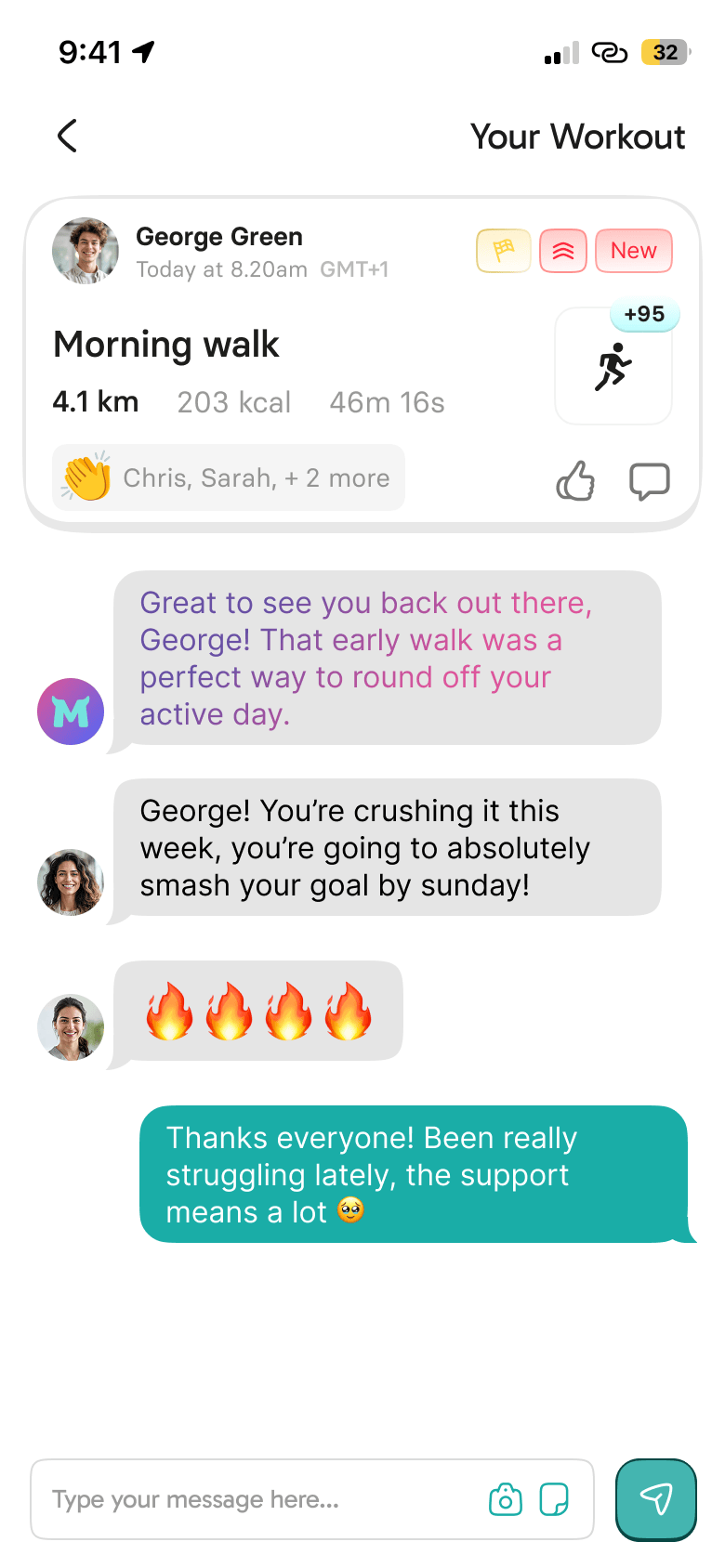
Your Motmot is the accountability Your virtual pet responds to your daily movement, and it evolves as you keep going. It does not die if you miss a day. It just gets a bit sad, because the Winter Arc is about consistency rather than perfection.
Adaptive goals that know October isn't December Motion sets your target from your actual recent activity and moves it as you change. Gentle in October, higher by December, without you having to guess the right number in advance.
No streaks to break This matters more over 92 days than it sounds. One missed day in November is where most Winter Arcs quietly end, and a counter resetting to zero is what makes that day feel terminal. There is nothing here to reset.
Everything counts Morning yoga counts. A lunchtime walk counts. Dancing while you clean the kitchen counts. Playing with the kids counts. Motion does not care whether you consider yourself athletic.
Weekly battles scored on effort Competition is based on the percentage of your own goal you hit, not raw numbers. A beginner pushing hard can genuinely beat someone fitter who is coasting.
The three-month shape
October, foundation. Focus on turning up. Twenty to thirty minutes daily. Do not worry about intensity.
November, momentum. Increase duration or add a second habit. This is where the dip lives, so expect it.
December, consolidation. Keep the parts that fit your life and adjust the plan for the holidays. You can keep practising in January.
Which Winter Arc difficulty should you choose?
Winter Arc Soft
- One form of movement daily, any duration
- Drink more water
- Read before bed
- One fruit or vegetable per meal
- Phone down by 10pm
Best for: first-timers, busy parents, high-stress jobs, anyone returning after a long break.
Winter Arc Standard
- 30 to 45 minutes of movement daily
- Track nutrition rather than restrict it
- Seven to eight hours of sleep
- Ten pages of reading
- One self-care practice
Best for: most people, and the version most likely to still be running in March.
Winter Arc Hard
- Gym five or six times weekly
- A strict nutrition plan
- No alcohol
- 5am wake time
- Daily cold shower
- Meditation practice
Best for: high achievers and people with a specific competition or event in view. Worth being honest that this version has the highest drop-out rate, and that dropping out of a hard arc often means doing nothing at all.
Winter Arc Custom
Pick three to five from fitness, nutrition, sleep, learning, financial targets, relationships, career, or creative work.
The key is choosing what matters to you rather than what looks good on TikTok.
Combining challenges
- Winter Arc with 75 Soft rules
- The Winter Arc timeline with a modified 75 Hard
- Winter Arc as part of The Great Lock In
What if you've already missed 1 October?
Then you start anyway.
- Starting 15 October gives you 78 days
- Starting 1 November gives you 61 days
- Starting today puts you ahead of everyone still waiting for a tidy date
The 1 October start exists because a shared timeline creates community, not because the date has any power of its own. A shorter arc still gives you time to practise and review your routine.
Your first week
Day 1: choose your big three. One fitness commitment, one nutrition awareness, one mindset practice. No more than that.
Days 2 to 3: test run. Try the routine. Too easy, add a little. Too hard, scale back. You are looking for something you could still do on a bad day.
Days 4 to 7: lock it in. Same time daily. Prepare the night before. Track it. Tell someone.
Week 2 onward: build. Add five minutes. Increase gradually. Find other people doing it.
Make it public
Plenty of people post a commitment, and it does help:
"I commit to my Winter Arc from [date] to 31 December. My non-negotiables are [three to five things]. I'm doing this because [reason]."
Post it, or just tell one person. Public commitment measurably improves follow-through, and it costs nothing.
Find a Winter Arc plan that fits your life
Walking Winter Arc
A gentle walking plan with a free weekly tracker.
Read moreWinter Arc for beginners
Choose one habit and use the first-week checklist.
Read moreWinter Arc for mums
Fit short walks around work, children and family plans.
Read moreWinter Arc during perimenopause
Adapt your plan when energy, sleep or symptoms change.
Read moreFrequently asked questions
If you have anything else you want to ask, reach out to us.
What's the difference between the Winter Arc and The Great Lock In?
The Winter Arc runs 1 October to 31 December, which is 92 days. The Great Lock In runs 1 September to 31 December, which is 121 days. The Winter Arc tends to be more flexible and more TikTok-community driven, while the Lock In is often framed as more intense. Plenty of people use the terms interchangeably.
Can I start the Winter Arc in November?
Yes. Start in November and use the time you have. Starting on 1 November gives you 61 days before January. Choose a manageable first week and carry on beyond December if you want. You do not need to catch up on October.
Do I have to post on TikTok to do a Winter Arc?
No. It started on TikTok and sharing does help with accountability, but plenty of people do it privately. Motion's community offers accountability without social media if you would rather not post.
What if I miss a day?
Nothing happens. Unlike 75 Hard, the Winter Arc has no restart rule. Pick it back up the next day. What actually ends a Winter Arc is deciding the missed day has ruined it, which is why Motion has no streaks to break.
Is the Winter Arc easier than 75 Hard?
Different rather than easier. It is longer at 92 days versus 75, but far more flexible, and you set your own rules instead of following fixed ones. Some people find that harder, because it takes more self-direction and there is nobody telling you the standard.
What should my Winter Arc goals be?
Start with whatever bothers you most right now. If that is fitness, start there. If it is sleep, prioritise that instead. Most Winter Arcs that survive include daily movement, some nutrition awareness, consistent sleep, and one personal goal. Two or three habits is plenty.
What step goal should I pick for a Winter Arc?
Lower than you think. 10,000 is the default people reach for, but it came from 1960s pedometer marketing rather than research. The 2025 Lancet Public Health review of 57 studies found most of the longevity benefit is already banked by around 7,000 steps a day. For a target you need to hold through December, see our guide to walking 7,000 steps a day.
What happens after 31 December?
Keep the parts of your routine that fit your life and change those that do not. You can continue practising into January. There is no fixed date by which a habit must feel automatic.

Your Fitness Journey Starts Here
Download Motion free and discover why this is the fitness app you'll actually keep using. Your future self (and your Motmot) will thank you.

