
Workplace Step Challenge
A practical guide for HR and wellness leads. How to design a step program your whole team can join — without privacy headaches, top-performer fatigue, or a wall of disengagement by week two.

Why do workplace step challenges keep showing up in wellness budgets?
Step programs sit in an unusual sweet spot for workplace wellness: cheap to run, easy to opt into, and one of the few interventions with a decent research base. The 2020 Cochrane review by Freak-Poli and colleagues on workplace pedometer interventions found short-term increases in physical activity across multiple trials, with associated improvements in BMI and blood pressure. Niven et al.'s 2021 four-year analysis of Scotland's Paths for All Workplace Step Count Challenge (10,183 participants) in IJERPH reported an average daily step increase of 906 between week 1 and week 8, equivalent to roughly nine extra minutes of moderate activity a day. A follow-up 2022 IJERPH study by Ryde and colleagues measured productivity, stress, and work engagement during the same program and found positive changes in stress and productivity self-reports.
The WHO's Global Action Plan on Physical Activity 2018–2030 explicitly recommends workplaces as a setting for population-level activity interventions. So the question for HR isn't whether to run one. It's how to run one that doesn't fall over by week two — or quietly alienate half the workforce.
Movement linked to fewer sick days
Active employees take fewer sick days and self-report higher productivity. The Ryde et al. 2022 study saw measurable shifts in perceived stress and output across a four-week challenge — not a moonshot, but a real signal for a low-cost program.
A reason to talk that isn't work
Department-vs-department challenges create cross-team chatter, especially in hybrid teams. People who never spoke in the company Slack start trading walking routes. That's the engagement payoff that doesn't show up in a step count.
One of the cheapest interventions to launch
No subscriptions per head, no gym installation, no expensive incentives required. The Cochrane review notes pedometer-based workplace programs are inexpensive relative to other physical activity interventions — and they scale easily across remote, hybrid, and shift-based teams.
How does Motion handle a workplace step challenge?
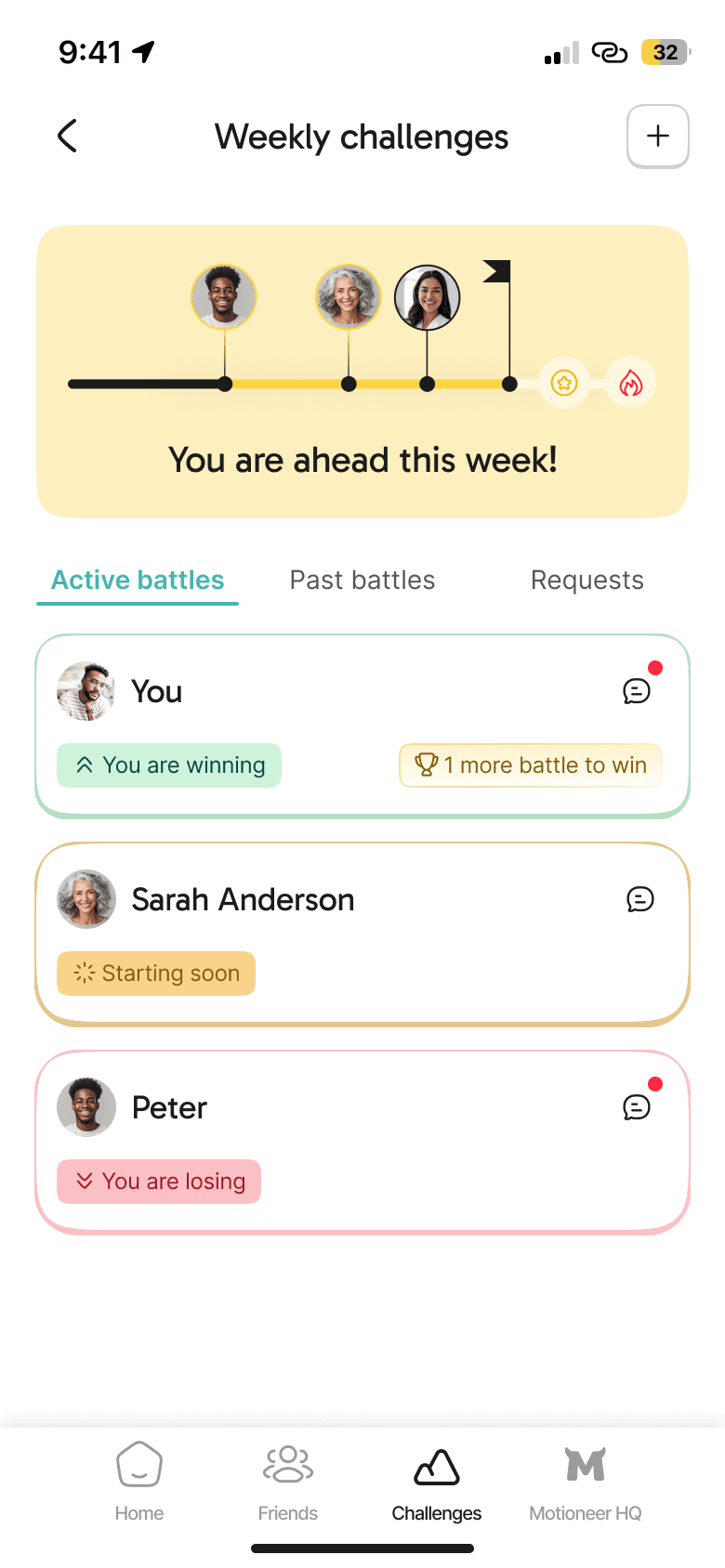
Most workplace step programs trip over the same thing on day one: a public leaderboard that ranks every employee by raw step count, with the same handful of people permanently at the bottom. Motion's leaderboards are built around percentage of personal goal achieved rather than absolute steps, so the marathon runner and the part-time office worker can sit next to each other in the standings. HR sees aggregated team progress; nobody sees a "lowest steppers" callout because the data isn't framed that way.
Setup for HR is a fortnight's worth of work compressed into an afternoon. Departments map straight onto Motion's team mode, you set a duration and a difficulty, and the join link goes out over email or Slack. There's no kit to procure, no IT ticket for new hardware, no per-seat licensing dance before a pilot can run.
The cross-platform piece matters more than it sounds. Some employees are Apple-watch people, some carry an Android, some have an old Fitbit, some have nothing more than the step counter built into their phone. Motion reads from all of them, so the challenge runs the same regardless of your BYOD policy or what each employee happens to own. For the broader picture of how Motion is built for step challenges, see our step challenges guide.
How do you make a workplace step challenge inclusive?
This is the part most off-the-shelf programs handle badly. A step challenge that only works for people who can comfortably walk several miles a day isn't a wellness initiative — it's a fitness contest with a wellness label. Three principles separate a good corporate program from a problematic one.
1. Don't measure raw steps. Measure progress.
Job roles vary wildly. A field engineer or care assistant clocks 12,000+ steps before lunch. A software engineer on back-to-back calls might log 2,500. Setting one universal target either bores the first group or shames the second. The 30-day step challenge format page covers this in depth, but the short version: use a percentage lift over each person's own baseline. Both employees committing to a +20% increase are working equally hard. Motion does this automatically; the free builder handles it too.
2. Make non-walking activity count.
Some employees can't walk for steps and shouldn't be expected to. Wheelchair users, employees with chronic pain, people recovering from injury, pregnant employees in later trimesters, anyone with a mobility-affecting condition. Programs that only measure walking exclude them by design. Motion lets you count strength sessions, yoga, swimming, cycling, wheelchair pushes, and other activity as challenge-eligible — so participation isn't gated on gait.
The US Equal Employment Opportunity Commission's ADA guidance on wellness programs is clear: voluntary corporate wellness programs must offer reasonable alternatives for employees who can't participate in a specific activity. "Hit 8,000 steps" doesn't meet that bar on its own. "Hit your personalised activity target, with steps as one option among several" does.
3. Run it by team, not individual.
Team mode is the single most inclusive design choice you can make. Individual mode turns a workplace challenge into a public ranking — and the bottom of that ranking is always the same handful of people. Team mode rolls every participant's effort into a shared total, so the contribution from someone hitting their +15% target matters just as much as someone smashing +50%. The team step challenge format is the default we recommend for corporate programs for exactly this reason.
Try our free step challenge builder before you commit
Add your team, pick a duration, and we'll generate personalised daily goals for each participant. No sign-up. Use it for a pilot week before rolling out to the wider company.
What goes wrong with workplace step challenges — and how to avoid it?
Most of the failure modes are predictable, which is good news. They mostly come from skipping the design phase and rolling out a generic template.
Top-performer fatigue
One or two highly active employees dominate the leaderboard for the whole challenge. By week two, everyone else has tuned out. The fix is structural, not motivational: use Team mode, percentage-based goals, and a "personal goal hit" win condition rather than a raw step count race. Motion's leaderboard ranks by percentage of personal goal achieved, not absolute steps. The marathon runner and the new starter can both be in the top three.
ADA, accessibility, and dignity
Beyond the legal floor, there's the cultural one: nobody should feel publicly identified as "the person at the bottom." Don't post individual rankings on a screen in reception. Don't email a weekly "lowest steppers" callout, even jokingly. Recognition should be for personal-goal hits, streaks, and team contributions — not for being naturally fast.
Data privacy
Step data is health data in most jurisdictions. In the EU and UK it's covered by GDPR, in California by CCPA, and globally by your company's own privacy posture. Three practical rules:
- Participation is voluntary. No one should feel professionally pressured to opt in.
- HR shouldn't see raw individual step counts. Aggregate, anonymous team totals are fine. Individual streams are a privacy minefield.
- The vendor matters. Pick a platform with clear data handling, opt-in sharing, and the ability for participants to leave with their data deleted. Motion stores step data per the Motion privacy policy and participants can opt out at any time.
Pay-to-win incentives
Tying rewards directly to raw step counts (a £200 voucher for whoever walks the most) reliably turns the challenge into a contest the same three people win every year. Better designs reward consistency (hit your personal goal every weekday), team contribution (your department finished a "virtual route"), or random draws among everyone who participated. The point is participation, not a scoreboard.
Comms that nobody reads
A workplace challenge needs three comms moments: a launch announcement explaining the format and why it's voluntary; a mid-challenge nudge with team standings (anonymised at the individual level); and a wrap-up that celebrates teams and personal-goal hits, not raw winners. That's it. More than that is noise.
Going further: tools, formats, and the B2B option
Motion for Teams — the B2B wellness program
If you want a managed program with admin dashboards, department-level reporting, and bulk onboarding, Motion for Teams is the version of the app built for HR and wellness leads.
Read moreFree Step Challenge Builder
Spin up a pilot in 30 seconds. Add your team, get personalised goals, share a link. No install needed for the planning phase.
Read moreTeam Step Challenge format
Deep dive on the format we recommend for corporate programs. How team mode levels the playing field across departments and fitness levels.
Read moreWorkplace step challenge FAQs
If you have anything else you want to ask, reach out to us.
How long should a workplace step challenge be?
Two to four weeks is the sweet spot for most corporate programs. Niven et al.'s analysis of Scotland's Workplace Step Count Challenge — an 8-week format with over 10,000 participants — showed steps increased week-on-week throughout the program, so longer formats can work if you keep momentum up with mid-challenge comms. For first-time programs, start with a fortnight. It's long enough to see a behavioural shift, short enough that nobody bails.
Should a workplace step challenge be individual or team-based?
Team mode is almost always the better choice for corporate programs. Individual leaderboards create top-performer fatigue and quietly exclude employees with mobility limitations, less active job roles, or care responsibilities. Team mode (departments competing on combined effort, or all teams contributing to a single company goal) folds in employees who'd never win a head-to-head race and turns the program into a shared project.
How do you handle accessibility and ADA compliance in a step challenge?
Three things matter most. First, allow non-step activities to count (yoga, strength training, swimming, wheelchair pushes). Second, set goals as a percentage lift over each person's own baseline rather than a flat target. Third, offer a reasonable alternative for any employee who can't participate in the activity-tracking format at all. The EEOC's guidance on voluntary wellness programs is clear that alternatives must exist. Motion is built around personalised goals and counts a wide range of activities, which makes the compliance side easier.
What's a fair step goal to set for employees?
Don't set one. Set a percentage lift over each person's individual baseline. An office worker on 3,000 steps and a retail manager on 11,000 will both be working hard at +20%. A universal '8,000 steps' target rewards people whose jobs already involve movement and discourages the people the program is actually meant to help.
How do you handle data privacy in a corporate step challenge?
Make participation voluntary, restrict HR access to aggregated and anonymised team-level data only, and choose a platform with clear data handling and opt-out controls. Step data is health-adjacent and in most jurisdictions (GDPR, CCPA, etc.) needs to be treated accordingly. A good rule of thumb: if the data wouldn't be acceptable to share in a 1:1 with a manager, it shouldn't be visible to HR either.
What's the ROI of a workplace step challenge?
The 2020 Cochrane review by Freak-Poli et al. found workplace pedometer programs to be a cost-effective way to increase short-term physical activity, with associated improvements in BMI and blood pressure. The 2022 Ryde et al. study of Scotland's national workplace step count challenge found positive shifts in self-reported productivity and stress. Step programs aren't a silver bullet — but they're one of the cheapest wellness interventions to launch, and the evidence base is more solid than for most office wellness initiatives.
What kinds of rewards work best — and which ones backfire?
Recognition tied to consistency works (a shoutout for hitting your personal goal every weekday, a team prize for finishing a virtual route). Random draws among all participants work. Pay-to-win incentives (the biggest cash prize for the most raw steps) reliably backfire — the same active employees win every time, everyone else disengages, and the whole thing turns into a contest rather than a wellness program.
What if some employees don't have a smartphone or wearable?
Motion supports manual entry for employees without a connected device, and most modern smartphones (iOS and Android) count steps natively. For shift workers without a personal phone at work, options include logging steps at the end of the shift, partnering with a low-cost pedometer, or counting time-based activity (e.g. a 20-minute walk = a fixed step contribution) for fairness.
Should we link rewards to medical outcomes like BMI?
No. Linking wellness program rewards to medical results creates significant legal exposure under the ADA, GINA, and equivalent laws outside the US, and is widely considered poor practice by wellness practitioners. Reward participation and consistency, not biometric outcomes. Many of the legal challenges against corporate wellness programs in the last decade have centred on this exact issue.

Your Fitness Journey Starts Here
Download Motion free and discover why this is the fitness app you'll actually keep using. Your future self (and your Motmot) will thank you.

