
Team Step Challenge
Combine everyone's personalised step goals into one shared total. Mixed fitness levels stop being a problem and start being the point.

Why does a team step challenge work where head-to-head fails?
A head-to-head step competition is great when everyone walks roughly the same amount. Pit a desk worker against a nurse who's on her feet all day, and you don't have a contest — you have one bored winner and one quiet quitter by Wednesday. A team step challenge fixes this by pooling everyone's personalised daily goals into one shared total. Nobody loses, because everyone's contribution adds to the same number.
The group psychology backing this is well documented. Carron, Hausenblas and Mack's 1996 meta-analysis in the Journal of Sport & Exercise Psychology ("Social influence and exercise") found task cohesion, the feeling of being bound to a group's shared goal, produced one of the largest effects on exercise adherence they measured. Wing and Jeffery's 1999 study in the Journal of Consulting and Clinical Psychology ("Benefits of recruiting participants with friends") found people who signed up with friends and got group support had a 95% completion rate vs 76% for solo participants, and 66% maintained their results long-term vs 24% going solo. Team beats individual on the numbers that matter.
Three things make team mode specifically good at keeping mixed groups moving together.
One number, everyone contributes
When the whole group's working toward a combined daily total, nobody's last and nobody's first. The quietest walker pulling 4,000 steps is just as essential to the team total as the marathon trainer doing 18,000.
Fair contributions across fitness levels
Each person's personal goal is a percentage lift from their own baseline. The 4,000-step walker doing +25% is working as hard as the 12,000-step runner doing +25%. Both feed the same shared total.
Everyone's steps actually matter
Kerr's research on the Köhler motivation effect found people work harder when their effort is necessary to the group's success. Team mode makes that real — miss your day and the team total drops.
How does Motion handle a team step challenge?
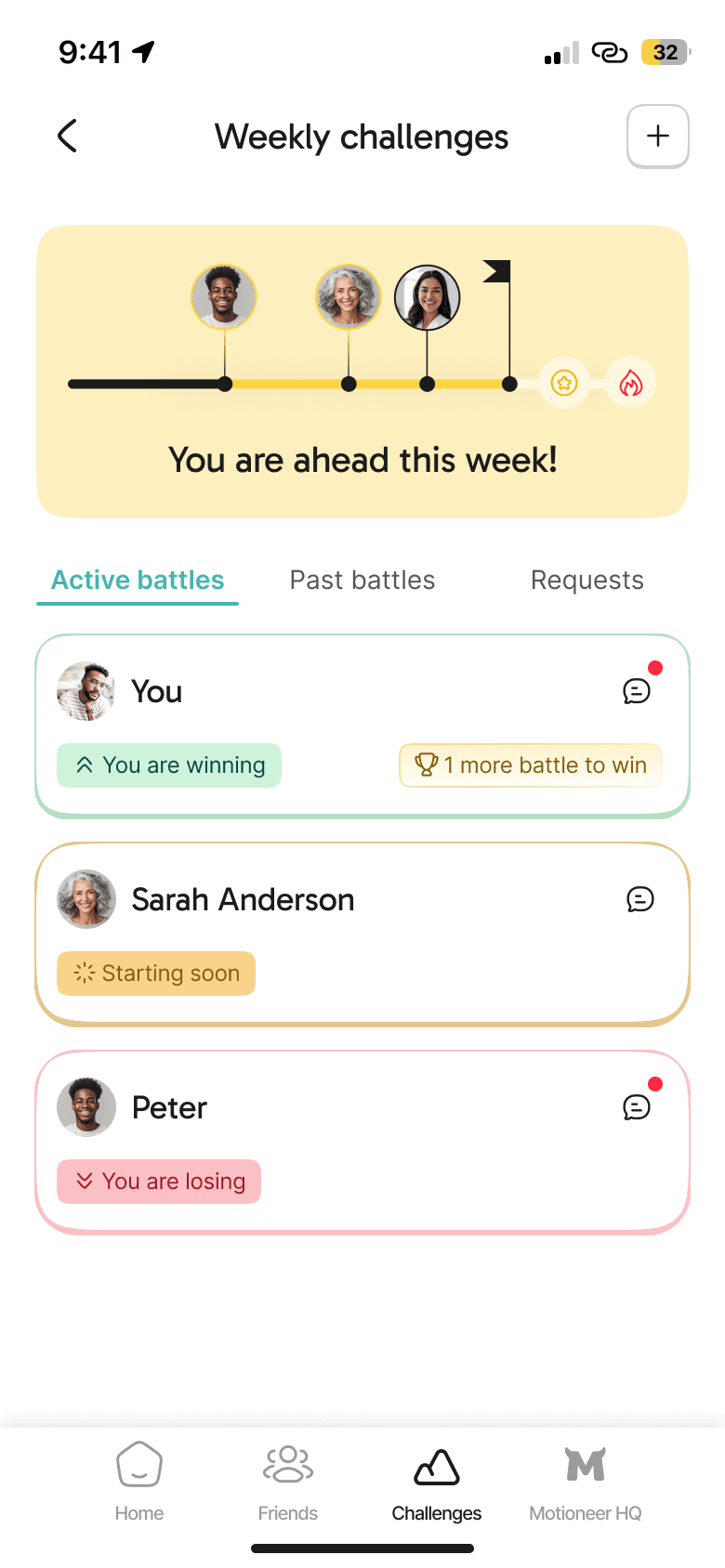
The hard part of running a team challenge by hand is the tally. Someone has to collect numbers, add them up, push out a daily figure, and chase the laggards who haven't reported in. By day four, the person doing this hates their team. Motion runs a live combined team total that updates as each member's steps come in from their device. No spreadsheets, no end-of-day cutoff, no one stuck doing data entry instead of walking.
The per-person view is the bit that makes team mode feel fair from the inside. Even though the headline number is the team's combined total, every member can see their own contribution and how it stacks against their personal goal. Quieter contributors who'd be invisible on a raw-step leaderboard get visibility for their effort. The deskbound member hitting +25% on their own baseline shows up as having done their job, regardless of how that compares to the marathoner's raw count.
For groups larger than ten, Motion supports sub-teams competing against each other (department-vs-department in a workplace, year-group-vs-year-group in a school, family-vs-family at a reunion). You get both engines: within-team collaboration and between-team rivalry, on the same screen. For the broader picture of how Motion is built for step challenges, see our step challenges guide.
How do combined team goals actually work?
A team step challenge in Motion sums each person's personalised daily goal into one shared team target. Hit the target collectively and the team wins the day. Miss it and tomorrow's a fresh chance.
Say your team has five people with very different lives:
- Aisha, deskbound consultant, baseline 4,000 steps/day → +25% goal of 5,000
- Tom, dog owner, baseline 8,000 → +25% goal of 10,000
- Priya, nurse on her feet all shift, baseline 13,000 → +25% goal of 16,250
- Marcus, retiree with a bad knee, baseline 3,500 → +25% goal of 4,375
- Sara, runner, baseline 10,000 → +25% goal of 12,500
Team daily target: 48,125 steps. Aisha contributing her 5,000 matters every bit as much as Priya contributing her 16,250 — both are doing the same job (each lifting 25% over their own normal day). The single number on the leaderboard makes the equivalence obvious to everyone.
This is the part that head-to-head step challenges can't do. In a raw step count contest, Priya wins by default. In a percentage-lift contest, the maths is fair but the daily experience is still five separate races. Team mode collapses it into one race the group runs together. That's the social facilitation principle in action — performance lifts when individual effort feeds visible group progress (Chaudhry et al., 2020, International Journal of Behavioral Nutrition and Physical Activity, found step-monitoring interventions raised daily steps by roughly 1,100/day on average across 57 randomised trials, with social and group elements amplifying the effect).
The maths underneath is identical to the wider step challenge format. What changes is whether each member's effort feeds a personal scoreboard or a collective one. Team mode swaps individual standings for shared progress without softening the work anybody has to do.
Try the free team step challenge builder
Add your team, set a difficulty, and we'll calculate a personalised daily goal for each person plus a combined team target. Share the link — no sign-up needed.
How big should each team be?
Five to ten people is the sweet spot. Smaller than that and one person's bad week wrecks the average. Bigger and you start losing the thing that makes team mode work — the feeling that your steps are noticed.
The team-cohesion literature lines up here. Carron's group dynamics work and the broader small-group research both put 5-9 as the band where members still feel personally accountable and where social loafing (people coasting because they assume someone else will pick up the slack) hasn't kicked in. Above ten or so, individual effort starts to feel diluted. Below five, the variance is just too high — one person on holiday or sick wrecks the team total.
If you've got more than ten people, the right answer isn't a bigger team. It's multiple teams competing against each other, with collaboration inside each team. That stacks both motivational engines: the within-team cohesion that keeps people showing up for each other, plus the between-team rivalry that gives the whole thing edge.
Setting up inter-team competition
Three patterns work well:
- Departments vs departments. Standard for a workplace step challenge. Each department becomes a team of 5-10. Larger departments split into 'Engineering A' and 'Engineering B'. Leaderboard shows which team is hitting its combined target most consistently.
- Mixed-fitness draft teams. Captains pick teams round-robin so each one ends up with a mix of high- and low-baseline members. Stops the fittest people stacking on one team and prevents the leaderboard from being decided on day one.
- Friends and family pods. Five-person pods built around natural friendship groups. Works for sports clubs running a winter step challenge or for extended families wanting multi-generational involvement. Pods compete on combined-target hit rate over a fortnight.
Whichever structure you pick, give each team a name. It's small, it's silly, and it doubles engagement.
When is team mode the wrong choice?
Team step challenges aren't always the right format. Some groups genuinely thrive on direct rivalry and team mode dampens what they actually enjoy — the trash talk, the daily lead changes, the satisfaction of beating a specific person.
Pick Compete (head-to-head) mode when:
- Everyone in the group has roughly similar baselines (within ~30% of each other)
- The group's already competitive — sports teams, friend groups who play together, families with sibling rivalries
- You want a clear individual winner at the end
- The group is small (3-5 people) and rivalry feels natural
Pick Team mode when:
- Fitness levels vary widely (this is the strongest case)
- The group includes anyone self-conscious about being 'the slow one'
- You're running a workplace or community challenge where inclusion matters
- You want collaboration to be the felt experience, not competition
- Group size is larger than ~6 people
A useful diagnostic: if you can already predict who'd win a head-to-head step contest, team mode is the better format. The challenge should be about effort and consistency, not about who has a step-friendly job.
Tools and related step challenge formats
Motion app — run team step challenges automatically
Personalised goals from real activity data, automatic tracking, combined team totals, and a live leaderboard. Free for iOS and Android.
Read moreFree Step Challenge Builder
Build a fair team step challenge in 30 seconds and share a link. No sign-up needed.
Read moreWorkplace step challenge
Department-by-department team challenges for office wellness programs. Cheap, inclusive, no fitness background required.
Read moreTeam step challenge FAQs
If you have anything else you want to ask, reach out to us.
What's the ideal team size for a step challenge?
Five to ten people works best. Smaller and one absence or sick day skews the team total too much; bigger and individual contributions start to feel invisible, which is when social loafing creeps in. If you've got 20 or 30 people, run multiple teams of 5-10 competing against each other rather than one big team.
How does a team step challenge handle mixed fitness levels?
Each person gets a personalised daily goal calculated as a percentage lift over their own baseline. A 4,000-steps-a-day desk worker doing a +25% target (5,000) is putting in the same effort as a 12,000-step nurse doing +25% (15,000). Both contributions feed the same shared team total. Mixed fitness levels stop being a problem; they're the reason team mode exists.
Should I pick Team mode or Compete mode?
Team if fitness levels vary widely, if anyone in the group might feel self-conscious about being 'the slow one', or if collaboration is what you want the group to feel. Compete if everyone has roughly similar baselines, the group thrives on rivalry, and you want a clear individual winner. Sports clubs and tight friend groups often prefer Compete. Workplaces, families, and mixed-fitness groups almost always do better in Team mode.
Can you run multiple teams competing against each other?
Yes — that's the strongest setup for any group bigger than about ten people. Each team has 5-10 members collaborating on a combined daily total, and the teams compete against each other on hit rate (or total steps relative to their combined goal). You get the within-team cohesion that keeps individuals showing up, plus the between-team rivalry that adds edge.
Does a team step challenge actually keep people more engaged?
Yes, and the evidence is robust. Carron, Hausenblas and Mack's 1996 meta-analysis in the Journal of Sport & Exercise Psychology found task cohesion produced one of the largest effects on exercise adherence in the literature. Wing and Jeffery's 1999 weight-loss trial in the Journal of Consulting and Clinical Psychology found 95% of friend-recruited participants completed the program vs 76% who joined solo, and 66% maintained results long-term vs 24%. Group structure significantly outperforms individual.
What if some team members barely walk at all?
That's exactly who team mode is designed for. Their baseline is low, so their personalised goal is low — and them hitting their goal contributes proportionally to the team total. The challenge is about consistency relative to their own baseline, not raw step count. A low-baseline member who hits their goal every day is more valuable to the team than a high-baseline member who flakes on weekends.
How long should a team step challenge run for?
Two to four weeks is the sweet spot. Long enough for the team identity to actually form (the first few days are setup), short enough that nobody loses momentum. Workplaces often run 30-day challenges to align with a calendar month. Friend groups frequently prefer 14 days. Anything over 60 days tends to fade — better to run back-to-back 30-day challenges than one long grind.
Can a team step challenge include cycling, swimming or gym sessions?
In Motion, yes. Other activities convert into points that count toward the team total, so members who hate walking but love cycling or yoga can still contribute. This matters more in team mode than in compete mode — when one number represents everyone, you don't want anyone locked out by activity preference.

Your Fitness Journey Starts Here
Download Motion free and discover why this is the fitness app you'll actually keep using. Your future self (and your Motmot) will thank you.

