
Family Step Challenge
One challenge, every age. Motion sets a personalised goal for each family member, tracks steps automatically, and turns daily walks into something the kids actually ask for.
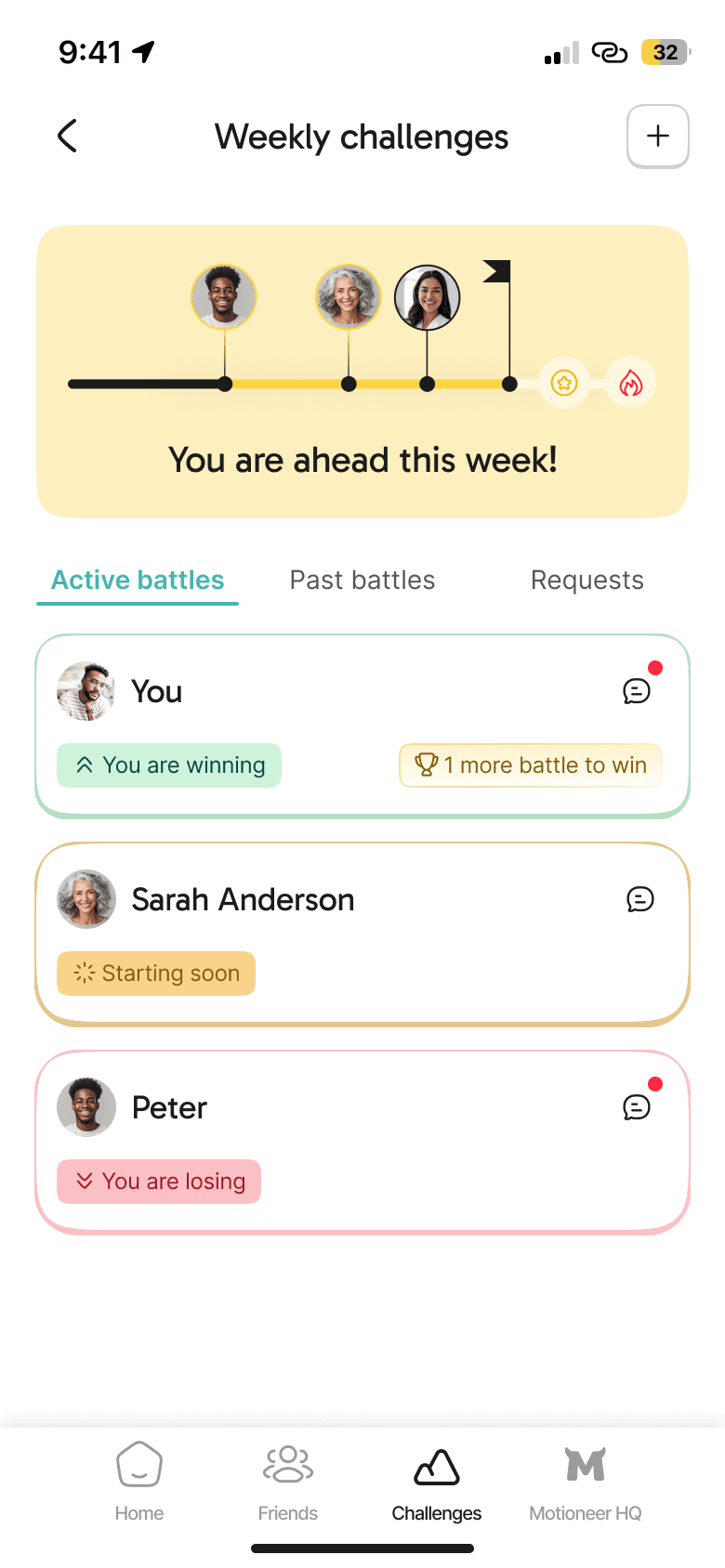

Why do family step challenges usually fizzle out by Wednesday?
Walking together as a family is one of the few things that actually checks every box: cheap, low-injury, good for everyone from preschool to retirement, and it scales from a ten-minute loop around the block to a full-day hike. The research backs it. The 2018 US Physical Activity Guidelines for Americans (2nd edition) ask kids 6 to 17 for at least 60 minutes a day of moderate-to-vigorous activity, adults for 150 to 300 minutes a week, and older adults for the same plus balance training. The WHO 2020 Guidelines on Physical Activity and Sedentary Behaviour agree, and add the line that matters most for families: "some physical activity is better than none."
So why do most family step challenges die by day four? Three patterns, every time.
10,000 steps for everyone
An eight-year-old and a 78-year-old don't have the same body, the same day, or the same baseline. Asking both to hit the same number makes one bored and the other defeated by Tuesday.
Someone always loses
Whoever has the longest legs and the fewest school pickups wins. The kids realise they can't beat dad. Grandma realises she can't beat the kids. Everyone quietly stops looking at the leaderboard.
Someone has to log the steps
Whiteboards on the fridge, screenshots in the family chat, a spreadsheet someone updates on Sundays. It works for a weekend. Then school starts, life happens, and the tracking quietly dies.
How does Motion handle a family step challenge?
The hardest part of a multi-generational challenge is the baseline. An eight-year-old genuinely walks 13,000 steps on a normal Tuesday. A 78-year-old grandparent might walk 3,500 on a good one. Setting a single target either bores the kid or breaks the grandparent. Motion calibrates each person's goal from their own real device data, so everyone's "fair lift" is calculated against the body they actually have. The grandparent at +15% and the kid at +15% are doing equivalent work, and the leaderboard reflects that.
Kids lose interest in step counts roughly the same week they lose interest in any new hobby. Motion's Motmot pet gives younger participants something to come back to that isn't a number: feed it, level it up, keep its streak alive. The walking becomes the input to a small game they actually want to play, which is a much stronger pull than "you're 1,200 steps off your daily target."
Family life doesn't run to a schedule. School concerts, exam weeks, illness, weekends with grandparents, a quiet rainy Sunday where nobody wants to leave the house. Motion's adaptive goals flex with the real shape of the week instead of holding everyone to a fixed number they're already behind on, which keeps the challenge feeling low-stakes rather than nagging. For the broader picture of how Motion is built for step challenges, see our step challenges guide.
What's a fair step target for a kid, a parent, and a grandparent?
This is the question that breaks most family step challenges before they start. There isn't one number that fits everyone, and the research is pretty clear about why.
The most cited paper on this is Tudor-Locke et al. 2011, "How many steps/day are enough? for children and adolescents", published in the International Journal of Behavioral Nutrition and Physical Activity. They reviewed the available data and landed on rough normative ranges:
- Preschoolers, ages 4 to 6: 10,000 to 14,000 steps a day is associated with roughly 60 to 100 minutes of moderate-to-vigorous activity. They're naturally bouncy, the number sounds high, it isn't.
- Primary-school kids, ages 6 to 11: Boys average 12,000 to 16,000 steps a day, girls 10,000 to 13,000. Kids walk more than adults do, full stop.
- Teenagers, ages 12 to 18: Steps a day fall steadily as kids get older, landing around 8,000 to 9,000 by age 18. Hitting 10,000 to 11,700 lines up with the 60-minute daily activity recommendation in both the WHO 2020 guidelines and the US 2018 guidelines.
- Adults, 18 to 64: No single magic step number, but 7,000 to 10,000 a day aligns with the WHO target of 150 to 300 minutes of moderate activity a week for most people.
- Older adults, 65+: A 2019 JAMA Internal Medicine study by I-Min Lee et al. found mortality benefits in older women plateauing around 7,500 steps a day. The WHO 2020 guidelines add that 65+ adults benefit from balance and strength training "on 3 or more days a week" alongside walking.
The point isn't to memorise the numbers. It's to notice that an 8-year-old's "normal" is a 78-year-old's "stretch goal." If you set the same target for both, one is bored and the other is broken. Set each person's challenge as a percentage lift on their own baseline instead. A 4,000-steps-a-day grandparent and a 14,000-steps-a-day ten-year-old both committing to +20% are doing the same amount of work. Motion calculates the baseline automatically from real activity data, so you're not guessing at anyone's "normal."
If you want to plan a challenge before you install anything, our free Step Challenge Builder will do the maths and let you share a plan as a link.
Plan a family challenge in 30 seconds
Add everyone, pick a difficulty, and we'll give each family member their own daily goal. Free, no install, share with one link.
How do you keep an 8-year-old interested for more than two days?
Kids don't care about cardiovascular risk reduction. They care about whether something is interesting right now. The good news: a step challenge is basically a video game with extra fresh air, if you set it up properly.
Themes beat numbers
"Walk 8,000 steps" is a boring sentence. "We're walking to the moon this month" is a story. Pick a destination, work out the distance, and convert the family's combined steps into miles or kilometres travelled on a map. Hadrian's Wall, Route 66, the length of the Amazon, your own town's perimeter — anything works. Kids will check the progress map four times a day.
Small, frequent rewards beat one big prize
Wait a month for "the winner gets an ice cream" and motivation has long since left the building. Stack lots of small wins instead: a sticker for hitting the goal, a family movie night after a streak of five days, a slightly bigger reward at the end of each week. Behaviour change research is consistent on this. Frequent, small reinforcement holds attention far better than one distant payoff. The classic "pedometer use to increase physical activity" review by Bravata et al. (2007), JAMA found that having a specific goal, with visible progress towards it, was the single strongest predictor of step gains.
Make the walk itself the game
Geocaching, photo scavenger hunts ("find five red things"), bird counts, who-can-spot-the-most-cats, podcast episodes the family listens to together while walking. The walking becomes the carrier for the activity the kids actually want to do. Steps are the byproduct.
Include everyone, even the non-walkers
Toddlers in strollers can be in charge of the snacks and the navigator's job. A grandparent with mobility issues can be the official scorer or the cheering section at the halfway point. If a family member uses a wheelchair, Motion counts wheelchair pushes and active minutes, so they're not left off the leaderboard. The whole point of a family challenge is that everyone is in, even if their version of "in" looks different.
Sample family challenge structures
- Weekend Warriors: Saturday + Sunday only, two big family walks, everyone has a small Saturday goal and a slightly bigger Sunday goal. Best for busy schoolweeks.
- School-Week Sprint: Monday through Friday, lower daily targets, a streak bonus if everyone hits five days in a row. Best for building a routine.
- Weekly Themes: Each week has a different focus: Walking Week, Hill Week, New-Park-Every-Day Week, Photo Week. Best for families who get bored fast.
- The Long Walk: One month, themed as a journey ("we're walking to grandma's house, 200 miles away, as a family"). Best for kids who like maps and stories.
The structure matters less than the consistency. Pick one, run it for two to four weeks, then change it up.
Tools and other formats
Motion app — the full family setup
Personalised goals for every age, automatic tracking from any device, family leaderboard, mini-games, and small rewards that keep the kids engaged. Free for iOS and Android.
Read moreFree Step Challenge Builder
Browser tool. Add the family, pick a difficulty, and we'll calculate a personalised daily goal for each person. No install required.
Read moreTeam step challenge
Better for families who'd rather pool steps than compete. Everyone's daily goals roll up into one shared family total.
Read moreFamily step challenge FAQs
If you have anything else you want to ask, reach out to us.
What's a safe step count for kids?
Kids naturally walk more than adults. The Tudor-Locke 2011 review in the International Journal of Behavioral Nutrition and Physical Activity found primary-school boys average 12,000–16,000 steps a day and girls 10,000–13,000. Preschoolers (ages 4–6) often land in the 10,000–14,000 range. There's no upper limit to worry about for normal activity — kids who run around are healthier than kids who don't. What matters more for younger children is variety: walking, running, climbing, jumping. The 2018 US Physical Activity Guidelines just ask kids 6–17 for 60 minutes of moderate-to-vigorous activity a day.
How do you make a step challenge fair when ages range from 8 to 80?
Don't use one number. Set each person's target as a percentage lift over their own normal day. A 4,000-step grandparent committing to +20% (so 4,800) and a 13,000-step ten-year-old committing to +20% (so 15,600) are working equally hard. Motion calculates everyone's baseline automatically from real device data, so nobody has to self-report. The free Step Challenge Builder does the same maths if you want a plan before installing anything.
What's a good step goal for a grandparent with limited mobility?
Anything more than yesterday. The 2019 JAMA Internal Medicine study by I-Min Lee et al. found mortality benefits in older women plateauing around 7,500 steps a day, but the curve starts rising well below that — even moving from 2,700 to 4,400 steps a day showed real benefit. The WHO 2020 guidelines are explicit: some physical activity is better than none, and for older adults the priority is regular movement plus balance and strength work 3 days a week. If 3,000 a day is the current normal, aim for 3,500 or 4,000 and call it a win.
Can you include toddlers in a family step challenge?
Yes, with the asterisk that you're not tracking their steps directly. Toddlers in strollers, babies in carriers, kids too young for a watch — they can still be part of the challenge. Give them a role: navigator, snack manager, official scorer, chief tree-spotter. The point of a family challenge is shared activity, not individual stats, and including the non-walkers usually makes everyone else more invested too.
How long should a family step challenge be?
For first-timers, start with a week. A 7-day step challenge is short enough that nobody loses interest, and you'll quickly learn what works for your family. Two- to four-week challenges are the sweet spot for building real habits. Anything longer than 30 days tends to lose momentum with kids, so it's usually better to run back-to-back monthly challenges with different themes than one open-ended grind.
How do I keep the kids motivated past day three?
Three things in combination, in order of importance. First, a theme that's not about the number: walking to the moon, around a fictional map, to a real holiday destination. Second, frequent small rewards (a sticker, screen time, a Friday treat) rather than one big prize at the end. Third, make the walks themselves interesting — geocaching, photo hunts, a podcast episode, picking a different park each weekend. Boring goals with no story attached are why most family challenges die by Wednesday.
Should we compete against each other or work as a team?
For most families, team mode is the better default. With everyone's daily goals rolling into one shared family total, the eight-year-old and the 78-year-old are both pulling on the same rope. The team step challenge format suits multi-generational households especially well. Competitive mode is fine for families where the kids are close in age and similar in fitness, but it can quietly demoralise younger or older members.
Do all step trackers work together for a family challenge?
In Motion, yes. We pull step data from iPhones, Androids, Apple Watch, Fitbit, Garmin, Google Fit, Apple Health, and most other common trackers. Everyone on the family leaderboard can be using something different. That matters because nobody is buying matching watches for a family challenge — kids are on phones, dad is on a Garmin, grandma is on a basic pedometer, and it all needs to roll up into one place.
What if one of us can't walk much that week?
Personalised goals fix this. Sick week, exam week, deadline week: Motion adjusts each person's baseline as their normal day changes, so the goal flexes with real life. And if you'd rather not track that week, the rest of the family's progress doesn't stop because one person stepped out. This is meant to be fun, not another chore.

Your Fitness Journey Starts Here
Download Motion free and discover why this is the fitness app you'll actually keep using. Your future self (and your Motmot) will thank you.

