
The 7-Day Step Challenge
Short enough that nobody bails. Long enough to count. The format we recommend for first-time groups, office teams, and anyone who wants a weekly competition that actually finishes.
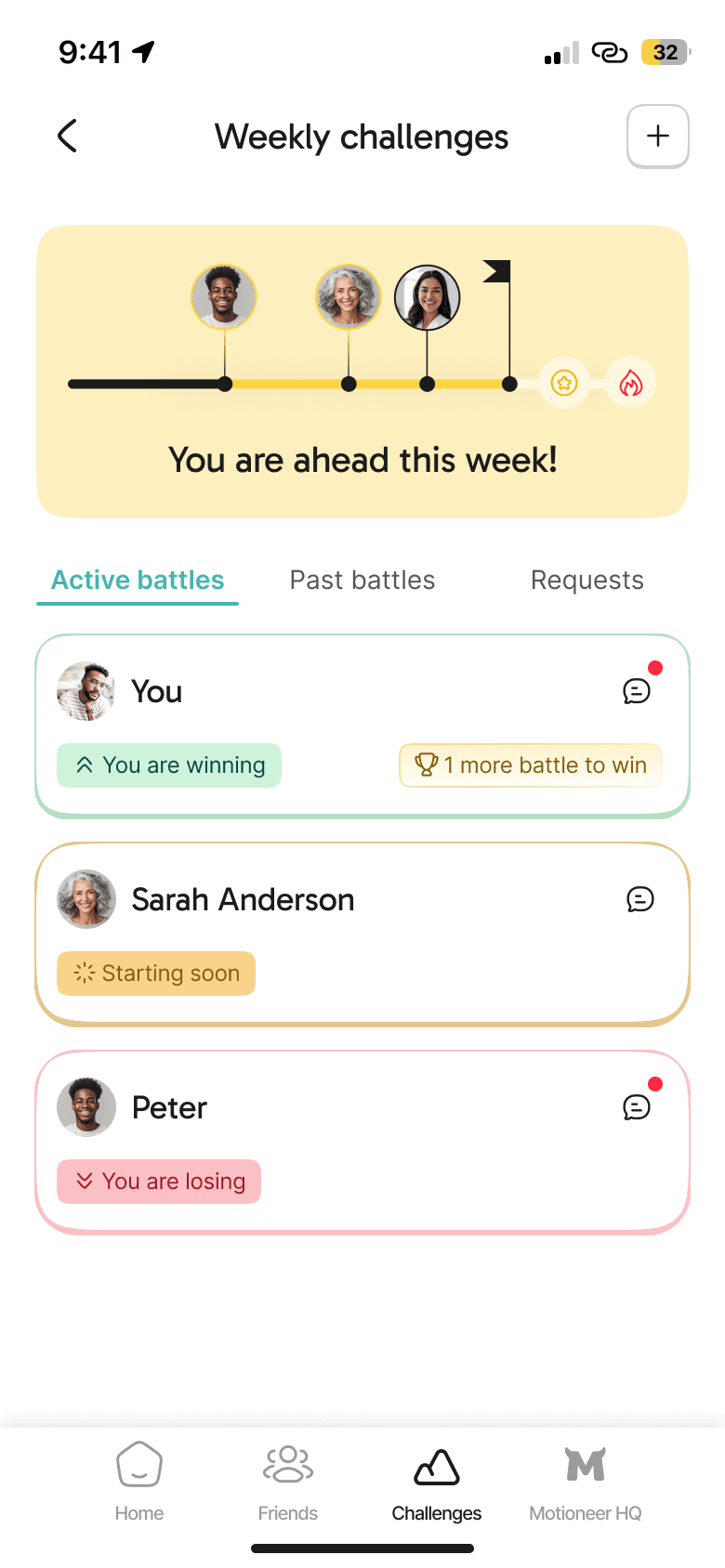

Why is a 7-day step challenge the right format for most groups?
A week is the format we recommend to anyone running a step challenge for the first time. It's the format most workplaces gravitate to once they've tried longer ones. It's also the format you can rerun every Monday without burning your group out.
The research backs it up. Mazeas et al.'s 2022 meta-analysis in the Journal of Medical Internet Research looked at 16 randomised controlled trials of gamified physical activity programs and found the strongest effects in interventions under 12 weeks. The authors flagged that longer programs risk becoming "redundant, boring, and exhausting" for participants. A 7-day challenge sits at the short end of that range, where engagement is highest.
Three reasons a week beats a month for most groups.
Easy to say yes to
Asking friends or coworkers to commit to a week is a much smaller ask than a month. People who'd ghost a 30-day challenge will happily try a 7-day one. Your sign-up rate goes up. Your dropout rate goes down.
Run it every Monday
A weekly step challenge that resets on Monday turns into a rhythm. Themed weeks (stairs week, lunchtime-walk week, no-elevator week) keep it fresh. Offices love this because there's always a new starting line.
+40% Push is in play
Over 30 days, asking people to lift their step count by 40% wears them out. Over 7 days, it's a sprint nobody has time to burn out from. Short formats let you set targets that would be reckless over a month.
How does Motion make a 7-day step challenge effortless?
A week is a short window. Lose two days to setup faff and you've already burnt almost a third of the challenge. Motion's onboarding skips the spreadsheet phase entirely: each person links the device they already use (iPhone, Apple Watch, Garmin, Fitbit, whatever), and steps start feeding the leaderboard in the background. No daily logging, no end-of-day screenshots, no nominating someone to chase the slow people in the group chat.
The live leaderboard runs for the full seven days because tracking is automatic. There's no Wednesday lull where someone forgot to update the shared sheet and the whole thing quietly dies. You can glance at your phone before bed and see exactly where you stand, whose week is going better than yours, and what tomorrow morning's walk would do to the ranking.
The other thing a week-long format wants is repeatability. When Sunday's leaderboard locks in, Motion makes it trivial to roll the same group into a fresh challenge for the following week, with a new theme, a slightly higher target, or a different difficulty. For the broader picture of how Motion is built for step challenges, see our step challenges guide.
What's the right difficulty for a 7-day step challenge?
Short challenges let you push harder than you'd dare to over a month.
Over 30 days, most groups land at +25% Stretch because anything higher gets exhausting by week three. Over 7 days, the arithmetic flips. You're not pacing for a month, you're sprinting for a week. +40% Push becomes the sweet spot for motivated groups, and even +50% works for fit groups who want a real test.
A person who normally walks 6,000 steps a day at +25% Stretch hits 7,500. At +40% Push, they hit 8,400. Over a single week, those extra 900 steps is about 8 minutes of extra walking. Over 30 days, those extra minutes compound into something that starts to feel like a job.
Some rough guidance for picking difficulty on a 7-day challenge:
- Steady (+10%): very new to movement, returning from injury, or running a wellness challenge with a wide fitness range. Office-wide challenges often sit here so nobody feels left out.
- Stretch (+25%): the default. Works for most friend groups and most office teams. Real lift, not punishing.
- Push (+40%): the format's natural home. A meaningful sprint over a week. Recommended for groups who've already tried a Stretch challenge and want to level up.
Our free step challenge builder calculates each person's target automatically and lets you swap difficulties before you commit. If you're not sure what'll work for your group, build a Stretch version and a Push version and let the group vote.
Build a fair 7-day step challenge in 30 seconds
Add your friends or your team, pick Push, and the builder calculates each person's daily target. Share the link. No sign-up, no install, no spreadsheets.
How do you stop a 7-day step challenge falling apart by Wednesday?
Most week-long challenges die on day three or four. The opening burst of enthusiasm runs out before anyone has built a real habit, and a single missed day feels like the whole thing is blown. Pacing and visibility do more than willpower here.
A sensible 7-day arc
Monday, fast start. Energy is highest. Most people overshoot their goal by 20-30%. Let them. The early lead matters less than the social proof that the challenge is alive.
Tuesday, first dip. Motivation usually wobbles. A live leaderboard does most of the work: seeing two friends ahead of you is a more effective nudge than any reminder notification.
Wednesday, the danger zone. Half the energy is gone, the weekend is far away, and one missed lunchtime walk can mean a missed daily target. Mini-games and small wins inside the challenge matter most on this day. A streak you don't want to break is worth more than a target you're chasing.
Thursday, recovery day. Anyone chasing the leader will catch up here. A slightly under-target day on Wednesday is normal and recoverable.
Friday, momentum back. Weekend in sight. The social side of the challenge picks up again.
Saturday, wildcard. Some people get huge step counts: hikes, errands, social walks. Others crash. Either is fine.
Sunday, finish line. The final leaderboard shake-out. Whoever's close on Sunday morning gets one last shot.
What actually prevents the Wednesday drop-off
Patel et al.'s 2017 BE FIT randomised trial in JAMA Internal Medicine tested gamified, socially-incentivised step programs against a control group. The gamification arm added 953 more daily steps than controls and held onto most of that lift after the intervention ended. Three components drove the result, and they're the same three that prevent mid-week dropoff in a 7-day challenge: automatic tracking, social visibility, and personalised goals.
In a Motion 7-day challenge, all three come built in. You don't have to remember to log your steps. You can see where you are versus your friends in real time. Your goal is set from your real baseline rather than a flat 10,000 that's either too easy or too punishing.
How is a 7-day step challenge different from a 30-day step challenge?
Both formats work. They work in different ways.
Goal-setting. A 30-day challenge needs sustainable targets. +25% Stretch is the safe ceiling for most groups. A 7-day challenge tolerates aggressive ones. +40% Push is appropriate and even motivating. The 30-day format guide covers the longer arc in detail.
Pacing. Over a month, you're building a habit. Daily consistency matters more than any single big day. Over a week, you're running a sprint. A huge Saturday hike can swing the whole leaderboard.
Recurrence. A 30-day challenge is usually a one-off, or maybe quarterly. A 7-day challenge is a format you can run every week. Offices that try weekly cadence usually stick with it: it gives every department a fresh start every Monday without the commitment overhead.
Drop-off risk. A 30-day challenge loses people in week two if goals are too high. A 7-day challenge loses people on day three if the leaderboard isn't visible. The failure modes are different. The 30-day pitfall is burnout; the 7-day pitfall is silence.
Best for. Pick 7 days for new groups, office-wide weekly competitions, and anyone testing the format. Pick 30 days when your group is already bought in and wants to build a real habit. The step challenges hub walks through all five formats if you're still deciding.
Related tools and formats
Motion app: run your challenge
Automatic step tracking, fair goals from real data, live leaderboard, and mini-games. Free for iOS and Android.
Read moreFree Step Challenge Builder
Build a fair 7-day challenge in your browser and share the link. No sign-up, no install.
Read more30-day step challenge
Building a real habit takes longer than a week. The 30-day format, the pacing, and the +25% Stretch target that holds up over a month.
Read more7-day step challenge FAQs
If you have anything else you want to ask, reach out to us.
What is a 7-day step challenge?
A 7-day step challenge is a week-long competition (or team effort) where a group of people commit to hitting a personalised daily step goal across seven consecutive days. Most groups run them Monday to Sunday. The short format suits first-time groups, office weekly competitions, and anyone who wants a low-commitment way to test the format before running a longer challenge.
How many steps a day should you do in a 7-day step challenge?
Don't pick an absolute number. Pick a percentage lift over each person's normal day. A 7-day challenge tolerates more aggressive targets than a 30-day one, so most groups land between +25% (Stretch) and +40% (Push). A person who normally walks 6,000 steps a day on Push will target around 8,400. Motion calculates everyone's baseline automatically, so you don't have to guess.
Is 7 days long enough to see results from a step challenge?
Yes for behaviour and social momentum, no for fitness transformation. A week isn't long enough to build a lasting step habit on its own. It is long enough to break sedentary patterns, prove to a group that the format works, and set up a recurring weekly cadence. Mazeas et al.'s 2022 meta-analysis found gamified physical activity interventions show their strongest effects when they're short and focused, which is exactly the territory a 7-day challenge sits in.
Can you run a 7-day step challenge every week?
Yes, and offices especially benefit from it. A weekly cadence (Monday-to-Sunday, resetting every Monday) keeps the format fresh, gives latecomers a new starting line, and lets you run themed weeks like stairs week, lunchtime-walk week, or no-elevator week. Most teams that try a recurring weekly challenge stick with it because each week is a fresh chance to win.
Why do most 7-day step challenges fall apart by Wednesday?
Two reasons. Either the goals are absolute ("10,000 a day" feels impossible to one person and trivial to another), or there's no live leaderboard so progress is invisible. Both kill the social side of the challenge. Personalised goals based on each person's baseline keep everyone in the race. A live leaderboard means a single off-day doesn't feel like the whole thing is blown.
Should I run a 7-day or a 30-day step challenge?
Run a 7-day challenge if your group is new to the format, if you want a weekly recurring competition, or if you want to push aggressive targets without burnout. Run a 30-day challenge if your group is already bought in and you want to build a real habit. Many groups start with a 7-day and graduate to monthly once they've seen the format works.
What's a good 7-day step challenge for the office?
A Monday-to-Sunday challenge in team mode by department, with each person on a +10% or +25% lift from their personal baseline. The workplace step challenge guide covers the setup in detail. Team mode is the key choice for offices: it pulls in employees who'd never win a raw step count race and turns the competition into a group effort by department.
Do 7-day step challenges actually work for fitness?
A week isn't long enough to remake your fitness. It is long enough to add real movement to your day and prove the format works. Bravata et al.'s 2007 JAMA systematic review found pedometer interventions increased daily steps by 26.9% over baseline on average. Patel et al.'s 2017 BE FIT trial in JAMA Internal Medicine showed gamified, socially-incentivised programs held onto most of that lift after the intervention ended. A 7-day challenge is the entry point. Stack a few of them together and the steps add up.

Your Fitness Journey Starts Here
Download Motion free and discover why this is the fitness app you'll actually keep using. Your future self (and your Motmot) will thank you.

