
30-Day Step Challenge with Friends
Long enough to build a real habit. Short enough that nobody bails. Here's how to plan a 30-day step challenge your group will actually finish, with fair goals from each person's real baseline.

Why does a 30-day step challenge work better than 7 or 90?
Thirty days is long enough to get past the first-week wobble and short enough that nobody quits in week three. The 2010 Lally et al. study in the European Journal of Social Psychology tracked 96 people forming new daily habits and found an average of 66 days to reach automaticity, with a range of 18 to 254 days. Nobody's habit is locked in at day 30. But 30 days is enough to push past the initial friction, prove to yourself you can do it, and make a daily walk feel less like a project.
It also lines up neatly with a calendar month. "Let's do this for May" is a far easier sell to a group than "let's pick a random Tuesday and go for six weeks." Calendar-month commitments are easy to remember, easy to start fresh, and easy to repeat. Most groups that run a successful step challenge end up running back-to-back monthly rounds rather than one long slog.
Past the friction point
Lally 2010 found habits stabilise on average around day 66, but the first few weeks are where most attempts die. Thirty days is enough to clear that early drop-off zone, even if the habit isn't fully automatic yet.
One month, clear bookends
A 30-day step challenge maps to a calendar month. Easy start date, easy end date, easy to commit to in a group chat. No awkward mid-month finish line.
Short enough to repeat
Thirty days is short enough that you'll want to run it again. Most groups that finish their first round start a second one within a week. That's how a one-off challenge becomes a habit.
How does Motion keep a 30-day step challenge from falling apart?
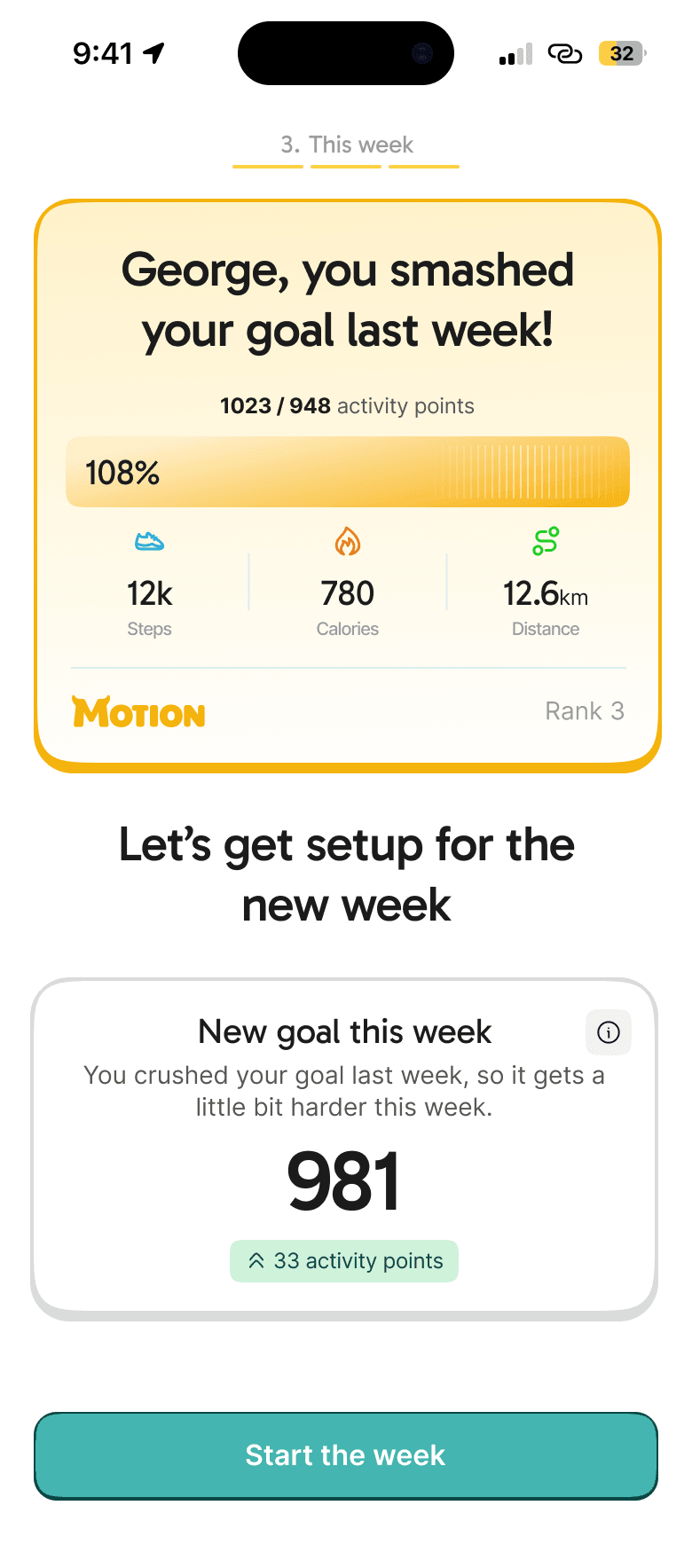
Long step challenges die in week two or three. Someone has a busy work week, misses a couple of days, decides they're too far behind to bother, and quietly drops out of the group chat. Motion's adaptive goals recalibrate to what's actually happening in your week, so a rough patch lowers your next few targets instead of writing off the rest of the month. A miss becomes a dip, not an exit.
The live leaderboard does the work in the middle of the month, when novelty has worn off. By day fifteen, nobody's checking the group chat for fun anymore. They check the leaderboard because they can see where they sit, who's just overtaken them, and what they'd need to walk this afternoon to flip it back. That visibility is the difference between a challenge that fizzles at the halfway mark and one that holds together to day 30.
Streaks and small in-app wins compound through the month. Hitting your personal goal on a quiet Tuesday is a tiny moment of satisfaction; stringing five of those together is a streak you'd rather not break on a rainy Wednesday. For the broader picture of how Motion is built for step challenges, see our step challenges guide.
The week-by-week energy curve of a 30-day step challenge
Every 30-day step challenge follows the same emotional arc. Plan each week around where the group's energy actually is, not where you wish it was, and you'll finish the month with most of your group still in.
Week 1: Ramp
Everyone's keen. Goals feel achievable. The novelty does the work. Your only job in week one: don't blow up your shins. If your daily baseline is 5,000 steps, jumping straight to 9,000 every day is asking for an injury and a quiet bow-out by day five. Hold the +25% Stretch line and let people stack early wins.
Week 2: Push
The honeymoon ends. Weather happens, work happens, the gloss wears off. Bravata's 2007 JAMA systematic review on pedometer interventions found pedometer users increased their daily steps by 26.9% over baseline, but only when progress stayed visible: live leaderboards, public step counts, not screenshots in a group chat. Make week two about notifications and small wins, not about sitting back.
Week 3: Hold
The drop-off week. People miss a day, feel behind, and quietly stop checking the app. Make it easy to come back: streak grace days, a "comeback" mini-game, a midweek group check-in. Anything that lets someone who skipped Tuesday still feel like they're in the challenge on Wednesday. Don't raise goals in week three. Hold the line and let the group regroup.
Week 4: Sprint
Energy returns because the end is visible. Groups want to push in week four: a final stretch goal, a weekend long-walk event, a leaderboard reshuffle. The 2016 Harkin et al. meta-analysis of 138 studies in Psychological Bulletin found progress monitoring drove the strongest behaviour change when it was publicly visible and physically recorded. Lean into that in week four: shareable end-of-challenge cards, a final leaderboard screenshot, a group photo of the closing-day walk.
Build your 30-day step challenge in 30 seconds
Add yourself and your friends, pick a difficulty, and we'll calculate a personalised daily goal for each person. Share the link with your group. No sign-up, no install.
What goes wrong in a 30-day step challenge (and how to fix it)
A 30-day step challenge fails for different reasons than a 7-day or a 90-day one. Seven days is too short to derail; ninety days collapses under its own weight. Thirty days has a specific failure mode: week-three boredom, paired with goals set too high in week one.
Pitfall 1: Same step target for everyone
"10,000 steps a day for 30 days" sounds clean but it's the fastest way to lose half your group by day four. One person normally walks 4,000 steps; another normally walks 11,000. Same target means one person is making real lifestyle changes and the other is coasting. Set goals as a percentage lift over each person's own baseline. +10% Steady is safe for new walkers. +25% Stretch is the right default for most 30-day step challenges. +40% Push only works for highly motivated groups with strong baselines, and even then it tends to peak in week two and fall apart in week three. Our free step challenge builder handles this for you: drop in each person's typical day, pick a difficulty, and it generates personalised goals for everyone in seconds.
Pitfall 2: Goals that never adapt
A 30-day step challenge with a fixed daily target ignores how your body responds. Some weeks you'll smash it; other weeks you'll struggle. Motion's adaptive goals recalibrate to your real activity, so a tough week doesn't tank the whole challenge. The Chaudhry et al. 2020 systematic review of step-count monitoring interventions in IJBNPA found people using step-count interventions averaged 1,126 more daily steps at four months. Sustained increases beat heroic weeks every time.
Pitfall 3: No tracking automation
Daily screenshots in a group chat. A shared spreadsheet. End-of-day check-ins. All of it works for a few days, then someone forgets, then the whole thing dies. Use a tool that auto-tracks and shows a live leaderboard. The Motion app pulls steps automatically from every phone and wearable; the free builder gets you a plan you can share without installing anything.
Pitfall 4: No week-three intervention
Week three is where every 30-day step challenge wobbles. If you don't plan for it (a midweek check-in, a small twist, a comeback day) the group will quietly disengage and never tell you. Build week three into the plan from the start.
Run a different length step challenge
Motion app: the full solution
Accurate fair goals from real data, automatic step tracking, a live leaderboard, and mini-games that keep your group motivated through week three. Free for iOS and Android.
Read moreFree Step Challenge Builder
Build a fair 30-day step challenge in the browser. Add friends, pick a difficulty, share a link. No sign-up needed.
Read more7-day step challenge
Shorter format for testing the idea with a new group or running themed weekly rounds at work.
Read more30-day step challenge FAQs
If you have anything else you want to ask, reach out to us.
What is a 30-day step challenge?
A 30-day step challenge is a group commitment to hit a daily step goal every day for a calendar month. Each person typically has a personalised daily goal set as a percentage lift over their own baseline. The point isn't the steps themselves, it's the social accountability and the month-long structure that turns daily walking into a real routine.
How many steps a day should I aim for in a 30-day step challenge?
Don't pick an absolute number. Pick a percentage lift over your own baseline. Most groups land at +25% Stretch for a 30-day step challenge. If your baseline is 5,000 steps a day, that's a target of 6,250. If your baseline is 9,000, it's 11,250. The 10,000-step number isn't from clinical research, it's from a 1960s Japanese pedometer ad. A 2019 cohort study by I-Min Lee et al. found mortality benefits plateauing around 7,500 steps a day in older women. Lift over baseline beats absolute targets every time.
Is 30 days long enough to build a walking habit?
Not fully. The 2010 Lally et al. study in the European Journal of Social Psychology found habits take an average of 66 days to reach automaticity, with a range of 18 to 254 days. Thirty days is enough to clear the early drop-off zone and prove the routine works for you. Most groups run back-to-back 30-day step challenges rather than one long 60- or 90-day grind, because monthly resets keep motivation fresh.
How do I keep a 30-day step challenge alive in week three?
Week three is the drop-off week. People miss a day, feel behind, and quietly disengage. Plan a midweek group check-in, build in streak grace days so a single miss doesn't kill the whole month, and don't raise goals in week three. Hold the line and let the group regroup. Save the push for week four, when the end is in sight.
Can I run a 30-day step challenge without an app?
You can, but most groups doing it manually lose half their participants by day ten. Daily screenshots, shared spreadsheets, and group-chat check-ins work for about a week. The Motion app auto-tracks steps from every phone and wearable into one leaderboard. The free Step Challenge Builder generates a shareable plan in the browser if you want to start without installing anything.
What's the difference between a 30-day step challenge and a 7-day step challenge?
A 7-day step challenge is for testing the format with a new group or running themed weekly rounds at work. Low stakes, easy to win, short enough nobody bails. A 30-day step challenge is for actually building a habit: long enough to push past the first-week novelty and prove the routine sticks. If your group has never run one before, start with a 7-day step challenge and graduate to 30.
Should I do a 30-day step challenge solo or with friends?
With friends. The 2016 Harkin et al. meta-analysis of 138 studies in Psychological Bulletin found progress monitoring works much harder when it's publicly visible than when it's private. A solo 30-day step challenge with no leaderboard tends to fade by week two. The same challenge with three friends and a live leaderboard tends to finish. Social visibility is what makes the format work.
What's a fair goal for a 30-day step challenge with a mixed group?
Set each person's goal as a percentage lift over their own baseline, not an absolute number. +25% Stretch is the right default for most 30-day step challenges. For a group with very different fitness levels (a family, a workplace team), consider a team step challenge format where everyone's daily goals combine into one shared total. That way a grandparent doing 3,000 steps and a teenager doing 12,000 both contribute meaningfully.

Your Fitness Journey Starts Here
Download Motion free and discover why this is the fitness app you'll actually keep using. Your future self (and your Motmot) will thank you.

