
Fitbit Alternatives in 2026
Fitbit, folded into Google Health in 2026, is excellent at measuring your body (steps, sleep, heart rate, VO2 max) and now adds Gemini AI coaching. But its fun, social side has been wound down. If you want fair, motivating challenges with friends, here's an honest comparison and when Motion is the better fit.
What is Fitbit (now Google Health), and who is it for?
Fitbit is one of the longest-running fitness ecosystems there is. It pairs wrist wearables (trackers and smartwatches, plus Google's Pixel watches) with a companion app for activity, sleep, and health monitoring. Google completed its acquisition of Fitbit in January 2021 [1] and, between 2023 and 2026, progressively absorbed it into its own stack. On May 19, 2026, the Fitbit app was officially renamed Google Health, reorganized into four tabs (Today, Fitness, Sleep, and Health), and layered with a Gemini-powered Health Coach. [2]
Credit where it's due: this is a strong product, and for the right person it's hard to beat. Its strengths are real:
- Best-in-class passive tracking. Mature, accurate-enough hardware with strong heart-rate, sleep-stage, and activity sensing that runs quietly in the background all day.
- Credible health metrics. VO2 max, a daily Readiness score, Cardio Load, SpO2, and a stress metric now called "Resilience," all in a data-rich dashboard that data-driven users and runners genuinely value.
- Cutting-edge AI coaching. A Gemini-powered Health Coach, natural-language "Ask Coach," and adaptive fitness plans (in the paid tier).
- Huge, established ecosystem. Over a million Play Store ratings [3], deep third-party integrations, medical-records support, and Google One AI Pro/Ultra bundling.
If you want clinical-grade, passive measurement of your body from a dedicated wearable, and you're comfortable inside the Google and Gemini world, Fitbit/Google Health is an outstanding choice. It is fundamentally a data and metrics platform: it measures you and surfaces scores. What it is no longer built around is fun, social, group competition. That's the distinction that matters when you're choosing between it and an app like Motion.
This page focuses on the Fitbit hardware and wearable ecosystem. If you're reacting to the new Google Health app specifically, its Cardio Load scoring, the redesign, or the paywall, see our Google Health alternatives guide.
Fitbit (now Google Health) vs Motion: side-by-side
Both are good apps with different jobs. Fitbit/Google Health is a wearable-and-metrics platform. Motion is a social, effort-based fitness game. Here's how they line up on the dimensions that usually decide it (pricing as of 2026).
| Dimension | Fitbit (now Google Health) | Motion |
|---|---|---|
| Price | Free app; Premium $99.99/yr or $9.99/mo (as of 2026, up from $79.99/yr) [4]. Best value needs a Fitbit/Pixel wearable (separate purchase) | Free to download and play; optional Premium |
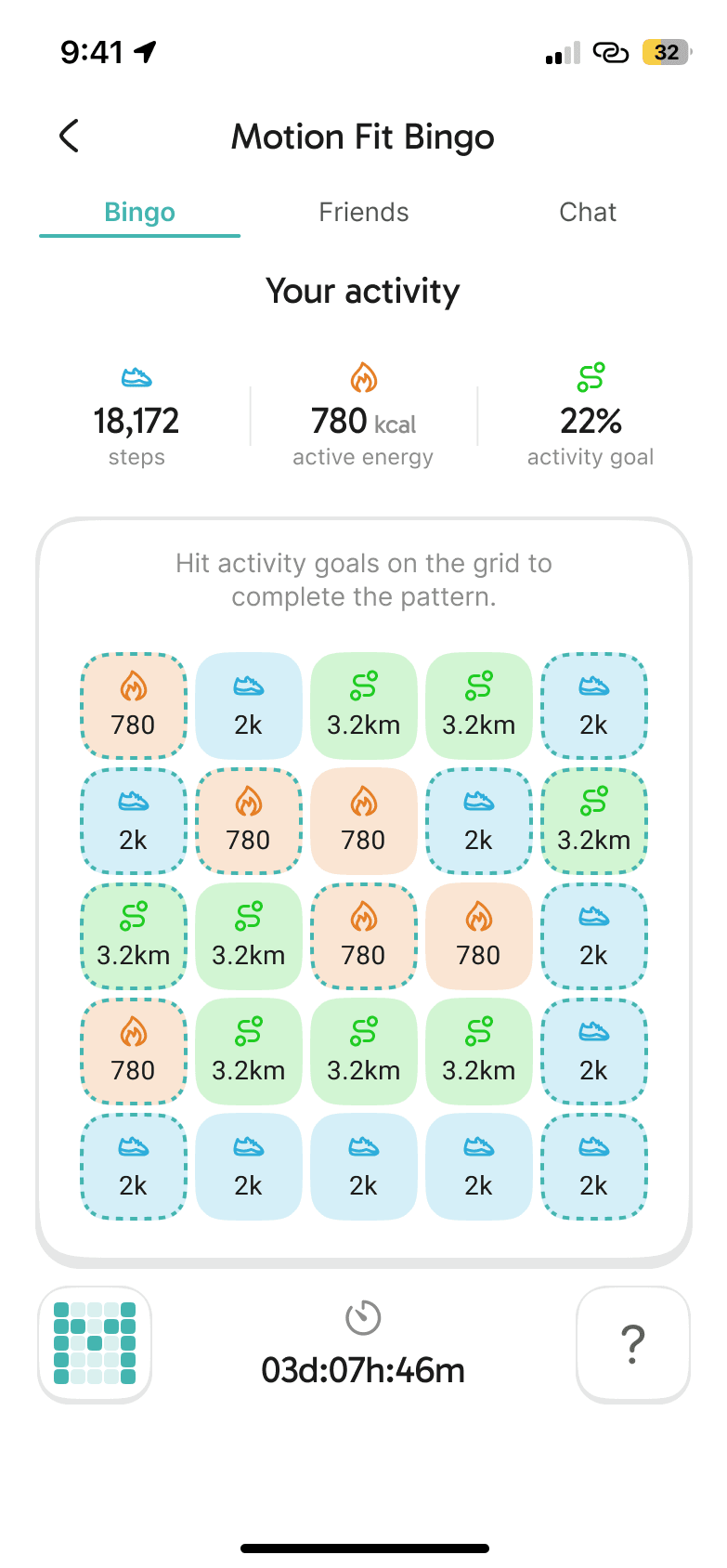
| Friend / group challenges | Largely retired: only a basic steps/Cardio-Load leaderboard remains; Challenges, Adventures, Get Fit Bingo and trophies were removed from March 2023 [5] | Built around them: weekly battles, step challenges, solo/competitive/team Get Fit Bingo |
| How competition is scored | Absolute output: whoever logs the most steps or cardio load wins | Effort-based: the percentage of your own adaptive goal you hit, so a beginner can out-compete an athlete |
| Fairness for mixed-ability groups | Not handicapped; a fitter person almost always tops a beginner | Designed for it: handicapped scoring keeps everyone in the race |
| Trackers supported | Fitbit & Google Pixel wearables; phone; some third-party app/device integrations | Phone plus most major wearables (including Fitbit), see full tracker compatibility |
| Platforms | iOS & Android | iOS & Android |
| Rating | ~3.8-4.0 (Google Play, 1.2M+ ratings) [3] to ~4.5 (App Store, US) [6]; the 2026 transition triggered review-bombing [7] | 4.6/5 App Store |
| Best for | Data-driven users and runners who want clinical-grade passive metrics and AI coaching from a wearable | Mixed-ability friend, family, and workplace groups who want fair, fun, motivating competition |
The two aren't mutually exclusive. Because Fitbit is one of Motion's supported integrations, a great setup is to track with your Fitbit and compete fairly in Motion: the precise metrics from one, the social game from the other.
When is Motion the better choice than Fitbit (now Google Health)?
If you want raw measurement and AI coaching from a wearable, Fitbit/Google Health is excellent at that. Motion is the better fit when what you actually want is fair, fun competition with other people, especially in a group where fitness levels vary. Here's where it pulls ahead.
Beginners can actually win
Fitbit's leaderboard scores absolute output: the fittest person almost always tops it, which quietly demotivates the people who most need encouragement. Motion scores the percentage of YOUR OWN adaptive goal you hit, so a beginner can genuinely out-compete an athlete. That's why it works for mixed-ability friend, family, and workplace groups. More on this in our guide to effort-based fitness goals.
The feature Google retired
Get Fit Bingo was a fan-favorite Fitbit Premium feature, and Google killed it along with Challenges, Adventures, badges and trophies. Motion has revived Get Fit Bingo in solo, competitive, and team modes. If you loved it on Fitbit, it lives on here. See our Get Fit Bingo page.
Encouraging, not clinical
Post-acquisition, Fitbit's tone is data-and-AI utilitarian: readiness scores, cardio load, an AI coach. Motion leans the other way: weekly activity battles, friendly competition, and no-punishment Motmot pets that cheer you on rather than guilt-trip you. No money-staking, no rewards churn, just motivation that's actually fun.
Works from your phone
Fitbit's best experience requires buying a Fitbit or Pixel wearable; phone-only use is limited. Motion runs from the phone in your pocket and works with whatever tracker your group already owns, so nobody's left out for having the wrong watch.
Built for people easing back in
For women 40+, beginners, families, and anyone restarting after a break, an absolute-output leaderboard is discouraging by design. Motion's adaptive goals meet you where you are and celebrate progress, not raw totals. That's exactly what helps a new habit stick.
Keep your Fitbit too
You don't have to choose. Track precisely with your Fitbit, then connect it to Motion and bring friends in for a fair weekly battle. Want to set one up in 30 seconds? Try the free step challenge builder. No sign-up, no install.
Fitbit (now Google Health) alternatives: FAQs
If you have anything else you want to ask, reach out to us.
Is Fitbit (now Google Health) free?
The core app is free, and as of 2026 it's the renamed Google Health app. The paid tier (previously Fitbit Premium at $79.99/year or $9.99/month) is being rebranded to Google Health Premium, with the annual price rising to $99.99/year (monthly stays $9.99). [4] Premium unlocks the Gemini Health Coach, adaptive fitness plans, and deeper sleep insights, and is also bundled into Google One AI Pro and Ultra plans in more than 30 countries. [4] Note that getting the full value really means owning a Fitbit or Pixel wearable, which is a separate one-time purchase. App-store listings may still show the older $79.99 figure during the transition.
Can I do step challenges with friends on Fitbit (now Google Health)?
Only in a limited way now. Fitbit's rich social layer (Challenges, Adventures, Get Fit Bingo, badges, trophies, open groups, the community feed, and direct messaging) has been progressively retired and is largely absent from the 2026 Google Health app. What remains is a basic weekly steps and Cardio-Load leaderboard with friends. If group challenges are the reason you want the app, a dedicated social fitness app like Motion's step challenges will serve you better.
What's the best Fitbit (now Google Health) alternative?
For social, fair competition, Motion is the closest replacement: it has even revived Get Fit Bingo. Beyond that, the best pick depends on what you're missing. For a cross-device step-challenge platform for workplaces, Stridekick is worth a look. For another big all-in-one health dashboard, Samsung Health or Google Fit are comparable. For just metrics and a wearable, Fitbit/Google Health is still excellent at that job.
How is Motion different from Fitbit (now Google Health)?
Fitbit/Google Health measures your body; Motion is a social fitness game. Fitbit is a metrics-and-hardware platform that passively tracks steps, sleep, and health scores (readiness, VO2 max, cardio load) with Gemini AI coaching. Motion scores the percentage of your own adaptive goal you hit rather than absolute output, so beginners can out-compete athletes. It also has weekly activity battles, Get Fit Bingo, and Motmot pets, with no money-staking. They can even work together: track with a Fitbit, compete in Motion.
Why did Fitbit remove Get Fit Bingo and its challenges?
Google deprioritized Fitbit's social features as it rebuilt the app around metrics and Gemini AI. Starting in March 2023, Get Fit Bingo, Challenges, Adventures, trophies, and open groups were retired in favor of a data-first product. [5] The 2026 transition drew significant user backlash and Play Store review-bombing over those lost features. [7] Motion has revived Get Fit Bingo in solo, competitive, and team modes for people who miss it.
Is Fitbit's competition fair for beginners?
Not really, and that's the main reason to consider an alternative for group play. The remaining leaderboard scores absolute output (most steps or cardio load wins), so a seasoned walker or runner will almost always finish ahead of a beginner, which tends to discourage the very people who'd benefit most. Motion uses effort-based, handicapped scoring instead, so everyone competes on the percentage of their own goal and a beginner can legitimately top a fitter friend.
Can I use my Fitbit with Motion?
Yes. Fitbit is one of Motion's supported integrations, so the two are complementary rather than competing. You can keep using your Fitbit or Pixel wearable for precise passive tracking, connect it to Motion, and then bring friends in for fair, effort-based challenges. See full tracker compatibility for the devices Motion supports.
Related comparisons and features
Google Health alternatives
Reacting to the new Google Health app, its Cardio Load scoring, or the Premium paywall? Here's how Motion compares to the renamed Fitbit app.
Read moreSamsung Health alternatives
Another big all-in-one health platform with social step challenges via Together. See how it compares and when Motion's fair, fun competition wins.
Read moreGoogle Fit alternatives
Google's lightweight activity tracker is being wound down into Google Health. Here's how it stacks up and what to use instead.
Read more
Your Fitness Journey Starts Here
Download Motion free and discover why this is the fitness app you'll actually keep using. Your future self (and your Motmot) will thank you.

