
The Best Stridekick Alternatives in 2026
Stridekick is a strong cross-device challenge platform, especially for corporate wellness. But if you run challenges for a mixed-ability friend or family group, here's an honest look at how Motion compares, and when each one is the right pick.

What is Stridekick, and who is it best for?
Stridekick (by Stridekick Inc.) is a fitness-challenge app and web platform built around group step and activity competitions. Its standout strength is breadth of device support: a group using a mix of Fitbit, Apple Watch, Garmin, Withings, Polar, Xiaomi, Apple Health and plain phone sensors can all compete on the same leaderboard. That cross-device flexibility is best-in-class, and it's the main reason people choose it.
You can run private or public challenges across several modes (Leaderboard, Streak, Target, Virtual Race and Custom Activity), competing on steps, distance or active minutes. There are also large public community challenges (Journey, Stick to it!, Teams, Group Target) so you can join in even without a ready-made friend group. Progress tracking includes weekly, monthly and yearly averages, all-time best days and unlockable activity levels. It even added an optional Echelon-powered "Workouts" content add-on with 500+ studio-quality classes.[3]
Stridekick is increasingly positioned for corporate and workplace wellness. Its top "Unlimited" tier adds team modes, a dedicated account manager and SuperDash reporting for HR and wellness coordinators.[4] A clever organizer-pays model means most participants use it completely free: only the person setting up the private challenge needs a paid plan. It's well rated (4.4/5 on the App Store) and considered user-friendly.[5] To its real credit, Stridekick avoids the money-staking gimmick some apps lean on; it actively promotes charity pools and lottery-style draws and advises non-cash prizes to deter cheating.
In short: if you're running a step challenge across a company or a big mixed-device group and want everyone on one leaderboard regardless of tracker, Stridekick is an excellent fit. Where it's less ideal is mixed-ability friend or family groups, which is exactly the gap Motion is built to fill.
Stridekick vs Motion: side-by-side comparison
Both apps run social step and activity challenges, but they're built on different philosophies. Stridekick competes on raw totals and leans toward big groups and corporate wellness; Motion scores effort against your own goal and is built for mixed-ability fairness and gentle motivation. Here's how they line up as of 2026.
| Stridekick | Motion | |
|---|---|---|
| Price | Freemium. Free tier: 10 people, 7 days, public only. Organizer-pays Pro tiers $12.99–$49.99/mo (or $139.99–$549.99/yr); Unlimited/corporate custom-priced.[1] Optional Echelon-powered Workouts content add-on (quote-based) | Free to download and play; optional premium subscription |
| Friend / group challenges | Yes: public and private group challenges (free up to 10 people / 7 days; longer and larger on paid tiers), plus large community and team challenges | Yes: friend, family and group challenges with a live leaderboard, built for ongoing play |
| How competition is scored (fairness) | Absolute totals for individual leaderboards (most steps / minutes wins); team modes use per-person averages to balance team size only, with no effort or personal-goal handicapping | Effort-based: you score the percentage of your own adaptive goal you hit, so a beginner can fairly out-compete a fitter member |
| Trackers supported | Fitbit, Apple Watch / Health, Garmin, Withings, Misfit, Polar, Xiaomi, iPhone / phone sensors (broad cross-device support) | Apple Health, Apple Watch, Garmin, Fitbit and phone step sensors |
| Platforms | iOS, Android and web | iOS and Android |
| Rating | 4.4/5 on the Apple App Store (2.9K ratings)[2] | 4.6/5 App Store |
| Best for | Cross-device groups and corporate / workplace wellness programs that want everyone competing on one leaderboard regardless of tracker | Mixed-ability friend and family groups, beginners, women 40+, and people easing back into movement who want fair, fun, low-pressure competition |
The biggest practical difference is in that fairness row. On Stridekick, individual leaderboards reward whoever logs the most steps or minutes, so the fittest, highest-volume mover almost always wins. Motion instead measures the percentage of your own effort-based goal you hit, which keeps a casual walker competitive against a marathoner.
When is Motion the better choice over Stridekick?
Stridekick is a great tool for the job it's designed for. But there's one situation where its scoring works against you: a group of friends or family at very different fitness levels. On a raw-total leaderboard, the fittest person wins by Tuesday and the beginner quietly gives up. Here's when you'd reach for Motion instead.
Beginners can actually win
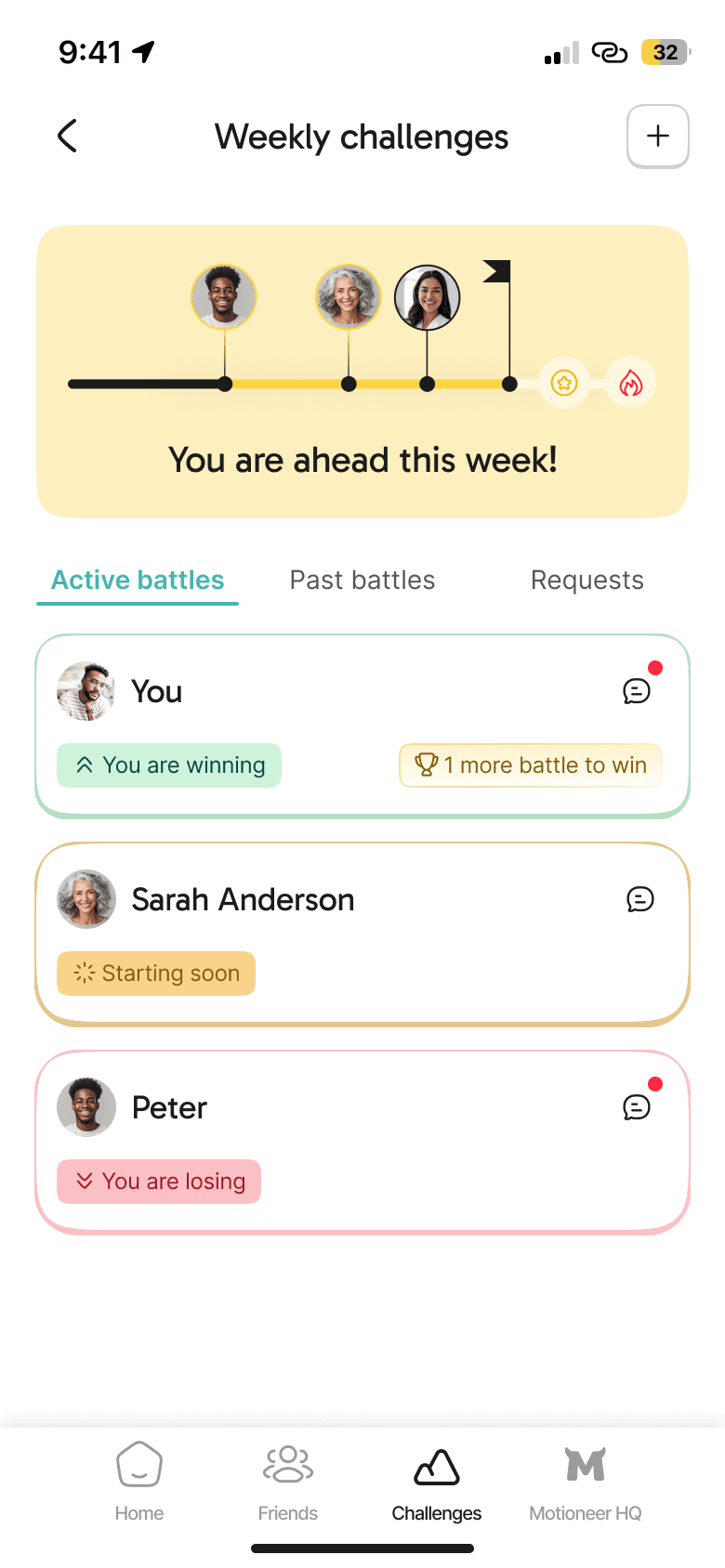
Motion scores the percentage of your own adaptive goal you hit, not your absolute step count. A returning-from-a-break walker hitting 110% of their goal beats a marathoner cruising at 90% of theirs. Stridekick's team 'averaging' only balances team size (not ability or effort), so a casual mover can never out-compete a high-volume one. See how Motion's weekly activity battles work.
Motivation without punishment
Stridekick's motivation comes mainly from raw leaderboards. Motion layers on a no-punishment game: collectible Motmot pets, Fit Bingo and small daily wins keep the chronically unmotivated and restarting-after-a-break crowd engaged rather than discouraged.
500 steps gets celebrated
Motion's moderated community celebrates a 500-step day like someone else's 50,000, perfect for families, casual friend groups and women 40+. Stridekick leans competitive and increasingly corporate, and reviews mention cheaters and spam accounts on bigger public challenges.
So which should you choose?
It really does come down to your group. If you're an HR or wellness coordinator running a company-wide challenge, or you've got a big group on a wild mix of trackers and you just want everyone on one leaderboard, Stridekick is the stronger pick. Its device compatibility, reporting tools and organizer-pays model are purpose-built for that. There's no reason to switch.
If you're running a challenge for friends, family, beginners, or anyone easing back into movement, Motion's effort-based scoring is the difference between a group that stays in the race and one that drops off in two days. Nobody feels demoralized for not being the fittest person in the chat, because everyone is competing against their own baseline.
Not sure where to start? Our free step challenge builder calculates a fair, personalized target for everyone in your group in about 30 seconds (no sign-up needed), and the step challenges guide walks through formats, difficulty and how to keep a group motivated for the whole challenge.
Stridekick alternatives: frequently asked questions
If you have anything else you want to ask, reach out to us.
Is Stridekick free?
Stridekick has a free plan, but it caps you at public challenges with up to 10 participants for up to 7 days. Private challenges and longer events require a paid organizer plan at $12.99–$49.99/month (or $139.99–$549.99/year) depending on participant count.[6] Helpfully, only the organizer pays; everyone they invite joins for free. There's also a custom-priced Unlimited tier for corporate programs and an optional Echelon-powered Workouts add-on (quote-based pricing). Prices are US figures and may vary by region or promotion.
Can I do step challenges with friends on Stridekick?
Yes, Stridekick is built around group challenges and lets friends, family or coworkers compete on the same leaderboard regardless of which tracker they own. On the free plan you can run a public challenge with up to 10 people for up to 7 days; private and longer challenges require a paid organizer plan. Fitbit, Apple Watch, Garmin, Withings, Polar, Xiaomi and plain phone sensors are all supported.
What's the best Stridekick alternative?
For a mixed-ability friend or family group, Motion is the strongest alternative because it scores the percentage of your own adaptive goal you hit, so beginners and casual walkers stay competitive against fitter members. If you mainly want a free phone-only step counter with global challenges, Pacer is worth a look. If your whole group is on Apple Watch, the Challenges app focuses on ring-closing competitions.
How is Motion different from Stridekick?
The core difference is fairness. Stridekick's individual leaderboards reward absolute totals (most steps, distance or active minutes), so the fittest, highest-volume person usually comes out on top, and its team modes only average to balance team size, not ability. Motion instead scores the percentage of your own personalized goal you hit, so effort beats raw fitness and a beginner can legitimately win. Motion also adds gentle, no-punishment gamification (collectible Motmot pets, Fit Bingo) and a supportive moderated community, where Stridekick leans toward raw competition and corporate wellness.
Does Stridekick or Motion handle mixed-ability groups better?
Motion. Stridekick's scoring is absolute, so a beginner competing against a regular runner will almost always lose on total steps, and its team 'averaging' balances team size, not individual fitness or effort, so a casual walker can't fairly out-compete a marathoner. Motion measures effort against each person's own adaptive goal, which means a returning-from-injury walker hitting 110% of their target can beat a fitter member at 90% of theirs. For families, casual friend groups and people restarting after a break, that effort-based fairness is the deciding factor.
Does Stridekick work with my fitness tracker?
Almost certainly. Broad device support is Stridekick's biggest strength. It syncs with Fitbit, Apple Watch and Apple Health, Garmin, Withings, Misfit, Polar, Xiaomi and your iPhone or phone step sensors. That's why mixed-device groups gravitate to it. Motion supports Apple Health, Apple Watch, Garmin, Fitbit and phone step sensors, which covers the vast majority of users, and you can read more on our full tracker compatibility page.
Related comparisons and features
Pacer alternatives
Pacer is the free, phone-only step tracker with global challenges. See how it stacks up against Motion for casual walkers and beginners.
Read moreChallenges app alternatives
The Apple-centric ring-closing competition app from the makers of Lose It!, and how Motion compares for friend and family groups.
Read moreEffort-based fitness goals
The fairness engine behind Motion: score the percentage of your own adaptive goal, so beginners can out-compete the fittest in the group.
Read more
Your Fitness Journey Starts Here
Download Motion free and discover why this is the fitness app you'll actually keep using. Your future self (and your Motmot) will thank you.

