
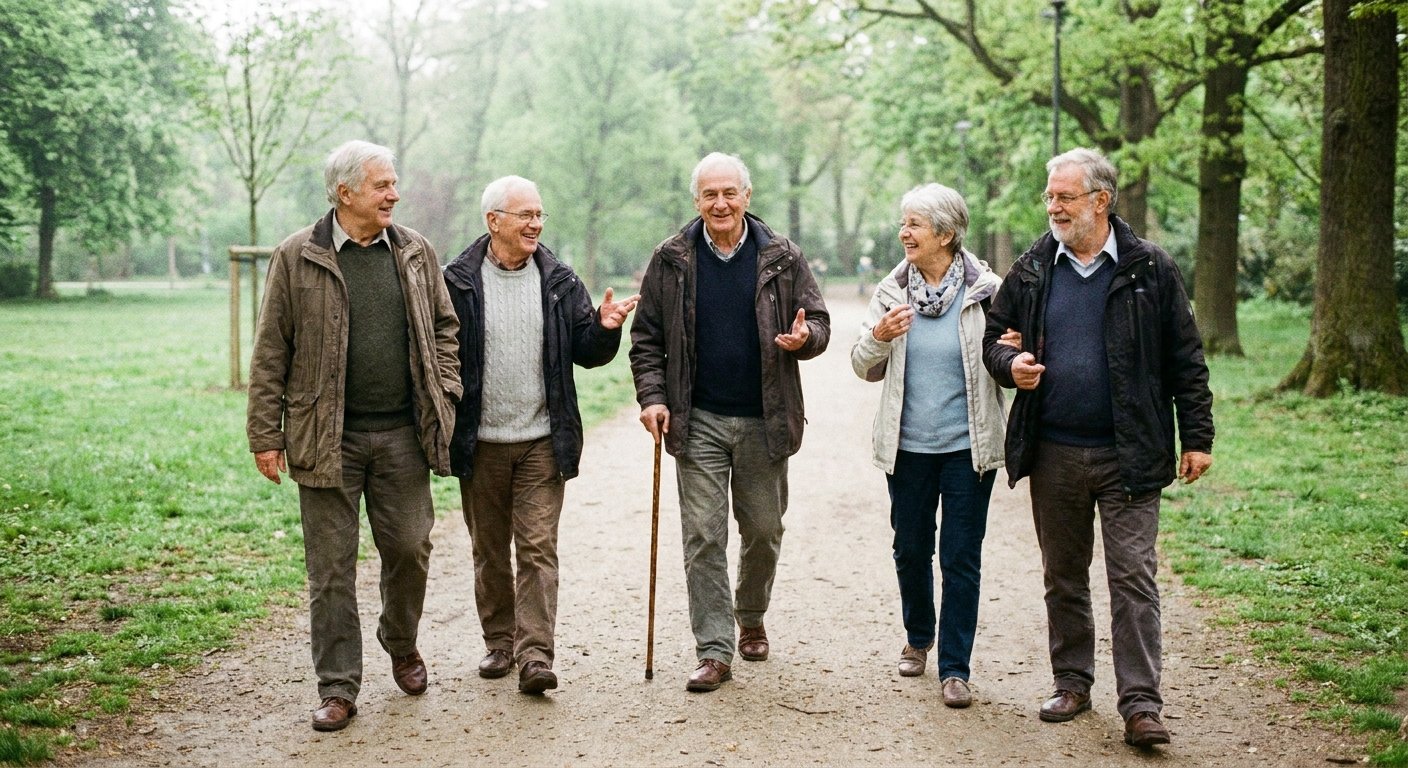
Walking groups for older adults work. The research is unusually consistent on this. But the majority of older adults who'd benefit most from a walking group will never join one.
Not because they don't want to. Because the barriers are real. Rural geography with no group within driving distance. Mobility that makes a 2-mile walk impractical. Caring responsibilities that won't fit a fixed Tuesday 10am slot. Social anxiety about walking with strangers. Weather. Transport.
This guide covers the genuine in-person options, UK and US both, honestly. It also covers what actually works for people who can't make in-person work. That second part is where most similar pages give up.
Why walking groups matter more for older adults after 60
Walking groups for older adults address two problems at the same time: physical inactivity and social isolation. After 60, both get harder to manage, and both start doing measurable damage.
On the isolation side: in the US, 1 in 3 adults aged 50 to 80 report feeling isolated from others, according to a 2023 University of Michigan National Poll on Healthy Aging.[1] In the UK, Age UK estimates 940,000 older people are often lonely, with 9 in 10 of them also reporting unhappiness or depression.[2] The National Academies of Sciences, Engineering, and Medicine found in their 2020 consensus report that social isolation in older adults is associated with a 50% increased risk of developing dementia, a 30% increased risk of coronary heart disease or stroke, and a 26% increased risk of all-cause mortality.[3]
On the physical side: a 2015 meta-analysis by Hanson and Jones, covering 42 studies on outdoor walking groups, found statistically significant improvements across a range of health markers: blood pressure, resting heart rate, cholesterol, body weight, and VO2max. The effect size for depression was d = -0.67, which is clinically meaningful.[4] Average adherence across those studies was 75%, which is high by exercise intervention standards.
Walking groups don't just get people moving. They solve the isolation problem at the same time. That combination is why the research on them is as strong as it is. For more on how walking specifically addresses loneliness, the walking for loneliness guide covers the mechanisms in detail.
What a walking group for older adults actually looks like
If you've never been to one, it helps to know what to expect. Most articles describe walking groups as though they operate at a brisk recreational pace. The senior walking groups that actually work for the 60-plus age range look quite different.
Typical pace is 2.5 to 3 miles per hour, not the 4mph that fitness trackers use as a default "brisk walk." Many groups are closer to 2mph, especially those explicitly for older adults or people with health conditions. Distance is usually 1 to 3 miles. Duration ranges from 45 to 75 minutes, including the informal chat before and after that's often a third of why people keep coming back.
Routes are chosen for accessibility: level or gently sloped, surfaced paths where possible, with resting points. Many groups go to a café or community center afterwards. That social element is not incidental. It's load-bearing for why people keep attending week after week.
There's no fitness test to join. Groups designed for older adults are typically led by trained walk leaders (volunteers in the UK, often affiliated with programs like Ramblers Wellbeing Walks or Paths for All) who are used to accommodating different paces and fitness levels within the same group.
Where to find a walking group for older adults in the UK
The UK has a reasonably well-developed infrastructure for health walks, but it's fragmented enough that people often can't find what exists near them.
Ramblers Wellbeing Walks is England's largest health walk program: free, short (some as brief as 10 minutes), led by trained volunteers, and designed for people returning to activity after illness or a long break. No booking needed. Find your nearest group at the Ramblers Wellbeing Walks finder.
Paths for All runs the equivalent in Scotland: over 200 community Health Walk projects, free, weekly, volunteer-led. Their Edinburgh Ageing Well Walks programme saw 87% of participants report feeling happier after activities in 2023/24. Find groups at pathsforall.org.uk.
Age UK local branches often run walking groups or refer you to local active-aging programs. Worth a direct call, as much of what exists locally isn't indexed online.
Local council leisure and active-aging programs frequently run free or subsidized group walks. Not usually findable by Googling. Call your local authority or search the council website for "active aging" or "healthy walks."
Faith community walks are common and informal. Many don't appear in any directory. Asking your local church, mosque, or community group directly is often the only way to find them.
For a broader guide including parkrun, the how to find a walking group near you covers the full range of platforms.
Where to find a walking group for seniors in the US
The US doesn't have a single national health-walks infrastructure the way the UK does, but there are several reliable routes into organized walking for older adults.
Senior Centers run organized walking programs in most US cities and counties, often including indoor walking for winter months. Many are free or very low cost.
SilverSneakers is included free with most Medicare Advantage plans. 95% of plans included fitness benefits as of 2025. It provides access to thousands of gyms and community centers nationwide, many of which run organized group walks. Check eligibility at silversneakers.com.
YMCA Active Older Adults programs run at most Y locations, with walking clubs, low-impact group exercise, and social programming for adults 55 and over. Financial assistance is available.
AARP Create the Good has a walking group directory and starter kit at createthegood.aarp.org.
parkrun is free, weekly (Saturday mornings), and operates at hundreds of US locations. It's officially a 5km event, but walkers are explicitly welcome, there's no time limit, and a tail walker ensures nobody finishes last. A 2021 BMC Public Health study found social connection and community belonging are the primary drivers of continued participation.[5] Find your nearest event at parkrun.us.
| Program | Country | Cost | Best for |
|---|---|---|---|
| Ramblers Wellbeing Walks | England | Free | Health-focused, accessible pace |
| Paths for All Health Walks | Scotland | Free | Community walks, dementia-friendly options |
| parkrun | UK + US + worldwide | Free | Weekly social event, walkers welcome |
| SilverSneakers | US | Free with Medicare Advantage | Gym access + organized classes |
| YMCA Active Older Adults | US | Low cost / assisted | Social programming + fitness |
| Senior Centers | US | Free or low cost | Local community walks |
| AARP Create the Good | US | Free | 50+ community groups |
What to do if you can't join a local walking group for seniors
The barriers to joining an in-person walking group are real. Most pages on this topic ignore them. Here they are honestly:
Rural geography. Many older adults have no group within a reasonable distance. If the nearest Wellbeing Walk is 45 minutes away and driving isn't an option, the practical answer is an online community, not another search.
Mobility limitations. A 2-mile group walk might be too much right now. That's a real constraint, not a permanent one. Shorter, solo walks are still walking and still count. Getting to a group can come later.
Caring responsibilities. Fixed weekly slots don't work when life interrupts unpredictably. Asynchronous formats, communities where you check in when you can, fit better than any scheduled group.
Social anxiety. Turning up to walk with strangers is harder than it sounds after a period of isolation. The worry about pace, fitness level, and whether you'll be welcome is common. Joining a walking group when you're out of shape or out of practice addresses this directly.
Weather and transport. Real factors for many older adults, particularly in winter or in climates where heat makes outdoor walking genuinely dangerous.
Online and hybrid walking alternatives for older adults
Online walking communities are a genuine option, not a consolation prize. They provide accountability, social connection, and motivation without needing transport or a fixed schedule.
The social accountability effect doesn't require physical co-location. A meta-analysis by Kassavou et al. covering 19 studies found a medium effect size of d = 0.52 for group walking interventions on physical activity levels across in-person and socially-supported remote formats alike.[6] Knowing other people are watching, and not wanting to let a group down, operates the same way when the group is online.
Discord-based walking communities offer daily check-ins and accountability partners, moderated to stay positive regardless of fitness level. Step challenges through apps let you compete on effort-based scoring rather than raw numbers. Walking-buddy pairings, where one person is connected to one other person, can be more reliable than a large group for many older adults. The virtual walking buddy guide covers how these partnerships work and why they stick.
For a full look at formats, online walking groups compares the main options.
How Motion's walking community works for adults over 60
Motion's main advantage for older adults is its scoring model. Activity Battles are weekly step challenges between friends, but competition is based on the percentage of your personal weekly goal you hit, not raw step counts. If your goal is 4,000 steps a day and you hit 95% of it, you beat someone whose goal is 15,000 but who only managed 80%. A 70-year-old on a garden circuit competes on the same terms as a 45-year-old who runs. This effort-based scoring makes competition feel fair across fitness levels, which is rare.
The Discord community is active and moderated. A place where 500 steps on a difficult day is acknowledged with the same warmth as 12,000. Peer support, not professional coaching, but consistent.
The Motmot, Motion's virtual fitness pet, adds a small motivational layer for days when no one is watching. It grows when you move and gets a little worried when you've been inactive. It won't nag, but for people who live alone, that small pull has a way of getting you out the door.
Motion's friend invite system means adult children and parents can connect accounts, run Battles together, and stay in each other's weekly rhythm without being in the same place.
How to start your own walking group for older adults
For activities coordinators, faith community organizers, or older adults who'd rather build something than wait for one to appear: the minimum viable version is two or three people, a fixed weekly slot, and a clear meeting point. That's it.
Practical route considerations: at least one rest point per mile, accessible toilet facilities nearby, surfaced paths where possible, and a conservative starting distance. One mile is enough to begin. The Ramblers' volunteer walk leader training (UK) and AARP's walking group starter kit (US) both provide templates without requiring formal qualifications.
For care-home contexts, the walk doesn't need to leave the premises. A consistent route around a garden or courtyard, same time each week, provides structure and social contact that most residents genuinely value.
If you're helping an older adult build a walking habit
Research on social support and older adult exercise adherence points consistently to one thing: the involvement of a close person has a stronger effect on long-term consistency than any formal program.[3] Encouraging a parent to join a group and then stepping back is not the same as staying involved.
What actually works is staying interested in the specifics. Not "did you walk today?" but "how was the route?" or "did you make it to the park?" Asking the specific question signals genuine interest rather than a duty check-in.
Walk together when you can. It doesn't need to be often. A monthly walk, or even walks timed to happen simultaneously from different places while you're on the phone together, reinforces the habit more durably than messages do.
Connecting through an app closes the gap when you can't be there. Motion's friend system lets adult children and parents link accounts, run Activity Battles, and track each other's weekly goals. Effort-based scoring means a 65-year-old parent and a 40-year-old adult child compete on fair terms, and the outcome isn't predetermined by who's fitter. The virtual walking buddy format covers how this kind of partnership works in practice.
The main thing to avoid is framing involvement as monitoring. Accountability that feels like surveillance creates resistance. Share your own progress. Ask questions. Let the habit build alongside each other.
Getting started with walking groups after 60
If you can get to an in-person group, try the Ramblers Wellbeing Walks (England), Paths for All Health Walks (Scotland), or your nearest Senior Center (US). These are designed for older adults, led by trained volunteers, and free. Start there before concluding that nothing suitable exists near you.
If the barriers above are real for you, an online community is not a compromise. It's a different format with most of the same benefits. Step challenges, accountability partnerships, and active communities can do the same job as a Tuesday morning walk, with more flexibility.
The research on walking groups for older adults is unambiguous about one thing: being connected to other people who are also walking changes how consistently you do it. The format that delivers that connection for your situation is the right one.
Sources
- University of Michigan National Poll on Healthy Aging (2023). Loneliness and isolation: Back to pre-pandemic levels, but still high, for older adults.
- Age UK (2024). Loneliness research and resources.
- National Academies of Sciences, Engineering, and Medicine (2020). Social Isolation and Loneliness in Older Adults: Opportunities for the Health Care System.
- Hanson S & Jones A (2015). Is there evidence that walking groups have health benefits? A systematic review and meta-analysis. British Journal of Sports Medicine.
- Stevinson C et al. (2021). Exploring the benefits of participation in community-based running and walking events: a cross-sectional survey of parkrun participants. BMC Public Health.
- Kassavou A et al. (2013). Do interventions to promote walking in groups increase physical activity? A meta-analysis. International Journal of Behavioral Nutrition and Physical Activity.
- Ramblers Wellbeing Walks. Find a wellbeing walk group.
- Paths for All. Scottish Health Walk Network.
- SilverSneakers. About the fitness programme for Medicare members.
- AARP Create the Good. Walking Group Starter Guide.


