
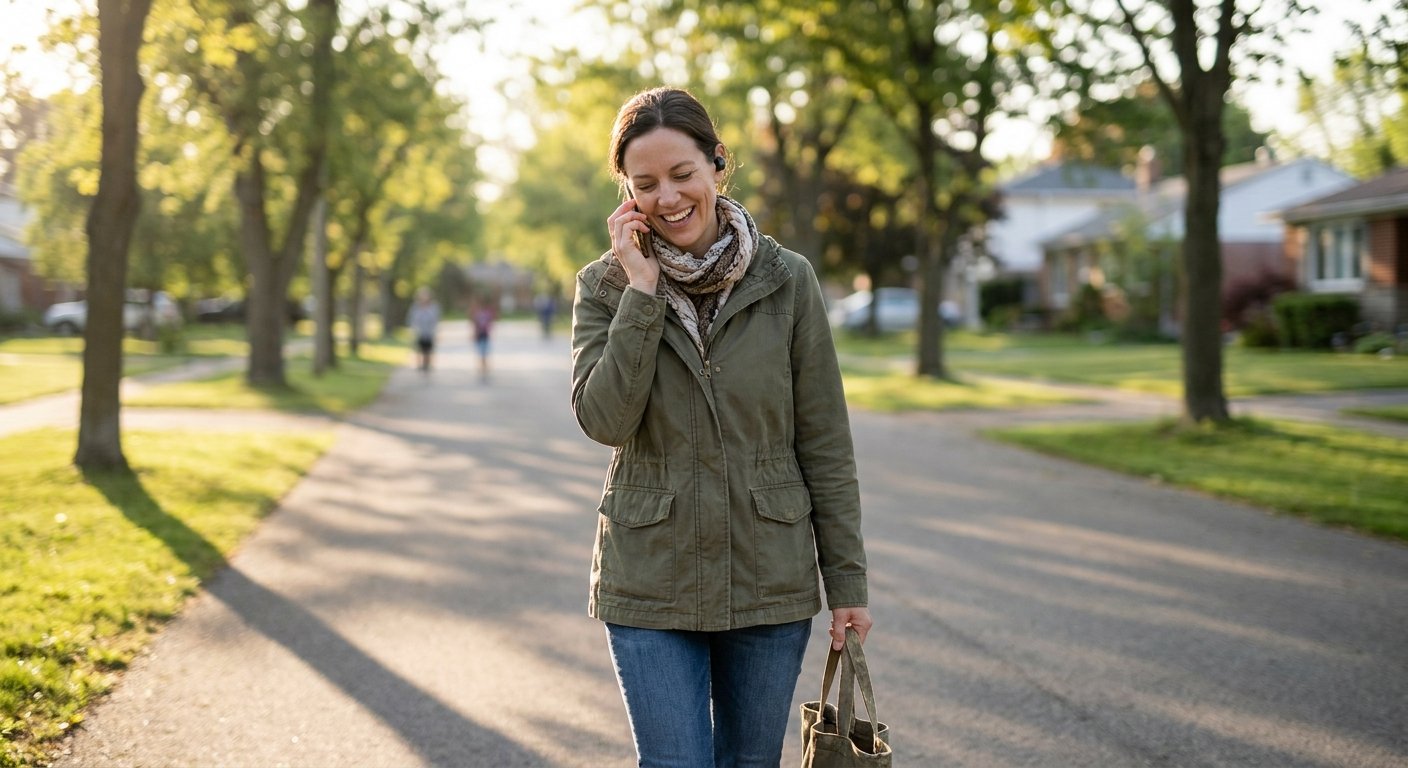
A virtual walking buddy is someone who shares your walking habit without sharing your location. You might call each other while you walk, agree to head out at the same time each morning, or track each other's weekly steps through an app. The format varies. The result is the same: you move more reliably because someone else is involved.
The research backs this up. A study published in the Journal of Consulting and Clinical Psychology found that people who joined a weight-loss programme with friends had a 95% completion rate, compared to 76% for those who joined alone. More striking: 66% of those with friends maintained their results in full, versus 24% going solo.[1] The programme involved lifestyle changes, but the mechanism that drove adherence was the same one that keeps people walking: not wanting to let someone down.
You don't need a walking group to get that effect. One person is often enough.
Why a single virtual walking buddy can outperform a group
Walking groups are excellent. If you haven't tried one, the group equivalent is worth exploring. But one-to-one accountability has properties that groups don't.
The first is visibility. In a group of ten, your absence on a Tuesday barely registers. In a two-person arrangement, your absence is the whole story. There's nowhere to hide, and most people don't want to hide. That mild social pressure is exactly the mechanism that drives consistency.
The second is what social psychologists call the free rider problem. In groups, individuals can coast on the effort of others. The group keeps moving whether you do or not. A two-person arrangement eliminates that entirely. Your effort is indispensable.
The third is flexibility. A group needs a fixed day, a route, a time that works for everyone. Two people can renegotiate on a Wednesday morning with a single text. That flexibility matters across the weeks and months when life inevitably interrupts.
And the trust is different. You tend to be more honest with one person about when you're struggling, slipping, or need the arrangement to change.
The three formats for a virtual walking buddy
There's no single right way to do this. Most people settle on one of three approaches.
The phone-call walk
You both head out at the same time with earbuds in and talk for the duration. You're not walking together physically, but the conversation makes it feel that way. This works especially well across time zones when one of you is slightly ahead or behind.
It's the most socially rewarding format. The walk becomes the reason to catch up rather than the thing you have to force yourself to do. The time passes faster. People often walk longer than they planned because the conversation isn't finished.
The practical note: keep a shared calendar slot for it. If it relies on a spontaneous "want to walk-chat now?" text, it won't happen consistently enough.
The same-time pact
You agree to walk at the same hour, separately, and check in before or after. "Heading out at 7" followed by "done, 38 minutes" is the whole transaction. No call required.
This works well for people who prefer to walk quietly, use that time for podcasts or music, or simply aren't in a chatty mood at 6:45am. The commitment is real even without the conversation. Knowing your buddy is lacing up at the same time is often enough.
The accountability here is gentle but effective. Most people won't send "heading out at 7" and then not go. The small act of declaring it locks you in.
App-tracked step challenges
You both use an app that tracks your weekly activity, and you compete or compare. This is the most data-driven format and suits people who are motivated by numbers and progress.
This format works best when the comparison is fair. Raw step counts are a poor basis for competition if one of you works a desk job and the other is on their feet all day, or if your fitness levels are genuinely different. Effort-based scoring fixes this.
What the research says about walking with another person
A 2023 Harvard Health article on walking with friends summarizes the evidence well: friends create expectations, and we don't like letting them down. That accountability effect is social, not technological. It doesn't require an app. A simple text exchange is enough to activate it.[2]
There's also a physiological dimension. Research by Heinrichs et al. found that social support suppresses cortisol responses to stress, with the effect strongest when a trusted person was present.[3] Walking with a friend, even virtually, involves that same social connection. The stress-buffering effect likely carries over.
And then there's the Köhler effect. Research published in PMC found that people exercised an average of 12.5 minutes longer per session when paired with a slightly more capable partner, compared to exercising alone.[4] You don't want to be the person who fell short. That mildly competitive instinct, when channeled into a supportive two-person dynamic, tends to extend sessions beyond what people would do alone.
How to choose a virtual walking buddy who will stick around
Not every friend makes a good walking buddy. Choosing the right person saves a lot of friction later.
Pick someone with a similar schedule. Not the same fitness level necessarily, but the same available windows. If you walk at 7am and your friend's mornings are chaos until 9, the arrangement won't hold.
Look for a similar commitment level. The biggest cause of these arrangements failing is asymmetry. One person is very invested, the other is lukewarm. Have a direct conversation about what you both want from it before you start.
Similar goals help, but aren't essential. You might be building a daily 20-minute habit while your friend is training for a 10k. That's fine, as long as you both see value in the accountability. What doesn't work well is if one person has already achieved the habit and the other is just starting. The dynamic gets patronizing fast.
Consider someone a bit ahead of you. The Köhler research suggests you'll push harder with a slightly more capable partner than with someone at the exact same level. That gentle upward pull is motivating rather than demoralizing, as long as the gap isn't too wide.
For nervous beginners, someone else who is just starting out can be even better. The shared vulnerability creates honesty and reduces the pressure to perform. There's specific value in finding someone at your level if you're returning to exercise after a long break. For more on that, you don't have to be fit to start.
Setting expectations with your virtual walking buddy before you start
The arrangements that collapse earliest are usually the ones that never had a clear agreement.
Before your first week, decide:
- How often. Daily check-ins are motivating but demanding. Three times a week is more sustainable for most people.
- What format. Call, text, app, or some combination.
- What accountability looks like. Is a missed day something you mention? Something you ignore? Most arrangements work better when you agree that honesty is welcome.
- What you'll do when one of you is sick, traveling, or having a rough patch. Agreeing upfront that the arrangement flexes around life removes a lot of guilt and pressure.
A short trial period also helps. Commit to four weeks explicitly. After that, check in on whether it's working for both of you and adjust. Most good walking partnerships evolve over time.
What to do when your virtual walking buddy arrangement falls off
This happens. It's not a failure of the relationship. It's just what happens when people have lives.
The important thing is naming it without drama. "I've been inconsistent this week, I want to get back on track" is enough. You don't need to apologize. You need to re-engage.
If your buddy is the one who's gone quiet, reach out with curiosity rather than accusation. "Haven't heard from you in a bit, everything okay?" opens the door. "You haven't walked in two weeks" closes it.
A walking buddy relationship that survives a few stumbles is more durable than one that has never been tested. The stumble is where the real accountability gets built.
If the arrangement breaks down completely, that's okay too. It served a purpose for a season. Finding a new walking buddy is easier the second time.
Finding a virtual walking buddy when your friends aren't walkers
Your best friend might run, your partner might cycle, your colleagues might be gym people. None of that means you're stuck walking alone.
A few places to look:
Dedicated apps. Apps like Walk Buddy and WalkingPal exist specifically to match walking partners. The quality of matches varies, and the communities are smaller than general fitness apps, but they're worth trying if your existing network isn't a fit.
Running clubs with beginner tracks. Many running clubs now have walk-run groups. The walking members tend to be highly motivated and actively looking for buddies.
Local Facebook or Nextdoor groups. A straightforward post ("looking for someone to do a morning virtual walking check-in with, anyone interested?") often gets responses from people in the same position.
Online fitness communities. Discord fitness servers, Reddit communities like r/loseit or r/fitness, and niche Facebook groups for walkers are all places where people actively seek accountability partners.
The key is to be specific about what you want. "Walking buddy" is vague. "Someone to do a daily 7am text check-in with, flexible pace, no pressure" tells people exactly what they're signing up for.
How Motion works as a virtual walking buddy system
Motion's Activity Battles are the closest thing to a built-in virtual walking buddy. You challenge a friend to a week-long step competition, and the scoring is based on effort rather than raw numbers. That means if you hit 90% of your personal weekly goal and your friend hits 80% of theirs, you win, regardless of who walked more steps in total. A beginner and an advanced walker can compete fairly.
The private challenge chat inside each battle serves the same function as the check-in texts in a two-person arrangement. You can motivate, tease, and commiserate. The difference is that the accountability is built into the structure, not dependent on remembering to message.
You can invite a friend directly to Motion, and they auto-connect to you when they sign up. Your effort-based goals are set using your own 12-week rolling activity history, so you're always being challenged at the right level for where you actually are.
And your Motmot grows stronger when you're consistent. It doesn't know your buddy hasn't texted back yet. It just knows you moved today.
If you don't have a friend to invite yet, Motion's Discord community has buddy-matching channels where people find accountability partners at their own level. No-judgment, active moderation, and a shared understanding that 500 steps and 5,000 steps are both worth celebrating.
Start with one person and one week
A virtual walking buddy doesn't need a formal plan or a complicated setup. Text one person today. Tell them you want to try a walking check-in for a week. Agree on a time. See how it feels.
Most people who try it keep doing it. Because the walks become the thing you look forward to, not the thing you have to force yourself out the door for.
Sources
- Wing RR & Jeffery RW (1999). Benefits of recruiting participants with friends and increasing social support for weight loss and maintenance. Journal of Consulting and Clinical Psychology, 67(1), 132-138.
- Godman H (2023). Better together: The many benefits of walking with friends. Harvard Health Publishing.
- Heinrichs M, Baumgartner T, Kirschbaum C, Ehlert U (2003). Social support and oxytocin interact to suppress cortisol and subjective responses to psychosocial stress. Biological Psychiatry, 54(12), 1389-1398.
- Feltz DL et al. (2016). Enhancing Aerobic Exercise with a Novel Virtual Exercise Buddy Based on the Köhler Effect. PMC.
- PMC (2022). Group exercise membership is associated with forms of social support, exercise identity, and amount of physical activity.
- Focusmate Blog. Finding a Virtual Accountability Buddy: Dos and Don'ts.
- Peloton Blog. A Guide to Exercising with a Virtual Workout Buddy.
- Harvard Health Publishing (2015). Being part of a walking group yields wide-ranging health benefits.


