
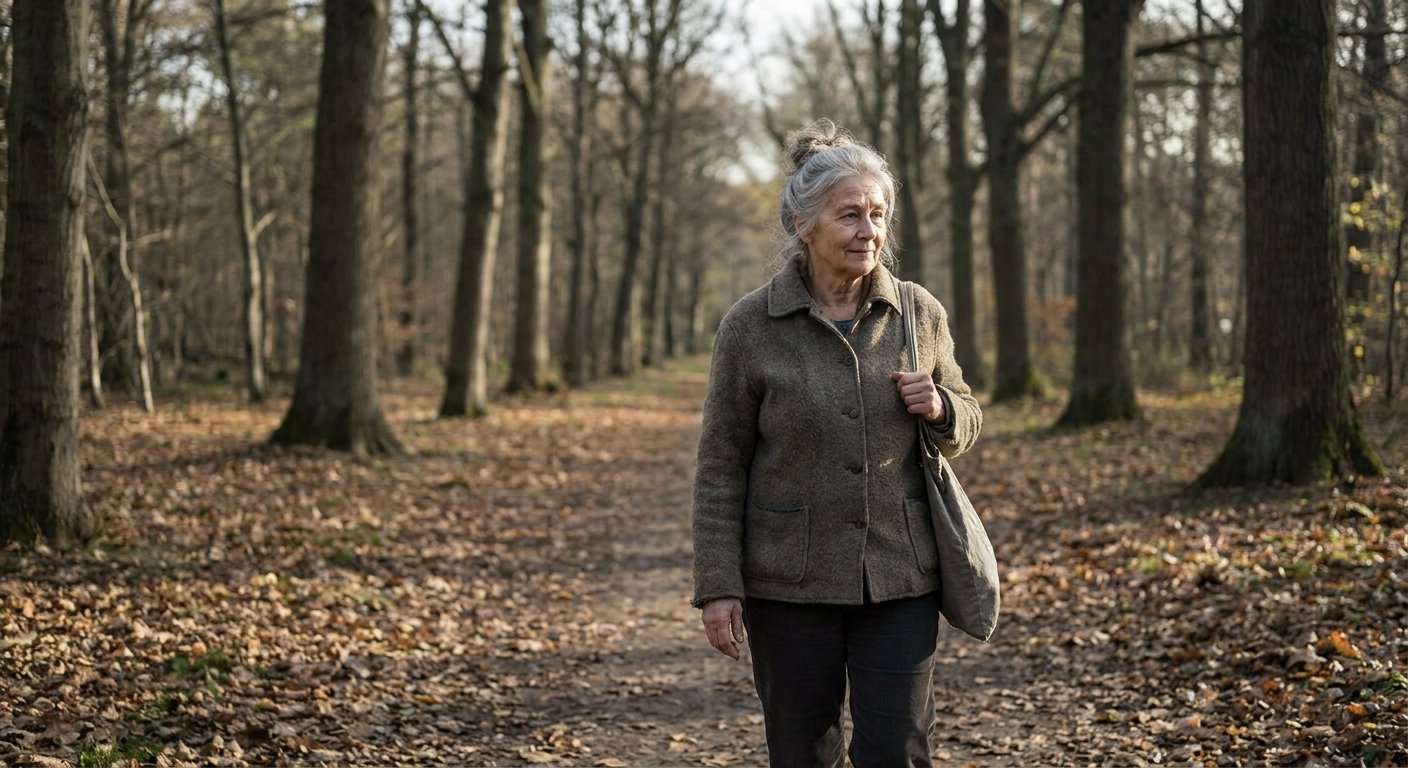
For 76% of older people surveyed by Re-engage, Sunday is the loneliest day of the week.[1] Local services are closed or reduced, the phone stays quiet, and the hours stretch. It's a specific kind of loneliness, the kind that builds not from a single loss but from the gradual thinning of social contact that comes with age.
What makes that worth understanding is not just the human cost. Loneliness is a physical health problem. Research published in 2015 found that social isolation carries a mortality risk comparable to smoking 15 cigarettes a day.[2] That comparison is now cited by public health agencies from the US Surgeon General to the CDC. Not as a metaphor, but as a straightforward statement of risk.
Walking is one of the most accessible activities available for tackling loneliness. It's free, requires no equipment, works across almost all fitness levels, and is embedded in many of the community programs that social prescribers already use. But the evidence on whether and how walking helps with loneliness is more nuanced than it's often presented. This post is an attempt to set that evidence out clearly, covering where it's strong, where it's mixed, and what it means in practice.
How big is the loneliness problem? The current data on social isolation
Loneliness is widespread, and the data across both the UK and US suggests it's worse than it was a decade ago. The UK Community Life Survey 2024/25 found that 6.6% of adults report feeling lonely often or always, a figure that has risen since the mid-2010s, when it sat between 4.9% and 5.6%.[3] That equates to several million people experiencing persistent loneliness in England alone.
In the US, the picture is similar. The 2023 Surgeon General's Advisory on loneliness reported that approximately half of American adults say they experience measurable loneliness, with around 14% meeting criteria for severe loneliness and more than 23% for moderate loneliness.[4] Among adults aged 45 and older, AARP research suggests around one in three are lonely.[5]
Older adults face particular risk. Age UK's "All the Lonely People" report projected that the number of over-50s experiencing loneliness in the UK would reach two million by the mid-2020s (a 49% increase on 2016 figures), driven by widowhood, ill health, and the loss of the everyday social infrastructure that work and family used to provide.[6]
That Re-engage finding about Sunday is not an anomaly. It reflects something structural: for people living alone, weekdays often have more built-in contact (a GP appointment, a trip to the shops, a phone call) and weekends strip that away. The loneliness isn't chronic in the clinical sense for everyone, but it is consistent and accumulating.
Why loneliness is a physical health problem, not just an emotional one
The clinical framing of loneliness as a public health issue rather than a personal feeling has hardened over the past decade, and the evidence behind it is now substantial. The most-cited study is Holt-Lunstad et al.'s 2015 meta-analysis, which analysed data from more than 3.4 million participants and found that social isolation was associated with a 29% increased likelihood of premature mortality, loneliness with a 26% increase, and living alone with a 32% increase.[2]
These figures are statistically comparable to well-established risk factors. The researchers noted that the mortality impact of social disconnection is comparable to smoking 15 cigarettes per day, a figure drawn from the same research program, and exceeds the impact of obesity.
The mechanisms are multiple. Chronic loneliness is associated with elevated cortisol and inflammatory markers, disrupted sleep, higher blood pressure, and suppressed immune function. The US Surgeon General's advisory summarized the downstream consequences: social isolation is linked to a 29% increased risk of heart disease, a 32% increased risk of stroke, and an approximately 50% increased risk of dementia in older adults.[4] The CDC includes social isolation and loneliness as established risk factors for heart disease, stroke, type 2 diabetes, depression, anxiety, and earlier death.[7]
For commissioners and link workers reading this: loneliness is not a welfare issue bolted onto health. It's a primary risk factor with a mortality signal roughly as large as physical inactivity itself. The case for intervening early is identical to the case for addressing obesity or hypertension.
Does walking help with loneliness? What the evidence says
The honest answer is: it depends on how you walk.
A 2023 cross-sectional study published in BMC Geriatrics examined 173 community-dwelling adults aged 65 and over and classified their walking by context: non-walking, walking mostly alone, or walking mostly with others. The key finding was specific: walking with someone was associated with significantly lower loneliness scores than not walking at all (adjusted β: -0.51, 95% CI: -1.00, -0.01).[8] Walking alone, by contrast, did not show a statistically significant association with lower loneliness in the same analysis.
That distinction matters. It means the mechanism linking walking to loneliness reduction is not simply the physical activity. It's the social contact that walking can provide when done with others.
This fits the broader mental health literature. A paper published in Innovation in Aging (Oxford Academic) examined the relationship between walking and loneliness and found that the effect of walking on loneliness was mediated through reductions in social isolation. Walking helped loneliness primarily by increasing social contact, not through exercise effects alone.[9]
There is a nuance worth naming here for commissioners: most loneliness measurement tools, including the widely-used UCLA Loneliness Scale, are sensitive but not always responsive to short-term interventions. Some group-walking randomised controlled trials show significant improvements on loneliness scales. Others show improvements in related constructs (social support, wellbeing, depression) without hitting the threshold for loneliness scale significance. This doesn't mean group walking doesn't help with loneliness. It means the effect is real but often indirect, and the evidence base is more mixed at the RCT level than advocates sometimes acknowledge. The practitioner-level evidence from walk programmes is consistently positive. The causal evidence from rigorous trials is promising but not yet conclusive.
Walking alone vs walking with others: where the loneliness effect comes from
The physical health benefits of walking don't depend on social context. The mental health and loneliness benefits largely do.
Hanson and Jones's 2015 systematic review and meta-analysis, covering 42 studies involving 1,843 participants, found that outdoor walking groups produced statistically significant reductions in depression scores with an effect size of d = -0.67.[10] That's a moderate-to-large effect. The same review found significant improvements in blood pressure, resting heart rate, cholesterol, body weight, and VO2max, with low rates of adverse effects across more than 74,000 hours of participant walking. These were ordinary community walking groups, not clinical exercise programs.
On adherence, Kassavou et al.'s meta-analysis of 19 group walking studies found a medium effect size of d = 0.52 on physical activity levels, with the effect growing stronger in studies that ran longer than six months.[11] Group-based formats keep people walking. And the longer they run, the more effective they get.
The mechanism is partly behavioral (social accountability makes you show up) and partly biological. Research by Heinrichs et al. found that social support suppresses cortisol, and that the combination of social support and oxytocin produced the lowest cortisol concentrations under stress.[12] When you walk with people you know and trust, the walk itself feels physiologically different. That's not sentiment. It's stress physiology.
Solo walking has real value for mood, cardiovascular health, and the general benefits of daily movement. But if the goal is specifically to address loneliness, the social element of walking is the active ingredient, not the walking itself.
Walking group programmes with evidence that loneliness intervention works
The strongest real-world evidence comes from established group walking programmes that have been running at scale for years.
Ramblers Wellbeing Walks, England's largest health walk programme, offers free, volunteer-led short walks across the country. An evaluation by Ecorys found the programme effective in maintaining physical activity and improving mental wellbeing, with documented reductions in loneliness and increases in social interaction among participants.[13] The walks are explicitly designed for people with health conditions, low fitness, or social isolation, making them one of the most directly relevant evidence sources for this population.
Paths for All (Walking Scotland) supports over 850 Health Walks across Scotland through a network of 400 organisations. Scottish Government data shows participation is associated with improved mood, increased social interaction, and reduced feelings of isolation, with qualitative feedback from participants naming social connection as the primary reason they keep coming.[14]
NHS England's Green Social Prescribing pilots, which ran from 2021 to 2023 across seven test sites, referred over 8,500 people to nature-based activities including walking programmes. Interim evaluation showed positive improvements in mental health and wellbeing, and 85% uptake when a green social prescription was offered.[15]
In the US, AARP's Connect2Affect programme connects older adults facing social isolation with local resources, including walking and activity groups, as part of a broader national strategy to address the loneliness epidemic.[5] The US Surgeon General's 2023 National Strategy for Social Connection explicitly names community walking and movement programs as part of the public health response to loneliness.[4]
The pattern holds across all of these: structured, facilitated walking in a social context, offered without barriers to entry, produces measurable improvements in wellbeing and social connection for people experiencing isolation.
What this means if you're dealing with loneliness right now
If you're reading this because you're lonely and wondering whether walking can help, the practical answer is yes. But the context matters.
Walking alone every day is better for your physical health than not walking, and there's evidence it can help with low mood. But if loneliness is the primary issue, walking in a social context is where the evidence is strongest. A structured local walking group, with regular faces and a fixed meeting time, gives you the social infrastructure that research suggests is the active mechanism.
Finding one is more straightforward than many people expect. How to find a walking group near you covers the main options by country and fitness level, including how to make initial contact before showing up. If you're worried about fitness or feel self-conscious about joining, joining a walking group when you're out of shape addresses those concerns directly. Most groups have a slow tier, and the culture in health-focused walks is generally welcoming by design.
For people who can't access an in-person group for practical or social anxiety reasons, online walking groups offer a real alternative. They don't replicate in-person contact, but they do provide accountability and community, and the research on virtual walking programs shows genuine improvements in activity levels.
If you're over 60, walking groups specifically for older adults covers the UK and US programmes designed with this age group in mind, including health walk formats, NHS referral routes, and what to look for in a group that's genuinely age-inclusive.
How Motion helps people who can't access a local group
Motion isn't a walking group. It doesn't replace the face-to-face contact that the evidence points to as the core mechanism behind walking's loneliness benefits. That's worth saying clearly.
What it does offer is a structured social accountability framework for people whose access to in-person groups is limited: rural location, mobility constraints, working patterns, caring responsibilities, social anxiety, or simply no suitable group nearby.
The Activity Battles are weekly walking challenges with friends, scored on effort rather than absolute steps. If your weekly goal is 3,000 steps and you hit 3,200, you win against someone whose goal is 12,000 and managed 11,000. That's genuine fairness across fitness levels, including people who are deconditioned, recovering from illness, or managing a chronic condition. The private challenge chat that comes with each battle replicates something walking group research points to as valuable: a small, steady accountability relationship with someone who notices whether you showed up.
The Discord community is where the broader social layer lives. It's peer-based, actively moderated, and structured around the principle that 500 steps deserves the same celebration as 50,000. For people who are isolated and not yet ready for in-person contact, a non-judgmental community of walkers who check in on each other daily is a genuine bridge.
Motion also uses a virtual fitness pet called a Motmot that responds to your activity. It grows when you move and gets worried when you go quiet. The behavioral effect of having something that reacts to your consistency is small but real, and for people managing loneliness alongside low motivation, it adds an extra reason to get out the door that doesn't depend on willpower alone.
The effort-based goals ensure that goals adapt to your actual activity level rather than staying fixed at a number that becomes demoralizing when life gets difficult. If you have a bad week, the system adjusts. That matters for people managing health conditions, grief, or the kind of low-energy isolation that loneliness itself produces.
What social prescribers and commissioners need to know about walking for loneliness
The evidence base. Group walking is well-supported as an intervention for mental health, physical activity adherence, and wellbeing. The Hanson and Jones 2015 meta-analysis (d = -0.67 for depression) and the Kassavou et al. adherence data represent a solid evidence base for outdoor group walking at the population level.[10][11] The BMC Geriatrics 2023 study adds a specific loneliness dimension, distinguishing the social context of walking from the exercise itself.[8]
Honest evidence gaps. Not every group-walking RCT shows significant reductions on the UCLA Loneliness Scale or comparable instruments. The JAMA Network Open 2022 systematic review of loneliness interventions in older adults, which covered 70 studies and 8,259 participants, found that multi-component social activity interventions showed the most consistent effects.[16] Walking as a standalone activity without structured social facilitation shows weaker effects. The facilitation matters. A walk with a trained walk leader who fosters conversation and tracks who hasn't come back is qualitatively different from a self-directed walking prescription.
Policy context. In the UK, group walking sits within the social prescribing framework established by NHS England, with link workers able to refer into Ramblers Wellbeing Walks, Paths for All Health Walks in Scotland, and local authority walking programs. The green social prescribing pilots provide an evidence base for commissioning nature-based walking in particular.[15] In the US, the 2023 Surgeon General's National Strategy for Social Connection explicitly recommends physical activity programs as part of the public health response to loneliness.[4]
Where digital tools fit. A significant proportion of lonely older adults face access barriers to community provision: rural geography, mobility limitations, anxiety, transport, and caring responsibilities are well-documented barriers in the literature. Digital accountability tools, including apps that create peer walking communities, can extend reach to people who can't or won't access in-person provision. They shouldn't be positioned as substitutes for community walking. The evidence doesn't support that. But as a complementary tool for people on waiting lists, in under-served areas, or managing access barriers, they have a documented role in maintaining activity levels and social contact. Motion's effort-based competition model and no-judgment community structure are designed to be inclusive at the lower end of the fitness spectrum.
If you're a commissioner or link worker interested in discussing how Motion fits alongside community provision, you can reach us via the Motion for Teams page.
Walking for loneliness: the evidence is clear enough to act on
Loneliness is a public health problem with a mortality signal as large as many conditions we take far more seriously. Walking with others in a structured, welcoming social context is one of the most accessible and evidence-supported tools for addressing it.
The evidence doesn't promise that any walk will cure loneliness. A solitary march around the block every morning is good for your heart, your blood pressure, and your mood. But if you're lonely, and the goal is connection, the research points clearly toward group-based walking with regular participants, facilitated by someone who cares whether you come back.
Find your group. Show up consistently. The rest tends to follow.
Sources
- Re-engage (2017). Older people reveal which day of the week is the hardest. Re-engage (formerly Contact the Elderly)
- Holt-Lunstad J, Smith TB, Baker M, Harris T, Stephenson D (2015). Loneliness and Social Isolation as Risk Factors for Mortality: A Meta-Analytic Review. Perspectives on Psychological Science
- Department for Culture, Media and Sport (2025). Community Life Survey 2024/25: Loneliness and support networks. GOV.UK
- U.S. Surgeon General (2023). Our Epidemic of Loneliness and Isolation: The U.S. Surgeon General's Advisory on the Healing Effects of Social Connection and Community. HHS / NCBI Bookshelf
- AARP Foundation. Connect2Affect: Overcoming Social Isolation
- Age UK (2018). All the Lonely People: Loneliness in Later Life
- CDC (2024). Health Effects of Social Isolation and Loneliness. Social Connection
- Shimada H et al. (2023). Context of walking and loneliness among community-dwelling older adults: a cross-sectional study. BMC Geriatrics
- Pristavec T (2018). Walking Away from Loneliness: The Mediating Role of Social Isolation. Innovation in Aging (Oxford Academic / PMC)
- Hanson S, Jones A (2015). Is there evidence that walking groups have health benefits? A systematic review and meta-analysis. British Journal of Sports Medicine
- Kassavou A, Turner A, French DP (2013). Do interventions to promote walking in groups increase physical activity? A meta-analysis. International Journal of Behavioral Nutrition and Physical Activity
- Heinrichs M, Baumgartner T, Kirschbaum C, Ehlert U (2003). Social support and oxytocin interact to suppress cortisol and subjective responses to psychosocial stress. Biological Psychiatry
- Ramblers (2024). Wellbeing Walks programme: prescribe walking
- Age Scotland / Paths for All (2021). Walk back better with Paths for All
- NHS England (2023). Green social prescribing
- Hoang P et al. (2022). Interventions Associated With Reduced Loneliness and Social Isolation in Older Adults: A Systematic Review and Meta-analysis. JAMA Network Open


