
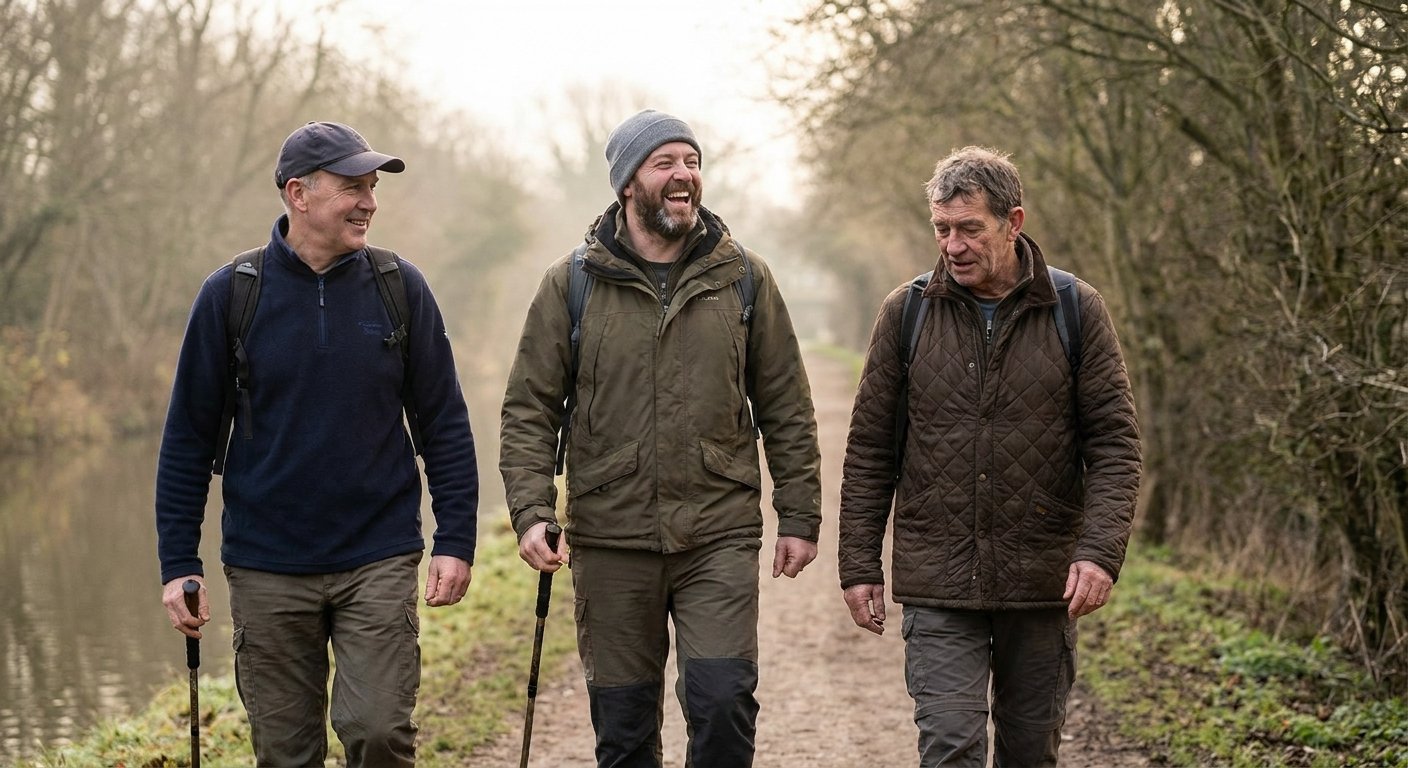
In March 2025, Greene King partnered with Macmillan Cancer Support to survey men across the UK about how they talk. The headline finding: 52% of men say they feel more comfortable discussing personal issues shoulder-to-shoulder (walking, driving, or sharing a meal) than sitting face to face.[1] When asked why, 36% cited something specific: being able to turn away if they get emotional.[1]
That detail is worth sitting with. It isn't about men being reluctant to feel things. It's about the geometry of the situation. Face-to-face conversation places two people in direct visual contact, which increases emotional exposure. Side-by-side removes that pressure. Both people can look ahead. Nobody has to manage their expression in real time.
Walking happens to be one of the best ways to create that geometry. And that's largely why men's walking groups (organized, regular walks for men only) have been growing steadily for the past decade.
This post covers what these groups are, what the research says about why they work, who they're for, and how to find your way into one.
What men's walking groups are (and what they aren't)
Men's walking groups are regular, organized outdoor walks attended entirely or primarily by men. Most are free, volunteer-led, meet weekly or fortnightly, and require no particular fitness level to join. The format is simple: a fixed meeting point, a route, and a couple of hours walking together.
They're distinct from generic walking clubs in one important way: the social design is intentional. The mix is men-only, the culture tends to be low-pressure and non-competitive, and the implicit understanding is that conversation is welcome but never required. You can come and just walk. Many people do, especially at first.
They're also different from group therapy or indoor peer-support groups. There's no clinical facilitation, no requirement to share. The walking is the structure: the activity gives everyone something to be doing, which takes the pressure off the conversation.
Most groups are free or low-cost. Saturday morning is a common slot. The pace is usually gentle (roughly 2.5 to 3.5 miles per hour), the distance modest (2 to 4 miles), and the duration around 60 to 90 minutes. Many groups have an optional coffee afterwards, which is often where the better conversations happen.
Why "walk and talk" works for men: the shoulder-to-shoulder effect
The shoulder-to-shoulder dynamic helps explain why men are more likely to open up walking than sitting down together. The Greene King research found that 26% of men say they open up most easily during walks, more than during car journeys, watching sport, or shared meals.[1] And the 36% who cited being able to turn away if they get emotional points directly to what makes the format work.[1]
The broader research on communication orientation supports this. When men talk with other men face to face, direct eye contact can register as challenging or confrontational.[2] Side-by-side conversation removes that dynamic entirely. Both people face the same direction. There's no need to hold eye contact. Nobody is performing composure for an audience of one.
This distinction between parallel and face-to-face conversation is well-established enough that it's become a design principle in male-specific community programs. The observation attributed to participants in men's community shed research, "men don't talk face to face, they talk shoulder to shoulder," captures it plainly.[3]
Walking also changes the physiological context of conversation. Movement suppresses the body's threat response. A review of cortisol research found that social support significantly reduces cortisol levels under stress, and the combination of movement and social presence creates conditions where difficult topics feel less threatening to approach.[4] The walk isn't incidental. It's part of what makes the conversation possible.
What the research says about walking, mental health, and men specifically
The evidence on walking groups and mental health is solid, and a 2025 study focused exclusively on men adds an important piece to it.
A randomized pilot trial by Dickmeyer et al. compared outdoor walk-and-talk therapy with conventional indoor therapy in 37 men with low mood (mean PHQ-9 score 11.4, mean age 44).[5] Over six weeks of weekly 60-minute sessions, the walk-and-talk condition showed a medium-sized effect on overall psychological distress, with larger improvements in stress and anxiety compared to indoor therapy.[5] Attendance, retention, and participant satisfaction all exceeded the study's feasibility benchmarks. To the authors' knowledge, it was the first randomized controlled trial to examine walk-and-talk therapy for men with low mood.
The broader walking group literature points in the same direction. Hanson and Jones's 2015 meta-analysis of 42 walking group studies found a statistically significant reduction in depression scores with an effect size of d = -0.67, moderate to large by conventional standards.[6] Across those studies, around 75% of participants adhered to regular group walking, a notably high figure for a behavioral intervention.[6] The same review found improvements in blood pressure, resting heart rate, cholesterol, body weight, and VO2max, with low rates of adverse effects across more than 74,000 hours of participant data.
For readers interested in the full clinical picture on walk-and-talk therapy, we've covered the evidence base in more depth separately.
Worth noting: most of these studies focus on depression and wellbeing outcomes. The loneliness evidence is more mixed at the randomized trial level. Group walking reliably improves mood and social functioning, but the direct effect on loneliness measurement scales is less consistent, though consistently positive in the practitioner literature. What the research does agree on is that the social element is the active ingredient, not the walking alone. Walking alongside other people does something that walking alone doesn't.
The male loneliness backdrop: why men's walking groups exist
Men's walking groups didn't emerge from nowhere. They're a response to a measurable problem that's been building for decades.
In the US, the Surgeon General's 2023 advisory on loneliness cited research showing that social isolation carries a mortality risk equivalent to smoking 15 cigarettes a day, a figure that exceeds the risk of obesity and physical inactivity.[7] For men specifically, loneliness is a larger suicide risk factor than for women, a pattern reflected in the UK data: in 2024, three in four suicides registered in England and Wales were male, with men aged 50 to 54 carrying the highest rate.[8]
The friendship data shows why. The Survey Center on American Life tracked men's close friendships from 1990 to 2021 and found that the share of men reporting six or more close friends fell from 55% to 27%, while the share reporting no close friends at all rose fivefold to 15%.[9] Pew Research (2025) puts the current figure for men with no close friends at 20%, compared to 17% for women. The numbers are close, but the behavioral pattern diverges sharply: men with friends are far less likely than women to turn to them for emotional support or to talk regularly.[10]
In Britain, Campaign to End Loneliness analysis of ONS data found that 6.33% of men report being chronically lonely (often or always), with overall chronic loneliness rising to 3.83 million people. That's half a million more than at the start of the pandemic.[11]
For a broader look at how walking intersects with the loneliness evidence across all demographics, our post on walking for loneliness covers that ground in detail.
None of this is about men being uniquely fragile. It's about social infrastructure. Work, parenthood, and geography are the main drivers of friendship decline for everyone. But the behavioral pattern of men not reaching out when that infrastructure erodes is well documented, and it has consequences.
Why men hesitate to seek mental health support (and why walking groups bypass the barrier)
The research on why men avoid formal mental health support is consistent across decades. Conformity to traditional masculine norms (self-reliance, emotional restraint, stoicism) is the dominant barrier.[12] Stigma, limited mental health literacy, and the structural design of many services (scheduled appointments, indoor rooms, explicit therapy framing) compound it.[13]
Men are less likely than women to seek help from a GP, a counselor, or a support group, and the gap is most pronounced for psychological problems rather than physical ones.[12] This isn't primarily a lack of awareness. It's that the format of standard mental health services sits in direct tension with the norms men have absorbed about what it means to ask for help.
Walking groups sidestep most of that. They're not positioned as mental health support. They're just a walk. There's no clinical context, no disclosure requirement, no admission that you're struggling. The activity provides cover: you can show up because you like walking, or because you wanted to get out of the house, or because a friend mentioned it. The benefit to mental health is real, but it comes through a side door.
This is the mechanism that researchers studying men's community interventions describe as "health by stealth": meaningful health outcomes delivered through activities that don't require men to identify themselves as needing support.[14] The framing matters. A walk is not a support group. It doesn't ask anything of you that a support group would.
What a men's walking group actually looks like
Most men's walking groups are low-key to the point of being unremarkable, and that's deliberate.
A typical session: meet at a fixed point (a car park, a town square, a pub forecourt) at 8 or 9 on a Saturday morning. Walk for 60 to 90 minutes along a route that's been walked before, at a comfortable pace that lets people talk without gasping. The groups are often 8 to 20 people, mixed ages. Some weeks there are first-timers, some weeks everyone knows each other.
The conversation is unpredictable. Sometimes it's practical: weekend plans, sport, work. Sometimes it's heavier. The norm most groups establish informally is that what's said on the walk stays on the walk. There's no pressure to contribute. You can walk at the back and listen. You can walk at the front and talk about nothing important. Both are fine.
The optional coffee or breakfast afterwards is where a lot of the more personal conversations happen. Smaller groups splinter off, the walk has warmed things up, and the structure is even looser than it was on the route.
Cost is typically zero. There's rarely any signup process beyond showing up. If there's an online presence, it's usually a Facebook group or WhatsApp thread used for logistics.
The pace is gentle enough that fitness level is rarely an issue. Men come who are fit, men come who are recovering from illness or injury, men come who haven't exercised in years. Nobody is being assessed.
Who men's walking groups are for (and who they aren't)
Men's walking groups are for any man who wants the format. That includes men going through a difficult patch: divorce, redundancy, bereavement, retirement, or a quieter kind of isolation that's just built up over time. They're also for men who are doing fine but want regular male company without a transactional reason to be in the same place.
They tend to work particularly well for men in mid-life transitions. Retirement strips away the daily social infrastructure of work. Divorce can leave men without the social network that was often partially maintained by a partner. Redundancy produces a sudden loss of identity and daily structure alongside the financial pressure. Walking groups don't solve any of those things. But they provide a regular, low-stakes reason to leave the house and be around other men.
What they aren't: a substitute for clinical care. If someone is managing severe depression, active suicidal ideation, trauma, or a condition that requires professional intervention, a walking group is not the right primary support. It can coexist with treatment. It can be something good in a difficult period. But it doesn't replace a GP, a therapist, or medication where those are indicated. Being explicit about this isn't a caveat. It's a practical truth that most walking group organizers understand and would say themselves.
How to find a men's walking group (or build the equivalent yourself)
Finding a men's walking group varies by location, but it's usually easier than expected. Searching "walk and talk men" combined with your town or area, or "men's wellbeing walk" in your local area, will often surface Facebook groups, community pages, or council-funded mental health programs. Local leisure centers, GP surgeries, and community mental health teams often hold details of groups that don't have a visible online presence. Some libraries maintain notice boards with walking group details.
If nothing comes up locally, the format scales down to two people. A regular walk with one friend (same time, same route, recurring commitment) creates the same shoulder-to-shoulder dynamic with the same low-stakes structure. The research on two-person walking accountability shows similar effects on both mood and consistency as larger groups. You don't need a dozen people for it to work.
For a practical guide to setting something up, whether a formal group or a two-person arrangement, we've covered the process in detail at how to start a men's walking group, including how to find a route, how to invite people without making it sound like a wellness initiative, and what to do when turnout is low in the early weeks.
How Motion fits in for men who can't access a local group
Not everyone has a men's walking group nearby. Rural areas, shift patterns, caring responsibilities, social anxiety: there are plenty of legitimate reasons why showing up at a Saturday morning walk isn't straightforward.
Motion's Discord community is an active online community of walkers with a no-judgment culture: 500 steps gets the same recognition as 50,000. It's peer-based rather than professionally facilitated, and it's built around accountability and encouragement rather than anything that looks like a support service. For men who aren't ready for in-person groups, or who want something in addition to one, it's a real alternative.
The Activity Battles feature is most relevant to the two-person dynamic. You challenge a friend to a weekly walking competition scored on effort (the percentage of your personal goal you hit), not raw steps. Someone whose weekly goal is 20,000 steps and someone whose goal is 60,000 compete on equal terms. The private challenge chat that comes with each battle creates a small, consistent accountability relationship that mirrors what walking group research identifies as one of the key mechanisms: someone who notices whether you showed up.
Motion's effort-based goals also adapt to your actual activity level. If you're coming back from a difficult period, or just starting out, the target adjusts to where you are rather than staying fixed at a number that's easy to feel defeated by.
For a broader overview of how online walking communities work as an alternative when local access is limited, our guide to online walking groups covers the main formats and what to look for.
Getting started with men's walking groups: what matters most
Men's walking groups work because they change the geometry of conversation, lower the barrier to social contact, and provide a regular structure that doesn't require anyone to admit they needed it. The evidence behind both walking and social connection is strong, and the format has proved remarkably durable across different cultures and contexts.
If there's a group near you, the hardest part is usually the first time. Most groups have a well-established norm of welcoming people who turn up alone. Go once. You're not committing to anything beyond that walk.
If there isn't one, you can build the equivalent. One friend, one recurring walk, one fixed time. Start there.
If you or someone you know is struggling right now, please reach out:
- UK, Samaritans: call or text 116 123 (free, 24/7): samaritans.org
- US, 988 Suicide & Crisis Lifeline: call or text 988: 988lifeline.org
- UK, CALM (men-focused): call 0800 58 58 58 or web chat: thecalmzone.net
Sources
- Greene King & Macmillan Cancer Support (2025). Shoulder to Shoulder: how men want to tackle difficult conversations
- Tannen D (2014). Why You Stand Side-by-Side or Face-to-Face. Psychology Today
- The Journal.ie (2016). 'Men don't talk face to face. They talk shoulder to shoulder'
- Heinrichs M, Baumgartner T, Kirschbaum C, Ehlert U (2003). Social support and oxytocin interact to suppress cortisol and subjective responses to psychosocial stress. Biological Psychiatry
- Dickmeyer A et al. (2025). Walk-and-Talk Therapy Versus Conventional Indoor Therapy for Men With Low Mood: A Randomised Pilot Study. Clinical Psychology & Psychotherapy
- Hanson S, Jones A (2015). Is there evidence that walking groups have health benefits? A systematic review and meta-analysis. British Journal of Sports Medicine
- U.S. Surgeon General (2023). Our Epidemic of Loneliness and Isolation. U.S. Department of Health and Human Services
- Samaritans (2024). Latest suicide data. Suicide facts and figures
- Cox DE (2021). Why Men's Social Circles Are Shrinking. Survey Center on American Life
- Pew Research Center (2025). Men, Women and Social Connections
- Campaign to End Loneliness (2023). The State of Loneliness 2023: ONS data on loneliness in Britain
- Möller-Leimkühler AM (2002). Barriers to help-seeking by men: a review of sociocultural and clinical literature with particular reference to depression. Journal of Affective Disorders
- Seidler ZE et al. (2024). Why do young men not seek help for affective mental health issues? A systematic review of perceived barriers and facilitators. PMC
- Misan G et al. (2021). Men's sheds as an alternative healthcare route? A qualitative study of the impact of Men's sheds on user's health improvement behaviours. BMC Public Health


