
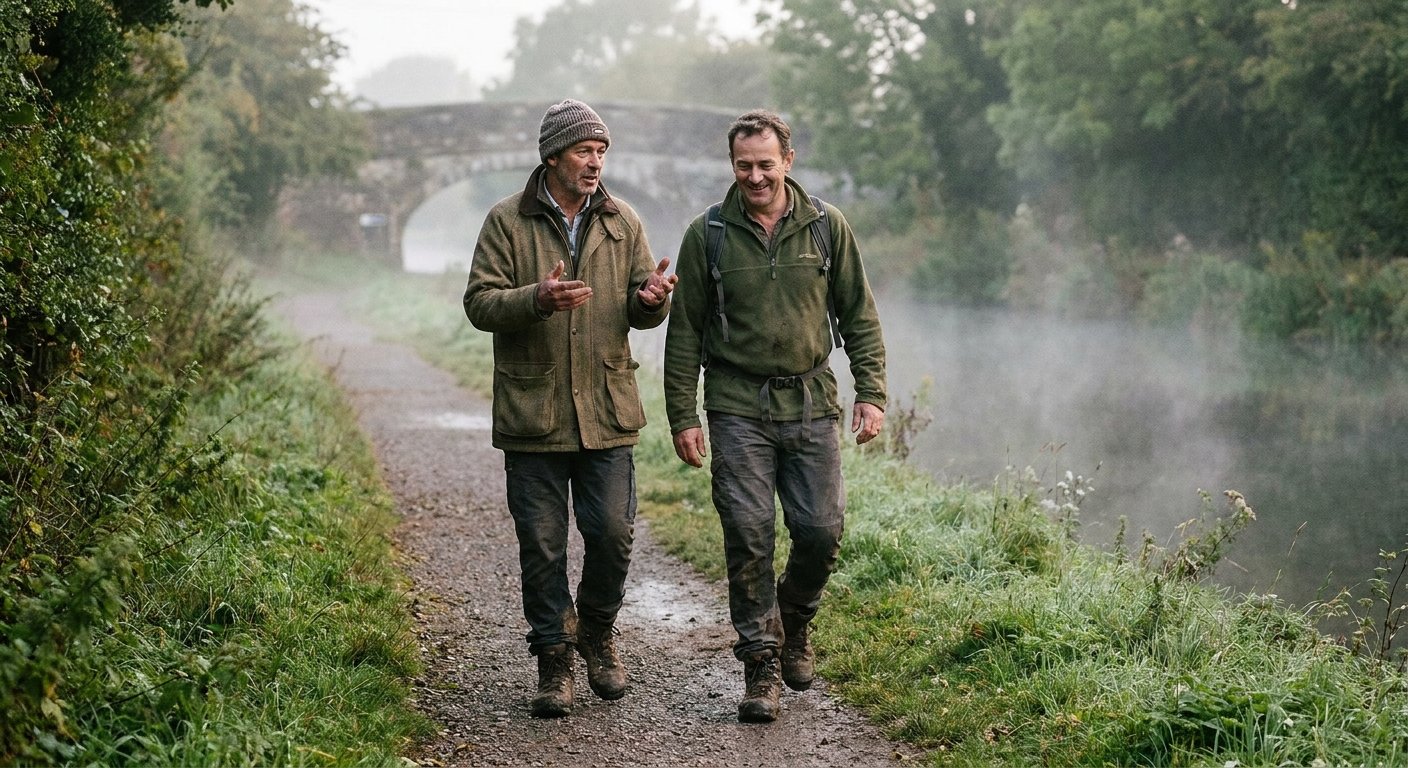
If you've already read why men's walking groups work, you don't need convincing. The question is just: how do you actually start one?
The short answer is that the minimum viable men's walking group is two people, a route they both know, and a time that works every week. That's it. Everything else you can figure out as you go.
This guide walks through the practical steps, from the first message you send to what you do when someone shares something heavy.
The minimum viable men's walking group: two mates, a route, a recurring time
You don't need to recruit a dozen people, build a WhatsApp group, or pick a name. Two men, walking together at a fixed time each week, is a walking group. It's small enough to start immediately and structured enough to actually repeat.
The research supports starting small. A 2015 systematic review and meta-analysis of 42 walking group studies found a mean adherence rate of 75% across the studies that reported it.[1] That's considerably higher than most exercise interventions. The mechanism is simple: other people expect you to show up. You go because you said you would.
Two people creates that dynamic as reliably as ten. If one person doesn't show, the walk doesn't happen, which actually increases the commitment. Neither person wants to be the one who cancels.
Three is slightly more resilient. If one person is away or ill, two still walk. That small redundancy matters for building habit. But don't wait until you have three confirmed before you start. Start with two and add a third when someone natural comes along.
One fixed time per week matters more than anything else. Not "we'll sort it on WhatsApp each week." Pick the day and time now, treat it like a standing appointment, and protect it. Weekend mornings work best for most groups. People are less likely to have work conflicts or last-minute demands than on weekday evenings.
How to invite men to a walking group without making it weird
This is the part most men overthink. The concern is usually: if I suggest a walk, it sounds like I'm implying something is wrong. Or that I want to have A Serious Conversation. Or that I'm asking for something more than most male friendships usually involve.
The answer is to not frame it that way at all.
Don't pitch it as a wellbeing initiative. Don't mention mental health unless that's the explicit context. Just invite someone for a walk. The conversation follows naturally from the activity. That's the whole point.
The research is clear that men prefer indirect, side-by-side contexts for opening up. A survey by Greene King and Macmillan found that 52% of men feel more comfortable discussing personal issues when side-by-side rather than face-to-face, and that 26% of men said they were most likely to open up during a walk.[2] The walk isn't a therapy session. It's just a better format for real conversation.
A message that works:
"Fancy doing a regular Saturday morning walk? Nothing intense, probably 45 minutes, then coffee. I'm thinking of making it a standing thing."
That's it. You're not asking someone to commit to anything emotional. You're asking them for a walk and coffee. Most people say yes to that.
For an ongoing group, the norm to establish early is a simple weekly check-in rather than formal RSVP. A Tuesday or Wednesday message asking "you in this Saturday?" works better than a group poll. It's low pressure, it's easy to answer, and it keeps the group from developing an admin overhead that makes it feel like work.
If you're worried about inviting someone who might feel self-conscious about pace or fitness level, just say it directly: the walk is easy terrain, easy pace, no pressure. Joining a walking group when you're out of shape covers that anxiety in more detail if you want to share it with someone who's hesitant.
Picking the route, the time, and the cadence for a men's walking group
Route. A good starting route is 2 to 4 miles, on easy terrain, ideally a loop so nobody has to double back, with access by car or public transport and something worth walking to at the end. A coffee shop, a cafe, a pub that opens for breakfast. The social component after the walk matters. It's where a lot of the actual conversation happens.
Avoid routes with navigation complexity when you're starting out. You want the group's mental energy on conversation, not on figuring out where to turn. A familiar local route you already know is better than somewhere impressive you've never walked.
Time. Saturday or Sunday mornings, 8am to 10am, covers most situations. Early enough that it doesn't eat the whole morning. Late enough that nobody's dragging themselves out of bed. Most men's walking groups that stick tend to settle into early weekend mornings within the first month, even if they start at a different time.
Weekday mornings before work can work if the group is disciplined, but they're more vulnerable to cancellation. A client call, a school run, a late finish the night before. Weekend mornings are more protected.
Cadence. Weekly is the format that sticks. A Hanson and Jones analysis of walking group studies found that the social commitment structure is the primary adherence mechanism.[1] That structure weakens considerably at fortnightly and almost disappears at monthly. You stop thinking of it as a regular thing and start treating it as an occasional event, which means it's always slightly optional.
If weekly feels too much right now, commit to fortnightly but build in a rule: if more than half the group wants to walk on the off-week, they can. You'll often find the group naturally drifts toward weekly once it gets going.
Only commit to what you'll genuinely do. An honest fortnightly walk that happens reliably is far more valuable than an aspirational weekly walk that falls apart after month two.
Setting the conversational norm for a men's walking group
Conversational norms determine whether a walking group stays a nice routine or becomes something more useful. You don't need to announce them. But having a few unspoken rules established early makes a real difference.
What's said on the walk stays on the walk. This doesn't need to be announced formally. Just act on it consistently. If someone mentions something personal during the walk, don't bring it up outside the group without permission. That norm establishes itself quickly when people see it being followed.
You can come and just listen. Not every walk will involve deep conversation. Some weeks someone will be quieter than usual. That's fine. Nobody needs to perform openness. The walk itself is the value, and conversation that emerges from it is a bonus.
No unsolicited advice. This one is harder for some men than others. When someone shares a problem, the instinct is to fix it. Resist that. Ask questions instead. "What are you going to do?" is more useful than "what you should do is." If someone wants advice, they'll ask for it.
One technique borrowed from men's circles that works well in a walking group context: start each walk with a brief round where everyone rates their week on a scale of one to ten, with no elaboration required. It's a low-stakes check-in that gives everyone a chance to signal how they're doing without having to volunteer a full explanation. A three out of ten creates space for conversation later if someone wants it. An eight out of ten is fine too.
None of this requires the group to be formal or therapy-adjacent. You can talk about football, work, cars, whatever. The research on Men's Sheds found that the health benefits came precisely because health was not the explicit purpose. The activity was the point.[3] That "health by stealth" dynamic appears in walking groups too. The conversation that matters often happens twenty minutes in, when everyone's relaxed and moving, not as a stated agenda item.
What to do when your men's walking group doesn't open up at first
Almost every walking group founder goes through a version of this. You've done the legwork, the route is good, the group is assembled, and for the first few weeks everyone talks about work, sport, and the news. Nothing deeper.
This is completely normal. Don't force it.
The walk-and-talk dynamic takes time to develop. Trust builds through repeated, low-stakes contact. You need several sessions of talking about nothing much before the more significant conversations start to emerge. Trying to accelerate that by steering the group toward deeper topics usually backfires. People feel managed.
A 2021 qualitative study on Men's Sheds noted that men frequently reported that meaningful connection and wellbeing improvements came gradually, through regular participation in shared activity, not through any particular moment or intervention.[3] The pattern is consistent across men's group formats: the threshold lowers over time. Weeks two and three feel like small talk. By month two, people are often more candid than they expected to be.
Even if the conversation stays at the surface level indefinitely, the walking group is still doing something. A 2025 randomized pilot study found that walking side-by-side with another person produced greater improvements in anxiety and psychological distress than conventional indoor conversation, even when the content of the conversation wasn't specifically therapeutic.[4]
The format is doing work even when it doesn't feel like it.
What to do when someone in your walking group shares something heavy
At some point, someone in the group will share something serious. A relationship breakdown, a health scare, a mental health struggle, a bereavement, job loss. It happens in most groups that run long enough. Here's how to handle it.
Listen first. Don't fix. Your job in that moment is not to solve the problem. It's to hear it. Most men who open up about something difficult are not looking for advice. They're looking to not be alone with it. Let them finish. Don't jump in with a solution.
Acknowledge what you heard. "That sounds really hard" is enough. You don't need the perfect response. You need to show that what they said landed.
Ask what kind of support they want. This is a practical question, not a therapy technique. "Do you want to talk it through, or just have it said?" gives the person control. Some people want advice. Some just needed to say it out loud.
Know when to signpost. If someone describes something that sounds like a crisis, severe depression, or a danger to themselves or others, your role is to listen and then gently point toward professional support. You are not a therapist. You don't need to be. But you can say: "I think this is bigger than a walk can fix, and I think talking to someone professional might help. Would you consider it?"
Research on why men avoid professional help identifies stigma, distrust of formal services, and reluctance to appear vulnerable as the main barriers.[5] A trusted person in a trusted context is often what gets someone to that first step. You don't have to have the answers. You just have to be the bridge.
Save the crisis resources listed at the end of this post in your phone before the group starts, so you have them when you need them.
For more on the evidence behind walking as a therapeutic context, walk-and-talk therapy: what the evidence says covers the research in depth.
Growing your men's walking group from 3 to 10+
Most groups grow naturally. You mention the walk to someone, they ask to join. Someone brings a mate. The group expands without any formal effort.
When to add new members: when the group feels stable and consistent, usually after three or four months. Adding people too early, before the culture is established, means the norms get reset with every new person. Wait until the group has a character before inviting strangers into it.
How to add people: bring-a-mate weeks work well. One Saturday a month, everyone can bring someone new. Low stakes for the new person because they're coming with someone they know. Low stakes for the group because it's not a permanent commitment either way.
Other routes for finding new members: local community Facebook groups, the noticeboard at a GP surgery or community center, the end of a local parkrun, or a post at a local gym. Keep the post simple. "Men's walking group, Saturday mornings, casual pace, coffee after. All welcome." No mission statement required.
The number to watch is around twelve. Beyond twelve walkers, the dynamic changes. Side-by-side conversations happen in pairs or small clusters rather than the whole group, which is fine, but the intimacy that makes the format work starts to dilute. Some groups solve this by splitting into two parallel groups that occasionally combine for a bigger walk. Others keep attendance loosely capped.
You don't need to formalize any of this. Just pay attention to when the group starts feeling large, and be thoughtful about adding new people at that point.
How Motion's tools support a men's walking group between walks
The walk is the core of the group. But what keeps men connected between walks matters too, especially in the early months when the group is still building its habit.
Motion's Activity Battles are a practical way to maintain group momentum between Saturday walks. You challenge a group member to a week-long step competition, and the scoring is effort-based, not absolute. Both competitors are judged on what percentage of their personal goal they hit, not who walks more steps. That matters for a group with different fitness levels. A man at 3,000 steps a day can beat someone doing 12,000 if he hits his personal target and the other person doesn't.
The friend invite system makes it easy to connect a small group on the app when you're starting out. Three or four of you in the same battle creates a shared stake in the week, without anyone needing to be physically together.
Motion's Discord community also connects you with a broader group of walkers who use the app, with daily check-ins and accountability partners at every fitness level. If you're building something local but want the wider context, it's there.
And if your group members are scattered or some live further away, online walking groups covers how to build connection around walking without being in the same location.
Start this week
Pick one person. Send a message today. Suggest a route you both know and a time next weekend that works.
That's it. That's the whole first step.
The walk after that is up to the two of you.
If you or someone in your group needs support:
- UK: Samaritans — 116 123 (free, 24/7) — samaritans.org
- US: 988 Suicide and Crisis Lifeline — call or text 988 — 988lifeline.org
- UK: CALM (men-focused) — 0800 58 58 58 — thecalmzone.net
Sources
- Hanson & Jones (2015). Is there evidence that walking groups have health benefits? A systematic review and meta-analysis. British Journal of Sports Medicine.
- Greene King & Macmillan Cancer Support (2025). Shoulder to Shoulder: half of men feel more comfortable having difficult conversations shoulder-to-shoulder.
- Misan et al. (2021). Men's Sheds as a health promotion setting: a qualitative study. BMC Public Health.
- Dickmeyer et al. (2025). Walk-and-Talk Therapy Versus Conventional Indoor Therapy for Men With Low Mood: A Randomised Pilot Study. Clinical Psychology & Psychotherapy.
- Seidler et al. (2024). Why do young men not seek help for affective mental health issues? A systematic review. European Child & Adolescent Psychiatry.
- U.S. Surgeon General (2023). Our Epidemic of Loneliness and Isolation: The U.S. Surgeon General's Advisory on the Healing Effects of Social Connection and Community.


