
The Benefits of Walking 20 to 30 Minutes a Day
Yes, 20 to 30 minutes of daily walking is enough to matter. It roughly matches the World Health Organization's 150-minute weekly target, the same maths behind the NHS's marathon-a-month scheme. Regular activity is linked to around a fifth lower depression risk, and inactivity is linked to one in six UK deaths.

Part of our walking guide. It also underpins our Movement 26.2 guide to the NHS's new walking scheme. That scheme is built on roughly this same amount of daily walking.
If you've ever wondered whether a walk this short really counts, or whether the numbers are just marketing, this page is the evidence file. Every figure links to where it comes from: NHS guidance, government data, or peer-reviewed research. Nothing here is dressed up, and nothing needs to be. Twenty to thirty minutes a day turns out to be a genuinely useful amount of activity. It's not a compromise, and it's not a consolation prize for people who can't manage more.
- UK deaths linked to physical inactivity
- 1 in 6
- Adults in England classed as inactive
- 11.8 million
- Of healthy life from walking 30 min, 5x a week
- Up to 4 years
- The WHO's weekly activity guideline
- 150 min
Is walking 30 minutes a day enough exercise?
Yes, for most adults it's enough to meet the main global guideline for physical activity.
The World Health Organization recommends at least 150 minutes of moderate-intensity activity a week for adults. Spread evenly across seven days, that's just over 21 minutes a day. Walk 30 minutes five days a week and you hit 150 minutes exactly, with two rest days spare.
That framing is catching on. The workplace programme for National Fitness Day asks businesses to get staff moving for 20 minutes a day, which lands in the same territory from the other direction.
Pace matters more than the exact minute count. NHS guidance on walking for health describes brisk, moderate-intensity walking as roughly 3 mph. That's a pace where you can still hold a conversation, but you couldn't sing along to a song. The same guidance confirms that a brisk 10-minute walk already counts towards your weekly total. The 30 minutes doesn't need to happen in one unbroken block.
Here's how that stacks up against the official activity ladder.
| Activity level | Weekly minutes |
|---|---|
| Officially inactive (Sport England) | Under 30 minutes a week |
| Walking 20 minutes a day | About 140 minutes a week |
| WHO recommended level | 150 minutes or more a week |
Workings: 20 minutes × 7 days = 140 minutes a week.
In the year to November 2025, 11.8 million adults in England, nearly a quarter of the population, did less than 30 minutes of activity a week, according to Sport England's Active Lives survey. Twenty minutes a day alone gets you within 10 minutes of the WHO's guideline. It also puts you a long way clear of that official inactive threshold: under 30 minutes a WEEK, not a day.
So the honest answer is that 20 to 30 daily minutes doesn't sit vaguely below the guideline. Depending on how many days a week you manage it, it sits at or very close to it.
Why does the NHS think a marathon a month is the right amount?
Because the maths behind Movement 26.2 starts from the same 150-minute guideline this page is built on.
HuffPost UK reports the scheme's own reasoning: "The WHO recommends 150 minutes of moderate activity a week. We realised that adds up to roughly the distance of a marathon every month." It's the same logic this page runs on, just turned into a distance instead of a number of minutes.
Here's that working shown out. At a brisk 3 mph, 150 minutes a week comes to 7.5 miles (150 ÷ 60 × 3). Over a 30-day month, that's about 32 miles, more than a full marathon distance of 26.2 miles. So the scheme's 26.2-mile monthly target is a gentler on-ramp than the full WHO guideline, not a harder version of it.
Our beginner's guide to walking a marathon a month works the sum the other way round. At 3 mph, 26.2 miles takes about 8 hours 45 minutes of walking across a month, roughly 120 minutes a week. That's about 80% of the WHO's 150-minute guideline. A marathon a month gets you most of the way there without asking for the full amount straight away. For the full picture of the scheme itself, see our Movement 26.2 guide.
What are the physical health benefits of walking 20 to 30 minutes a day?
Substantial, and backed by some of the starkest public health numbers around inactivity.
Physical inactivity is linked to 1 in 6 deaths in the UK, according to the government's own health guidance. It's also estimated to cost the NHS around £0.9 billion a year. Those numbers exist because so much of the population falls well short of the activity that would change them, not because walking is a minor detail of good health.
Sir Brendan Foster helped design the Movement 26.2 scheme. He told the BBC that walking 30 minutes, five times a week, could add up to four years of healthy life. That's not a claim about a single walk. It's what the habit is worth over time, exactly what 20 to 30 daily minutes is designed to build.
The step evidence backs this up from a different angle. Harvard Health reports on a JAMA study where women who averaged 4,400 steps a day had a 41% lower mortality rate than those averaging 2,700. The benefit levelled off around 7,500 steps a day.
A much larger review has since pointed the same way. In 2025, researchers pooled 57 studies across more than ten countries in The Lancet Public Health and found that walking 7,000 steps a day was associated with a 47% lower risk of death from any cause compared with 2,000, with the curve largely flattening after that. They also found meaningful gains simply going from 2,000 to 4,000 steps, which is roughly what a single daily walk adds.
A 20 to 30-minute walk on top of a normal day's activity typically adds about 2,000 to 3,375 steps. Most days, that's enough to land you inside the range where the evidence shows a real benefit, nowhere near a five-figure step count. Our guide to walking 7,000 steps a day covers that research in full.
What does walking do for your mental health?
It's linked to a measurably lower risk of depression, even at doses well below the full guideline.
A study pooling data across many trials (a dose-response meta-analysis) published in JAMA Psychiatry found that adults getting half the recommended level of activity had an 18% lower risk of depression than adults who did none. Adults meeting the full recommended level had a 25% lower risk. The researchers estimated that 11.5% of depression cases could have been prevented if everyone met the guideline. They concluded that "relatively small doses of physical activity were associated with substantially lower risks of depression."
That half-dose finding matters here. Half of the WHO's 150-minute guideline is 75 minutes a week. The marathon-a-month average of roughly 120 minutes a week sits comfortably between the half-dose and full-dose figures above. You don't need to hit the full 150 minutes before the mental health benefits start showing up. Twenty to thirty minutes most days already puts you well inside the range where the evidence shows a real effect.
For more on the connection between activity and mood, see our guide to fitness and mental health.
Do you have to walk the 30 minutes in one go?
No. Splitting it up works just as well.
NHS Better Health says plainly that "walking briskly, even for 1 minute, counts as exercise" and that "every minute of activity counts, and the more you do, the more you'll benefit." The NHS built its free Active 10 app around exactly this idea, timing brisk 10-minute stretches rather than asking for one long walk.
That matches how most people actually fit walking into a day. None of these need to feel like "exercise" at the time, and together they can easily add up to your 20 or 30 minutes.
- A walk to the school gates
- A loop around the block at lunch
- A stroll to the shops in the evening
Our full look at whether short walks count goes through the evidence in more depth, including how the official guidance on this has changed in recent years.
What does 20 to 30 minutes of walking actually look like?
Here's what 20 and 30 minutes of brisk daily walking add up to, using the NHS's benchmark pace of about 3 mph.
| Daily walk | Distance a day | Steps a day | Distance a month |
|---|---|---|---|
| 20 minutes | 1.0 mile | ~2,000-2,250 | ~30 miles |
| 30 minutes | 1.5 miles | ~3,000-3,375 | ~45 miles |
Workings: minutes ÷ 60 × 3 mph = miles a day. Steps use the 2,000-2,250 steps-per-mile range from Harvard Health and peer-reviewed step-count research. Distance a month = distance a day × 30.
Both rows clear the Movement 26.2 monthly target of 26.2 miles comfortably, with room to spare even on a day you skip entirely.
Twenty minutes a day is close to the distance in our walking 1 mile a day guide. See that page if you want to look at what this specific distance does on its own. Want to push a little further? Forty minutes a day gets you to around 2 miles, covered in our walking 2 miles a day guide.
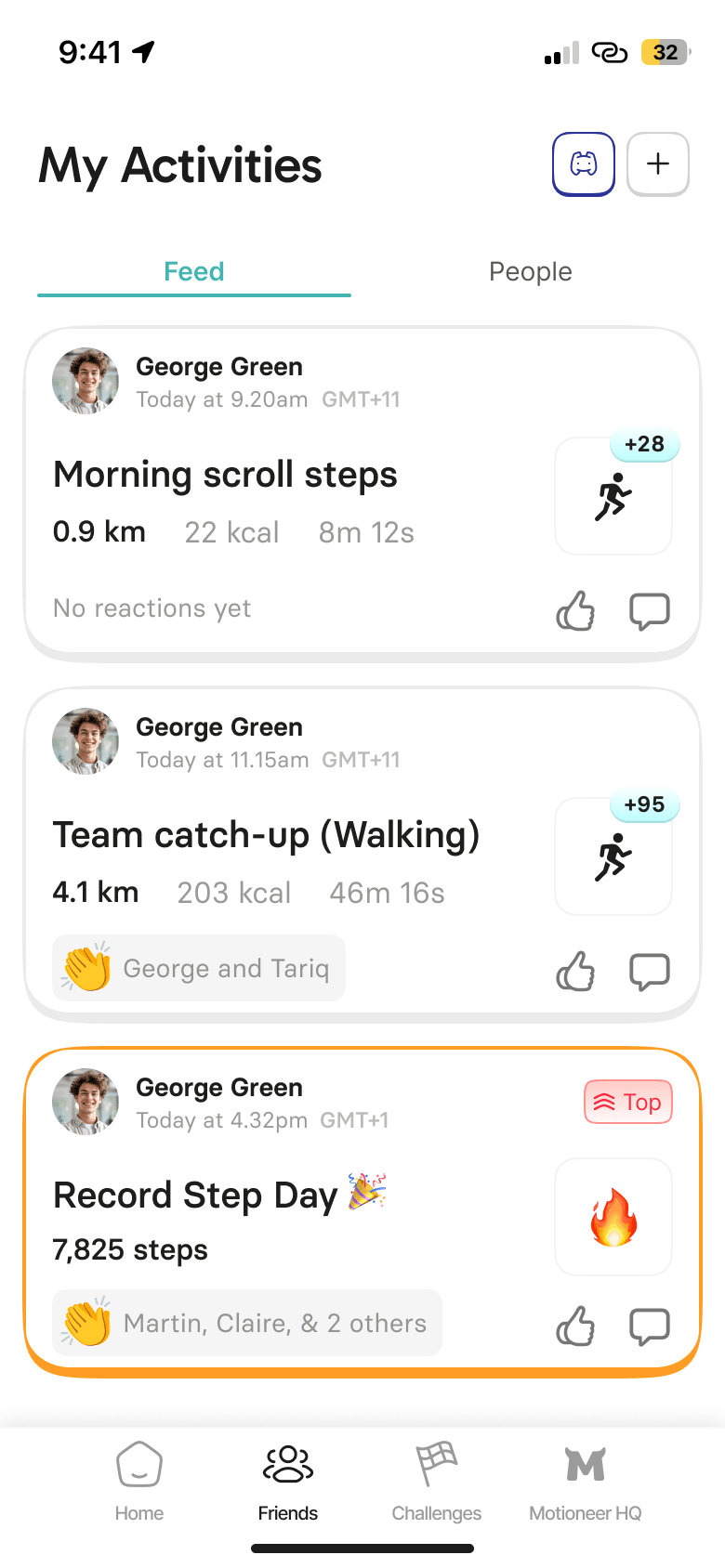
If remembering to walk is the hard part rather than the walking itself, that's what streaks are for. Motion works alongside the NHS Movement 26.2 challenge by turning a daily 20-minute walk into something you track without thinking about it, rather than one more thing to remember.
Continue exploring the evidence
Movement 26.2: what it is and how it works
The full explainer on the NHS's marathon-a-month walking scheme, and how its target lines up with this page's numbers.
Read moreWalking a marathon a month: beginner's guide
A gentle four-week build-up plan for reaching 26.2 miles a month, plus what to do when you miss a few days.
Read moreDo short walks count?
The evidence on splitting your daily walking into shorter chunks, and why the old 10-minute rule was dropped.
Read moreBenefits of walking 20 to 30 minutes a day: FAQs
If you have anything else you want to ask, reach out to us.
Is walking 20 minutes a day enough?
It's most of the way there, and well past the official inactive threshold. Twenty minutes a day comes to about 140 minutes a week, close to the 150 minutes of moderate activity the World Health Organization recommends. The official 'inactive' threshold is under 30 minutes a WEEK, not a day, according to Sport England's Active Lives survey. That puts 20 daily minutes a long way clear of it.
Is walking 30 minutes a day enough to lose weight?
It burns a modest number of calories rather than a dramatic one, so treat it as one part of managing your weight rather than the whole plan. For the full calorie maths by weight and pace, see our guide to calories burned walking a marathon. The benefits covered on this page, lower risk of early death and depression, are about the activity itself, not about the number on the scale.
Do you need to walk briskly for the benefits?
Brisk is the benchmark most of the evidence on this page uses, and it's roughly where moderate-intensity activity starts. NHS guidance describes brisk walking as around 3 mph, fast enough that you can still talk but couldn't sing. The NHS's free Active 10 app is built around counting exactly these brisk minutes.
Can you split the 30 minutes into shorter walks?
Yes. The World Health Organization removed its old 10-minute-minimum rule in 2020. Its updated guidelines confirm that activity no longer has to be accumulated in bouts of at least 10 minutes to count. See our full look at whether short walks count for the evidence.
Is 30 minutes a day better than 10,000 steps?
They're different ways of measuring similar activity rather than competing targets. Harvard Health reports that real benefits appear from around 4,400 total steps a day, well short of the popular 10,000 figure. A 20 to 30-minute daily walk, added on top of your normal daily movement, typically lands you inside that beneficial range without needing a five-figure step count at all.

Start your marathon this month - free
Twenty to thirty minutes of daily walking is already enough to matter. Motion turns that habit into visible streaks and a goal that flexes with your week, and works alongside the NHS Movement 26.2 challenge without being an official part of it. See the full Movement 26.2 guide.

