
WeWard Alternatives in 2026: A Fair Look at Motion vs WeWard
WeWard pays you (modestly) to walk. Motion motivates with effort-based competition and gentle gamification, no points to grind and no cash at stake. Here's an honest comparison so you can pick the right walking app for your group.

What is WeWard, and who is it best for?
WeWard is a French-built "walk-to-earn" app (launched in 2019)[1] that tracks your daily steps with your phone's pedometer or a connected tracker and rewards you with a points currency called "Wards." Hit daily step thresholds (roughly 2,500 up to 20,000 steps) and beat your weekly average and you can earn up to about 25 Wards a day. Around 1,000 Wards is worth roughly $10, which you can cash out via PayPal or Venmo, spend on gift cards and discounts from hundreds of brand partners, or donate to charity.[2] On top of that it layers gamification (XP, levels, leagues and leaderboards, collectible "WeCards," weekly challenges) and social features (friend challenges and a global leaderboard).
To be clear and fair: WeWard is a legitimate, payout-honoring product, not a survey or rewards scam. Multiple independent reviewers confirm real cash and gift cards arrive, and the company reports more than $50M transferred to over 30M users across 29 countries,[3] with strong app-store ratings (~4.9 stars from 87K+ reviews on the US App Store).[4]
Where WeWard genuinely shines
- It actually pays out. The rewards are real, redemption is flexible (cash, hundreds of brand gift cards and discounts, or charity), and the brand reports $50M+ transferred to users.
- Extrinsic motivation can nudge steps up. WeWard reports an average step increase of around 24% among users,[5] and a small payout is enough to get some people walking more.
- Free to start, no hardware required. It works off your phone's pedometer, so there's nothing to buy to begin earning.
- Feel-good options. The charity and sustainability framing (CO2 averted, donations) gives it a purpose beyond a personal payout.
If you're a reward- or deal-driven casual walker who wants a small payoff or a charity contribution for steps you already take, WeWard is a well-built fit. The honest caveats: rewards are slow and grindy (roughly 100 days at 10,000 steps a day to earn $10, and earning visibly slows after the first payout), tracking is mostly phone-pedometer based (no carried phone, no credit), and the leaderboards reward whoever walks the most. If a payout grind is not what motivates you, an effort-based step challenge app may suit you better.
WeWard vs Motion: side-by-side comparison
The core difference is the engine. WeWard runs on extrinsic, financial reward (get paid to walk), while Motion runs on effort-based competition and no-punishment gamification. One pays you points. The other makes mixed-ability competition fair and fun. Here's how they line up as of 2026.
| Dimension | WeWard | Motion |
|---|---|---|
| Price | Free; optional Premium ~$5.99/mo or ~$46.99/yr + in-app purchases (as of 2026) [6] | Free to download and play; optional premium subscription, no money staked |
| Friend & group challenges | Yes, friend challenges plus global and league leaderboards | Yes, weekly activity battles with friends, family, and teams |
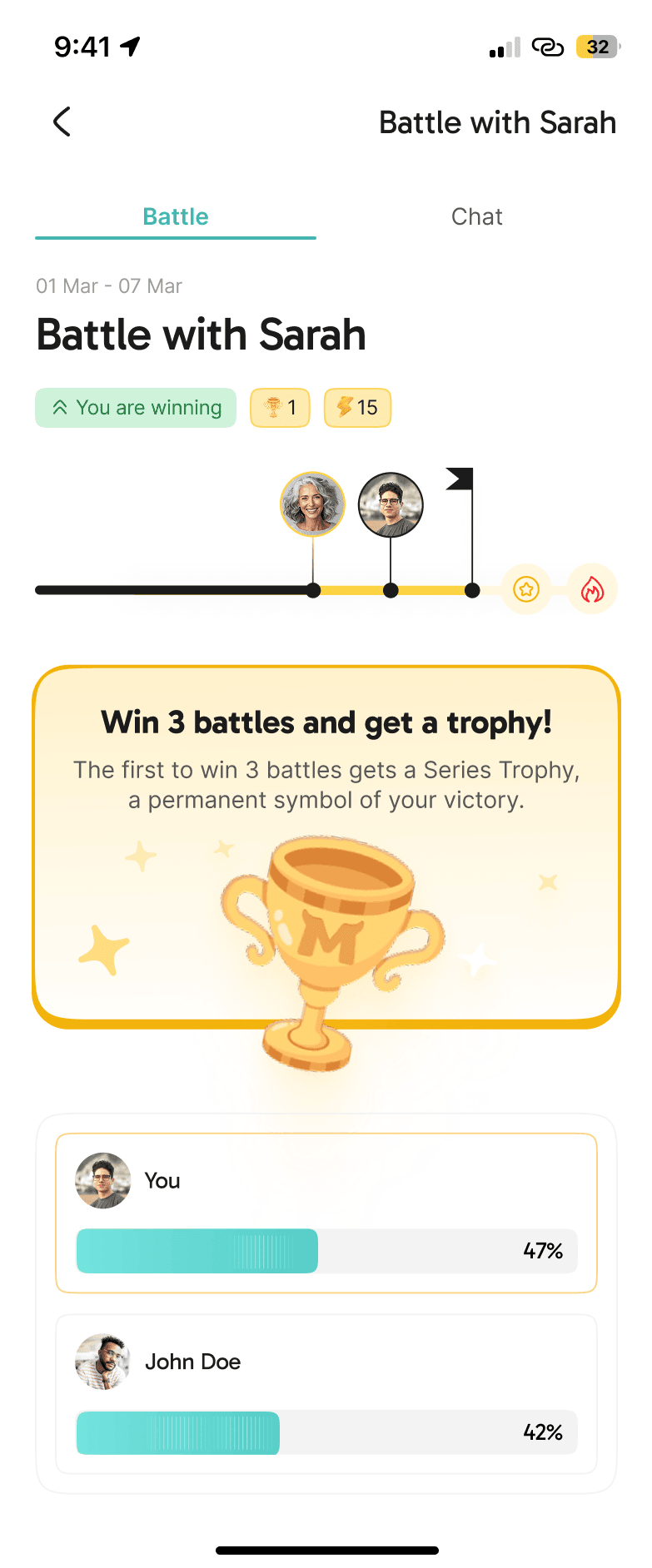
| How competition is scored / fairness | Absolute: rewards total steps walked; escalating goals and timed challenges favor the fittest | Effort-based: scored on the % of your own adaptive goal, so a beginner can out-compete a marathoner |
| Trackers supported | Phone pedometer, Apple Health, Google Fit, Fitbit, WeWard Sense (limited smartwatch support) | Apple Health/Watch, Fitbit, Garmin, Google Fit, and more |
| Platforms | iOS, Android | iOS, Apple Watch, Android |
| App Store rating | ~4.9/5, 87K+ reviews (US App Store); ~3.9/5 on Google Play [7] | 4.6/5 App Store |
| Motivation engine | Extrinsic / financial (earn "Wards" redeemable for cash, gift cards, charity) | Effort-based competition + gentle gamification (pets, Fit Bingo, community) |
| Best for | Reward/deal-driven casual walkers who want cash, gift cards, or charity donations for steps | Mixed-ability friend groups, families, beginners, restarters, and women 40+ who want warm, free motivation |
When Motion is the better choice than WeWard
WeWard is a strong pick if a small cash or gift-card payout is what gets you moving. But there's a specific situation where Motion is clearly the better fit: a mixed-ability friend group, family, or workplace team that wants a fun, fair, encouraging challenge rather than a payout grind.
WeWard's leaderboards and escalating goals reward absolute step volume, so the fittest person almost always wins, and beginners, women 40+, or anyone restarting after a break get left behind (and may be priced out of timed challenges like "8,000 steps in an hour" that they physically can't hit). Its motivation is also extrinsic: once payouts feel too small, engagement tends to drop. Motion is built differently, which is why it fits exactly the audiences WeWard under-serves.
Effort, not raw steps
Motion scores the percentage of your own adaptive goal you hit, so a beginner walking 4,000 steps can out-compete a marathoner in the same weekly battle. That's real fairness for groups with wildly different fitness levels, not a leaderboard the fittest person always tops.
Gentle gamification
Motmot pets thrive when you move but never die or punish you when you don't. Add Fit Bingo and a moderated community where 500 steps is celebrated like 50,000. An off week costs you nothing, no lost points, no grind to recover, just pick back up tomorrow.
Intrinsic, not a payout grind
WeWard's model leans on a slow grind for modest cash and an upsell ladder of Premium and card packs. Engagement fades once the payout feels too small. Motion keeps people for the fun, the friends, and the encouragement, not the fear of missing a few cents.
Which should you choose?
There's no single winner here, it comes down to what actually motivates you.
Choose WeWard if you're reward- or deal-driven, you walk fairly consistently anyway, and a small cash payout, gift card, or charity donation is the nudge that gets you out the door. The payout is its genuine strength, and it delivers on it honestly, just slowly.
Choose Motion if you want to run step challenges with friends where mixed fitness levels compete fairly, you'd rather not chase a points grind, or you want motivation that feels warm and fun rather than transactional. Motion suits women 40+, beginners, restarters, and families especially well, the people for whom an absolute-step leaderboard is more demoralizing than motivating.
To set up a fair head-to-head with your group this week, use our free step challenge builder.
WeWard alternatives: frequently asked questions
If you have anything else you want to ask, reach out to us.
Is WeWard free?
Yes. WeWard is free to download and use on iOS and Android, and core step-earning is free. That said, it monetizes through ads and upsells: as of 2026 there's an optional Premium subscription (reported at about $5.99/month or $46.99/year) plus à la carte in-app purchases like card packs ($0.99–$8.99) and XP or repair boosters (~$0.99). Motion, by contrast, is free to download and play with no points to grind and no money staked.
What's the best WeWard alternative?
For mixed-ability groups who want fun, fair challenges without a payout grind, Motion is the strongest WeWard alternative. If you specifically want to be paid for walking, other walk- and move-to-earn apps like Sweatcoin are the closest match. Motion uses personalized, effort-based goals so everyone competes fairly, plus gentle gamification and a supportive community, all free to play. If a money stake for accountability is what you want, StepBet-style apps are worth a look instead.
Can I do step challenges with friends on WeWard?
Yes, WeWard has friend challenges, but they score absolute steps walked, so the fittest person almost always wins. Escalating goals and timed challenges can leave beginners or less-mobile friends behind. If you want challenges where mixed fitness levels compete fairly, Motion runs weekly activity battles scored on effort, not raw step totals.
How is Motion different from WeWard?
The core difference is the motivation engine: WeWard pays you points for steps, while Motion scores you on the effort you put in relative to your own goal. WeWard runs on extrinsic reward: earn 'Wards' for steps and redeem them for cash, gift cards, or charity. Motion runs on effort-based competition, so a beginner can out-compete a much fitter friend in the same battle. Motion also adds no-punishment gamification (Motmot pets, Fit Bingo, a celebratory community) and is free to play, with no points grind and no money at risk.
Does WeWard actually pay you to walk?
Yes, WeWard pays out real money and gift cards, but earnings are slow: roughly 1,000 Wards equals about $10, which takes around 100 days of 10,000 steps a day. WeWard is legitimate (the brand reports $50M+ transferred to users) and redemption is flexible across cash, gift cards, and charity. Earning also visibly slows after your first payout. Think of it as a small bonus for steps you'd take anyway, not a meaningful income.
Why might WeWard not work for an older or beginner walker?
Because WeWard scores absolute steps, so high escalating targets and timed challenges favor whoever walks the most. Goals reportedly climb into the tens of thousands of steps as you level up, with timed challenges like hitting a set count within an hour. For older walkers, beginners, women 40+, or anyone restarting after a break, those targets can be physically out of reach, making competition demoralizing rather than motivating. Apps that score effort instead of raw volume, like Motion, keep everyone in the race no matter their starting point.
Related comparisons and Motion features
Sweatcoin alternatives
Sweatcoin pays a digital currency for verified outdoor steps. See how move-to-earn rewards compare with Motion's effort-based, no-cash challenges.
Read moreStepBet alternatives
StepBet has you bet cash on hitting your own step goals. A look at money-staking accountability versus Motion's no-cash, fun-first model.
Read moreRewards for walking: the honest guide
What each way to get rewarded for walking is really worth, from cash-back apps that pay pennies to the NHS scheme coming in 2027 and habit apps like Motion.
Read more
Your Fitness Journey Starts Here
Download Motion free and discover why this is the fitness app you'll actually keep using. Your future self (and your Motmot) will thank you.

