
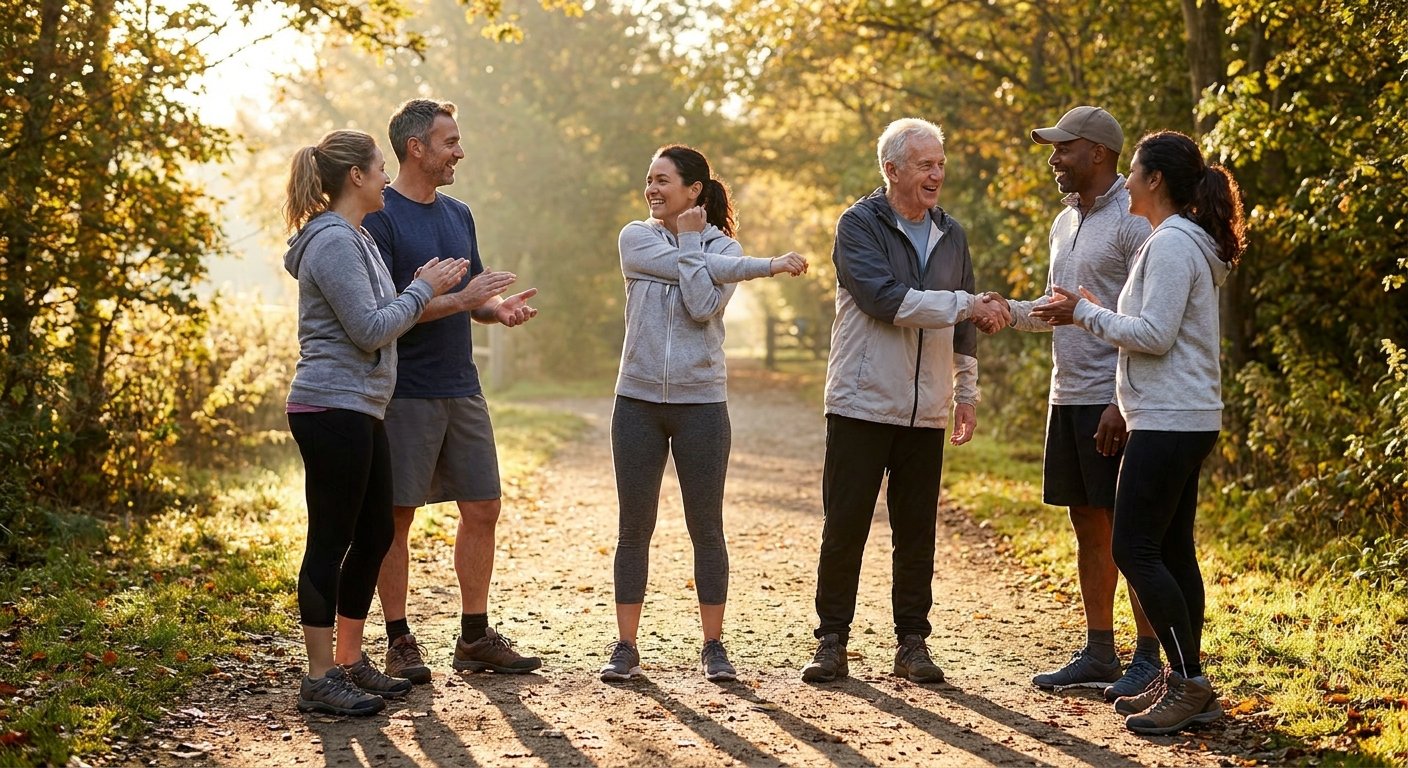
The actual walking is the easy part. It's showing up the first time that trips people up. Not knowing anyone. Not knowing where to stand. Wondering whether you'll be too slow or too out of place.
That hesitation is normal. Research on group walking programs consistently finds that people who get past the first session stick with them at a 75% adherence rate.[1] The problem is the first session.
This post covers both paths: in-person walking groups vs online ones. They're pretty different experiences, and one will suit you better than the other. Read both sections and pick the one that doesn't make you want to immediately cancel.
What a typical in-person walking group meetup looks like
Most first-timers show up not knowing what a walking group meetup actually involves. Here's a realistic picture.
Arrival and the meeting point
Groups usually meet at a trailhead, a parking lot, a park entrance, or a community center. The listing or event page will specify. Arrive 5-10 minutes early. Not because the group will penalize you for being late, but because the walk leader often does a quick headcount and a few words before setting off, and arriving after that moment feels awkward.
When you get there, introduce yourself to whoever's closest and mention it's your first time. Almost every group has a designated walk leader or back-marker whose job is partly to notice new faces. You won't have to hunt them down. They'll come to you.
The Ramblers, one of the UK's largest walking organizations with decades of experience running group walks, recommend letting the walk leader know about any health conditions before you start. Not because it's required, but because it helps them look out for you if anything comes up.[2]
Pace tiers and how they work
Most walking groups of any real size offer multiple pace options: slow, moderate, and brisk. The listing will usually describe the expected pace in minutes per mile, or give a general description like "comfortable conversation pace" versus "brisk cardio pace."
If you're unsure which tier to join, pick the easier one. A walk that's slightly too slow is easy to recover from. A walk where you're gasping to keep up on day one is not a great first impression of the hobby.
Groups in the US typically cover 2-4 miles in a session, taking anywhere from 45 minutes to 90 minutes depending on pace and terrain. The walk leader sets off at the front. A back-marker (an experienced walker) stays at the rear so nobody gets left behind.
During the walk
You don't need to be chatty. Some people walk quietly. Most people talk. The conversation is usually light: where people live, jobs, pets, where they've walked before. Nobody is going to quiz you on your fitness history.
There will be natural rest stops: a viewpoint, a bench, a road crossing. Groups wait for everyone to catch up at these points before moving on. If you need to slow down or stop for any reason, tell the person nearest to you or wave to the back-marker. Groups don't leave anyone behind.
Don't walk ahead of the leader. That's the main etiquette rule that actually matters. The leader knows the route. You don't.
After the walk
Many groups do a coffee or a pub stop afterward. This is genuinely optional. Nobody will track whether you stayed for it. But it's also the part where you're most likely to make a connection that brings you back next week. If your schedule allows, stay for 20 minutes.
What to bring on your first group walk
A practical list for in-person walking groups:
- Footwear: Supportive shoes or walking trainers. No need for expensive hiking boots for a 2-3 mile walk on maintained paths. Just avoid flat-soled canvas shoes for anything longer than an hour.
- Water: Carry at least 500ml. More on warm days.
- Layers: A lightweight waterproof layer takes up almost no space and saves a miserable walk if the weather turns.
- Phone: Charged, with the organizer's number saved. GPS maps are useful if you get separated from the group.
- ID and a small amount of cash: Useful if you end up at the coffee stop or need to get home independently.
- Snack: Not essential for a 2-3 mile walk, but worth having if you've eaten recently or tend to feel shaky on exercise.
You don't need specialized gear. A sensible pair of trainers and a waterproof jacket covers 90% of group walks.
What's expected of you at a walking group
The bar is low. Show up. Pay attention to the leader. Don't surge ahead of the group at the faster tiers and then wait, bored, for everyone else. That breaks the rhythm for other walkers. Stay aware of the pace you signed up for.
If you're struggling, say so. Walk leaders and back-markers are used to this, and they'd rather know than have you drop back silently and get lost.
If you need to leave early, tell the leader at the start. Most groups have a bail-out point midway where you can turn back without disrupting the group's flow.
One thing that surprises first-timers: nobody expects you to know anyone or make friends immediately. Some people join walking groups and stay fairly anonymous for weeks before they connect with someone. That's fine. The structure of the walk does the socializing for you.
What joining an online walking community feels like in the first week
Online walking communities are different in almost every way that matters to anxious first-timers. There's no specific time to show up. No one can see your face. You can participate as much or as little as you want.
If you're worried about pace, fitness level, or whether you'd keep up with a group, online walking communities are worth trying first.
The introduction post
Most online communities, Discord-based ones especially, have an introductions channel. The standard format is simple: your name, where you're from, why you're there. One or two sentences is enough. People respond with a greeting. That's it. No awkward standing-around moment, no pressure to be interesting.
The first week is about as low-stakes as it gets. You can lurk for a few days and read other people's posts before saying anything. The research on online walking communities shows that this kind of self-directed entry is one reason people find them easier to start with.
How weekly step threads work
Many online walking communities run weekly step-count threads where members post their totals at the end of the week. These aren't leaderboards in the competitive sense. People celebrate 3,000 steps just as much as 30,000. The function is accountability and visibility. Knowing you'll post your number at the end of the week is a mild but real motivator to actually walk.
Step threads also give you a quick read on the range of the community. If you see posts from people doing 4,000 steps a week alongside people doing 15,000, you know you're in a group where your starting point won't raise eyebrows.
Challenges between strangers who become regulars
The shift from lurker to participant usually happens around a challenge. Someone posts a step goal for the week. You join in. You both hit it, or you both don't. You commiserate or celebrate. That's how online walking friendships start. Not through introductions, but through shared attempts at something small.
Group walking research consistently finds that social cohesion is the key driver of long-term adherence.[3] Online communities build that cohesion through shared accountability rather than shared physical space. It works differently, but it works.
How Motion's walking community works in practice
Motion's Discord community has a substantial number of walkers, and it runs the way the best online walking communities do: no judgment on numbers, active moderation, and a culture where 500 steps gets the same encouragement as 50,000.
The Activity Battles feature turns a weekly step challenge with a stranger-turned-regular into something with low-key stakes. Both people compete on effort (percentage of their personal weekly goal) rather than raw step counts. So if your goal is 20,000 steps and theirs is 60,000, you're not at a disadvantage from the start. A Motmot is also a reliable conversation starter when you're not sure what else to say.
If you're building up from scratch and want goals that adjust to what you're actually doing rather than a fixed daily target, Motion's adaptive goals do that automatically based on your activity history.
Picking the right walking group format for you
In-person and online walking groups both work. The research on group walking is unambiguous: people who walk with others stick with it longer, enjoy it more, and see better health outcomes than people who walk alone.[1]
The only question is which format you'll actually show up for. If the logistics and social dynamics of an in-person group sound manageable, go. If they don't, an online community gets you most of the same benefits with a fraction of the friction. Pick the one you won't talk yourself out of.
Sources
- Hanson S, Jones A (2015). Is there evidence that walking groups have health benefits? A systematic review and meta-analysis. British Journal of Sports Medicine
- Ramblers (2024). What to expect when you join a Ramblers group walk
- Jenkin CR et al. (2022). Group exercise membership is associated with forms of social support, exercise identity, and amount of physical activity. PMC
- AARP Create the Good (2024). Start a Walking Group
- American Heart Association (2024). Walking: Start or join a walking club
- Ramblers (2024). What to wear when walking
- Tennstedt SL et al. (2016). Adherence to community-based group exercise interventions for older people: A mixed-methods systematic review. Preventive Medicine


