
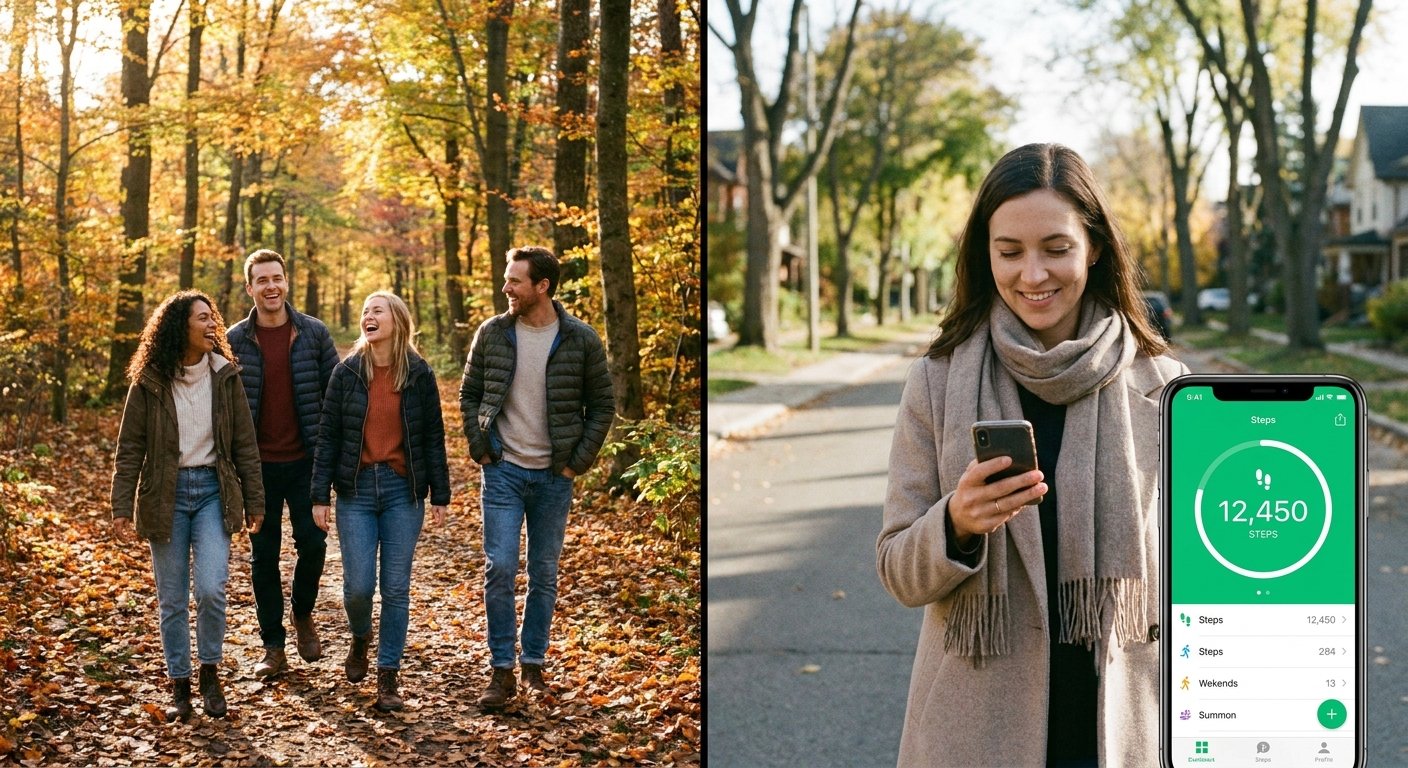
The walking group question has a new dimension now. For most of history, "walking group" meant showing up at the park on Saturday morning. Now it can mean joining thousands of people online who all track their steps, cheer each other on, and keep each other accountable without ever being in the same place.
Both versions work. The research backs them both. But "works" isn't the same as "right for you," and choosing the wrong format is one of the most common reasons people try a group and quietly stop going.
Here's an honest breakdown of what each type actually offers, where each falls short, and how to figure out which one fits your life.
What the research says about in-person walking groups
In-person walking groups have a solid evidence base. A 2015 systematic review and meta-analysis published in the British Journal of Sports Medicine examined 42 studies covering 1,843 participants and over 74,000 hours of group walking.[1] The results were clear: participants saw significant improvements in blood pressure, cardiovascular fitness, body composition, depression scores, and walking capacity. Average adherence across the studies where it was measured was around 75%.
A 2013 meta-analysis by Kassavou, Turner, and French added to this picture, finding a medium-sized positive effect on physical activity across 19 studies involving 4,572 people.[2] The effect was meaningful and statistically robust.
That's a lot of data saying the same thing: people who walk in groups move more and feel better.
The mechanism isn't complicated. When you have somewhere to be at 8am on Wednesday, with people who expect you, you go. The social obligation built into an in-person group is genuinely powerful. Harvard Health notes that "friends have expectations, and we tend not to want to let them down."[3] That simple accountability keeps you walking on days when you wouldn't go alone.
There's also the environmental piece. Walking outside with other people combines three things that each improve mental health independently: physical movement, social connection, and time in nature. In-person groups deliver all three at once.
When in-person walking groups win
In-person groups are the stronger choice in a few specific situations.
You respond to physical accountability. If "someone's waiting for me" is what gets you out of bed, you need a real meeting point. The obligation to show up in your actual body is harder to ignore than a notification on your phone.
You want local community. The Ramblers in the UK run over 69,000 walks per year through their Wellbeing Walks programme.[4] For people whose primary barrier is loneliness or social isolation, an in-person group can become a core part of their week in a way an online community rarely does. Research on walking group participants has found that for some people, the group is their main social contact. Movement is a means to connection, not the other way around.
You want route variety and local knowledge. Your group knows the scenic route that avoids the traffic lights, where the benches are, and which coffee shop is worth stopping at halfway. That kind of local texture is hard to replicate online.
You're new to regular exercise and benefit from structure. Showing up at a fixed time and place with a set route removes decisions. For someone just starting out, fewer decisions mean fewer opportunities to bail.
If any of these describe you and there's a walking group within reasonable distance, look into it. The how to find a walking group near you guide covers the practical search in detail.
The real barriers to in-person walking groups
The evidence for in-person groups is strong. But a substantial slice of the population faces genuine obstacles that have nothing to do with motivation.
Geography. Rural and semi-rural residents often have no groups within realistic distance. Research has consistently shown that walking group uptake skews toward people who are already socially well-connected and live in areas with adequate provision.[5] If the closest group is 45 minutes away, the barrier isn't willingness.
Scheduling. Walking groups typically meet at fixed times, often weekend mornings or weekday evenings. Shift workers, parents of young children, people with irregular work patterns, or anyone managing health conditions with unpredictable energy levels may simply not be able to commit to a fixed slot. Research on parental barriers to exercise specifically flags guilt and scheduling conflicts as the dominant obstacles.[6]
Social anxiety. Studies on walking group participation have found that the prospect of joining an established group and meeting strangers is a real deterrent for some people, particularly those who are new to exercise or feel self-conscious about their fitness level.[7] Walking at the back of a group while out of breath in front of people you don't know is not an appealing prospect for everyone.
Weather and access. In-person groups get cancelled or thinned out in bad weather. They require you to travel to a meeting point. They may not be accessible to people with mobility limitations who need more control over pace and distance.
These aren't excuses. They're practical constraints that make online formats more suitable for large numbers of people.
What the research says about online walking groups
Online walking groups are newer than in-person ones, so the evidence base is smaller. But what exists is encouraging.
A randomised controlled trial published in the Journal of Medical Internet Research found that adding an online community to a walking programme improved retention rates by 13 percentage points (79% vs 66%).[8] Participants in the online community arm stayed engaged longer and dropped out at roughly half the rate (hazard ratio of 0.47). The study also found that participants who had lower social support at baseline posted more and benefited more, suggesting online communities particularly help the people who are already isolated.
A workplace study comparing virtual and in-person walking programmes found both groups showed comparable improvements in physical activity and fitness after four weeks, with the virtual group showing a slightly larger increase in steps.[9] The virtual format offered scheduling flexibility that the researchers noted may support adherence for people with time constraints.
Broader research on community-based social support interventions confirms that they increase physical activity, and that online delivery can reach populations who can't access in-person options.[10]
When online walking groups win
Online formats have clear advantages in specific circumstances.
You live somewhere without a local group. This is the biggest one. If geography is the problem, online is the obvious answer. You get the accountability and social dimension without needing a group within driving distance.
Your schedule doesn't fit fixed meeting times. Online communities let you check in when it suits you. If you walk at 6am before your shift, or 10pm after the kids are in bed, your online group is there for you in a way a Wednesday-morning in-person group can't be.
You're self-conscious about fitness level. No one can see you out of breath. You can walk at your own pace, on your own route, and share your steps afterward. For people returning to exercise after a long break, or who feel uncomfortable being observed while exercising, this matters.
Weather is a serious issue where you live. Online walking groups work in any weather. You can walk on a treadmill, walk indoors, or walk somewhere that doesn't require travelling to a group meeting point. The accountability doesn't disappear when it rains.
You want to connect with people who share a specific focus. Want to find other people managing the same health condition, at a similar fitness level, or with the same goals? Online communities can be far more specific than whatever local group happens to exist near you. The online walking groups guide covers this in more detail.
In-person vs online walking groups: a direct comparison
| Factor | In-person | Online |
|---|---|---|
| Accountability to show up | High (social obligation) | Moderate (app-based, community check-ins) |
| Geographic access | Limited to local area | Available anywhere |
| Schedule flexibility | Low (fixed times) | High (walk any time) |
| Social connection depth | Deep over time | Broad, lighter initially |
| Weather dependency | High | Low |
| Barrier for newcomers | Can feel intimidating | Lower threshold to join |
| Route variety | Group-led, locally known | Self-directed |
| Cost | Usually free | Usually free or low-cost |
Neither column is obviously better. The right answer depends on which row matters most to your actual situation.
How Motion keeps online walking social
If an online walking group suits your situation better, the experience doesn't have to mean walking alone and watching a step counter.
Motion's Activity Battles let you challenge friends to head-to-head weekly step competitions. The scoring is effort-based: you're competing on what percentage of your personal weekly goal you hit, not who takes more raw steps. A beginner walking 4,000 steps can beat someone walking 12,000 if they're both measured against their own targets. That makes it actually fair across different fitness levels, which is one of the things in-person walking groups often get wrong.
The Motion community on Discord has a lot of walkers in it. It's active, moderated, and runs on a no-judgment culture. 500 steps gets the same celebration as 50,000. For people who want the social check-in and encouragement of a group without the fixed schedule of showing up somewhere, it's a real alternative. If you want something more one-on-one, the virtual walking buddy guide covers how to make that work.
Your Motmot (your digital fitness pet in Motion) also keeps you company between group interactions. It gets enthusiastic when you're consistent, which sounds small until day four of a rainy week when you'd rather stay on the sofa.
You don't have to choose just one
The most effective approach for many people is both. Use an in-person group for the walks when your schedule allows. Use an online community for the weeks when it doesn't. The goal is consistency over time, not purity of format.
If you're starting from scratch, try the format with the lower barrier first. For most people, that's online. Get the habit established, build your step base, and add in-person walks as they become practical.
If you already have a local walking group you love, an online community like Motion can extend the accountability to the days between group walks. The two formats complement each other more than they compete.
Sources
- Hanson & Jones (2015). Is there evidence that walking groups have health benefits? A systematic review and meta-analysis. British Journal of Sports Medicine.
- Kassavou, Turner & French (2013). Do interventions to promote walking in groups increase physical activity? A meta-analysis. International Journal of Behavioral Nutrition and Physical Activity.
- Harvard Health Publishing. Better together: The many benefits of walking with friends.
- The Ramblers. Wellbeing Walks programme: prescribe walking.
- Dougall et al. (2020). Inequities and inequalities in outdoor walking groups: a scoping review. BMC Public Health.
- Rhodes et al. (2017). Overcoming barriers to exercise among parents: A social cognitive theory perspective. Journal of Behavioral Medicine.
- Batsis et al. (2021). Barriers and Motivators to Physical Activity Prior to Starting a Community-Based Walking Program. BMC Geriatrics.
- Richardson et al. (2010). An Online Community Improves Adherence in an Internet-Mediated Walking Program. Journal of Medical Internet Research.
- Smith et al. (2021). Effectiveness and implementation of a virtual versus in-person walking program among employees on physical activity, fitness, and cognition. Health and Technology.
- The Community Guide. Physical Activity: Social Support Interventions in Community Settings.


