
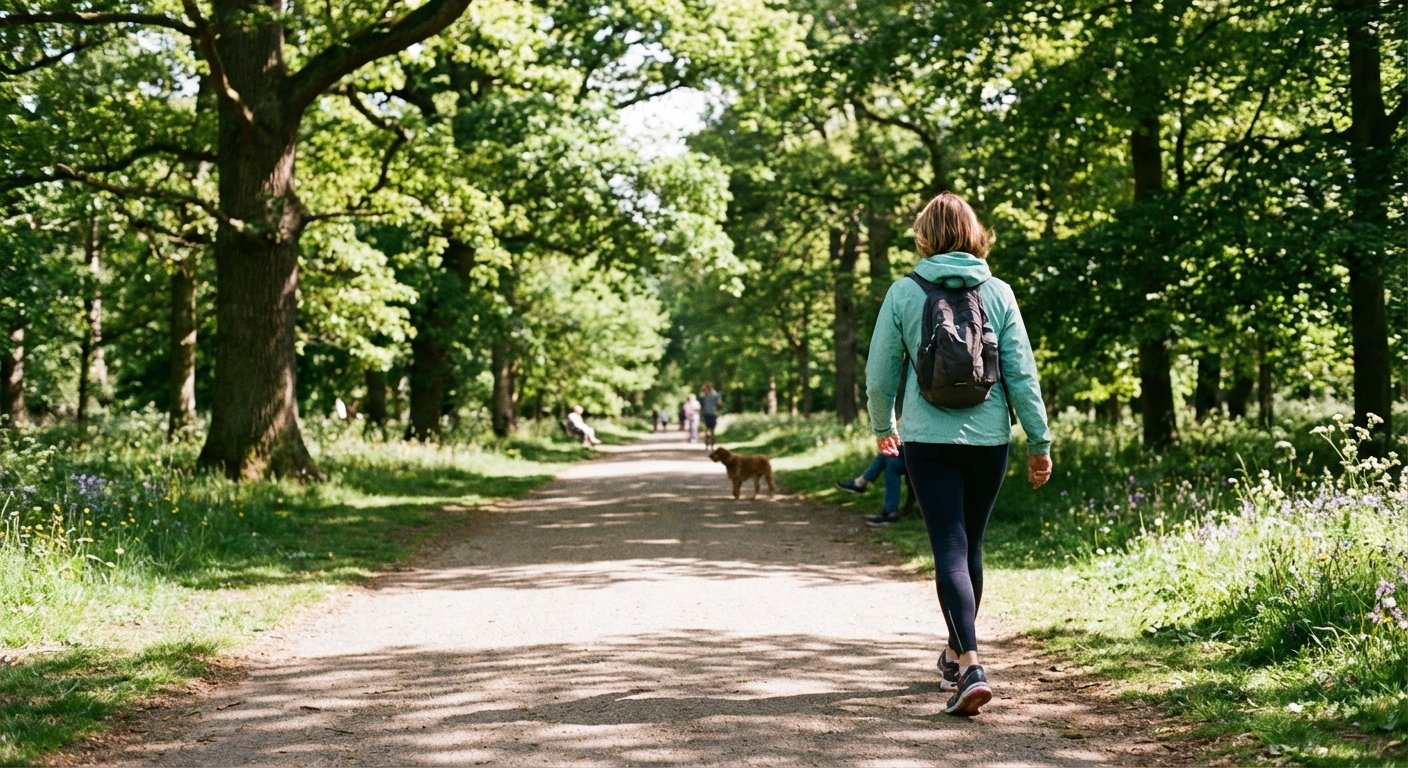
Walking is the most popular form of exercise among perimenopausal women. A survey by the Newson Health Research and Education team found that 79% chose walking as their preferred way to stay active during the menopause transition.
That's not surprising. Walking is free, requires no equipment, fits around your schedule, and doesn't need you to be in any particular shape to start. But most articles about walking and menopause either oversell it ("walking cures everything!") or undersell it ("walking isn't real exercise"). Neither is true.
Here's what the research actually shows.
What walking does well
Mood, anxiety, and depression
This is where walking shines. A 2025 meta-analysis of 21 randomised controlled trials involving over 2,000 menopausal women found that physical activity significantly reduced both depressive symptoms and anxiety [1]. Low-to-moderate intensity activity, which includes brisk walking, was effective across all menopausal stages.
A 12-week pedometer-based walking study found that postmenopausal women who increased their daily steps from around 2,500 to 3,500 saw clear reductions in depression and anxiety scores [2]. That's not a big increase in steps. It's roughly an extra 15-minute walk per day.
Walking outdoors adds another layer. Natural light exposure helps regulate circadian rhythm, which is disrupted by hormonal changes during perimenopause. And if you walk with someone else, the social connection provides its own mental health benefit.
Sleep
Sleep disruption is one of the most common and most debilitating perimenopause symptoms. A 2023 systematic review and meta-analysis in Frontiers in Medicine found that exercise, particularly brisk walking, significantly improved sleep quality and reduced insomnia severity in menopausal women [3]. The benefits were measurable from just 4 weeks and became stronger at 8-16 weeks.
The pedometer-based walking study also found real insomnia improvements [2]. Interestingly, the act of tracking steps seemed to reinforce the habit. Women who could see their daily progress walked more consistently, which matters because sleep improvements depend on regularity, not occasional big efforts.
Heart health
This is the big one that doesn't get enough attention. After menopause, women face a 2-6 times higher incidence of cardiovascular disease compared to premenopausal women of the same age [4]. The protective effect of oestrogen on blood vessels, cholesterol, and inflammation declines during perimenopause, and cardiovascular risk starts climbing years before your last period.
A landmark study in the New England Journal of Medicine followed 73,743 postmenopausal women and found that walking and vigorous exercise produced comparable cardiovascular risk reductions [5]. You don't need to run. Walking does the same job.
A separate study found that postmenopausal women with the highest physical activity levels had a 35% lower incidence of heart failure, with walking being the most common activity reported [6].
The perimenopause window is when cardiovascular prevention matters most. Walking now is an investment in your cardiovascular health for the next 30 years.
Joint pain and stiffness
Over 50% of perimenopausal women report joint pain or stiffness, often in the hands, knees, and hips [7]. Oestrogen has anti-inflammatory properties and helps maintain cartilage, so its decline contributes directly to joint discomfort.
It sounds counterintuitive, but walking helps. Movement lubricates joints, strengthens the muscles that support them, and reduces stiffness. A review in Menopause found that an exercise programme including walking is at the forefront of managing knee osteoarthritis in midlife women [8]. The worst thing for stiff joints is not moving them.
Stress and cortisol
During perimenopause, your body becomes more sensitive to cortisol (the stress hormone). Oestrogen normally helps regulate cortisol, so as oestrogen declines, stress has a bigger physical impact: disrupted sleep, increased abdominal fat storage, higher blood pressure, worse mood.
A systematic review and meta-analysis found that physical activity is an effective strategy for lowering cortisol levels [9]. Walking works well here because it lowers cortisol without spiking it first. High-intensity exercise temporarily raises cortisol before bringing it down. Walking keeps the whole curve gentle, which is exactly what an overstressed system needs.
What walking doesn't do well
Most articles won't tell you this, but honesty matters more than optimism on a topic like this.
Hot flushes
Despite what you'll read elsewhere, the evidence that walking reduces hot flushes is weak. A well-designed randomised controlled trial published in BJOG found that exercise was not an effective treatment for vasomotor symptoms (hot flushes and night sweats) [10]. The researchers were direct: "Women should not be advised that exercise will relieve their vasomotor menopausal symptoms."
A 2024 overview of 17 reviews covering 80 studies and around 9,000 participants confirmed that the evidence for aerobic exercise reducing hot flushes remains inconclusive [11].
Walking has many proven benefits during perimenopause. Fixing hot flushes isn't reliably one of them. If hot flushes are your main concern, talk to your doctor about HRT and other treatments. Walk for the other reasons.
Bone density (on its own)
Walking is a weight-bearing exercise, which is good. But a systematic review and meta-analysis in Menopause found that walking alone has no significant effect on bone mineral density at the lumbar spine, radius, or whole body [12]. The one exception: walking for more than 6 months showed a positive effect on femoral neck (hip) BMD.
The UK "Strong, Steady and Straight" consensus statement is clear: walking is not enough on its own for meaningful bone protection. It needs to be combined with resistance training and impact exercise [13].
This doesn't mean walking is useless for your bones. It contributes. But if bone density is a concern (and it should be for every perimenopausal woman), you need to pair walking with strength training.
Walking needs a partner
Walking is excellent for mood, sleep, cardiovascular health, joint pain, and stress. But it's not a complete exercise programme on its own. The UK consensus on bone health recommends resistance training and impact exercise alongside weight-bearing activity like walking [13].
The ideal combination: strength training 2-3 times per week, with walking on your rest days. Together, they cover everything perimenopause throws at you.
Next in this series: How many steps do you actually need during perimenopause? breaks down the 10,000-step myth and what the research says your real target should be. And a practical 4-week walking plan gives you a starting point that adapts to your energy and symptoms.
How Motion helps
The research in this article points to three things: walking improves mood, sleep, and heart health during perimenopause. Tracking your steps reinforces the habit. And consistency matters more than intensity.
Motion connects to your Apple Watch, Fitbit, or Garmin and sets adaptive weekly goals based on your actual activity history, not an arbitrary number. Had a rough week with broken sleep? Your target adjusts. Had a strong week? It nudges you forward.
Your Motmot (your digital fitness pet) grows stronger when you're consistent, not when you hit some magic step count. And Motion's friend challenges turn your daily walks into friendly competition scored on effort, so your 4,000 steps on a tough day can beat someone else's 10,000.
The evidence says walking works. Motion helps you keep doing it.
Sources
- PubMed: Yue et al. Effects of physical activity on depressive and anxiety symptoms in menopausal women. Meta-analysis of 21 RCTs (2025)
- PubMed: Abedi et al. Effect of pedometer-based walking on depression, anxiety and insomnia in postmenopausal women (2015)
- PubMed: Qian et al. Effect of exercise on improving sleep in menopausal women. Systematic review and meta-analysis (2023)
- PubMed: El Khoudary et al. Menopause Transition and Cardiovascular Disease Risk. AHA Scientific Statement (2020)
- PubMed: Manson et al. Walking compared with vigorous exercise for cardiovascular events in women. NEJM (2002)
- PubMed: LaMonte et al. Physical Activity and Heart Failure in Postmenopausal Women (2018)
- The Menopause Charity: Joint Pain and Muscles
- PubMed: Curry et al. Knee osteoarthritis in midlife women (2022)
- PubMed: De Nys et al. Effects of physical activity on cortisol and sleep. Systematic review and meta-analysis (2022)
- PubMed: Daley et al. Effectiveness of exercise for vasomotor menopausal symptoms. RCT (2015)
- PubMed: Money et al. Impact of exercise on menopause symptoms. Overview of 17 reviews (2024)
- PubMed: Ma et al. Walking and bone mineral density in perimenopausal and postmenopausal women. Meta-analysis (2013)
- PubMed: Brooke-Wavell et al. Strong, Steady and Straight. UK consensus on exercise for osteoporosis (2022)


