
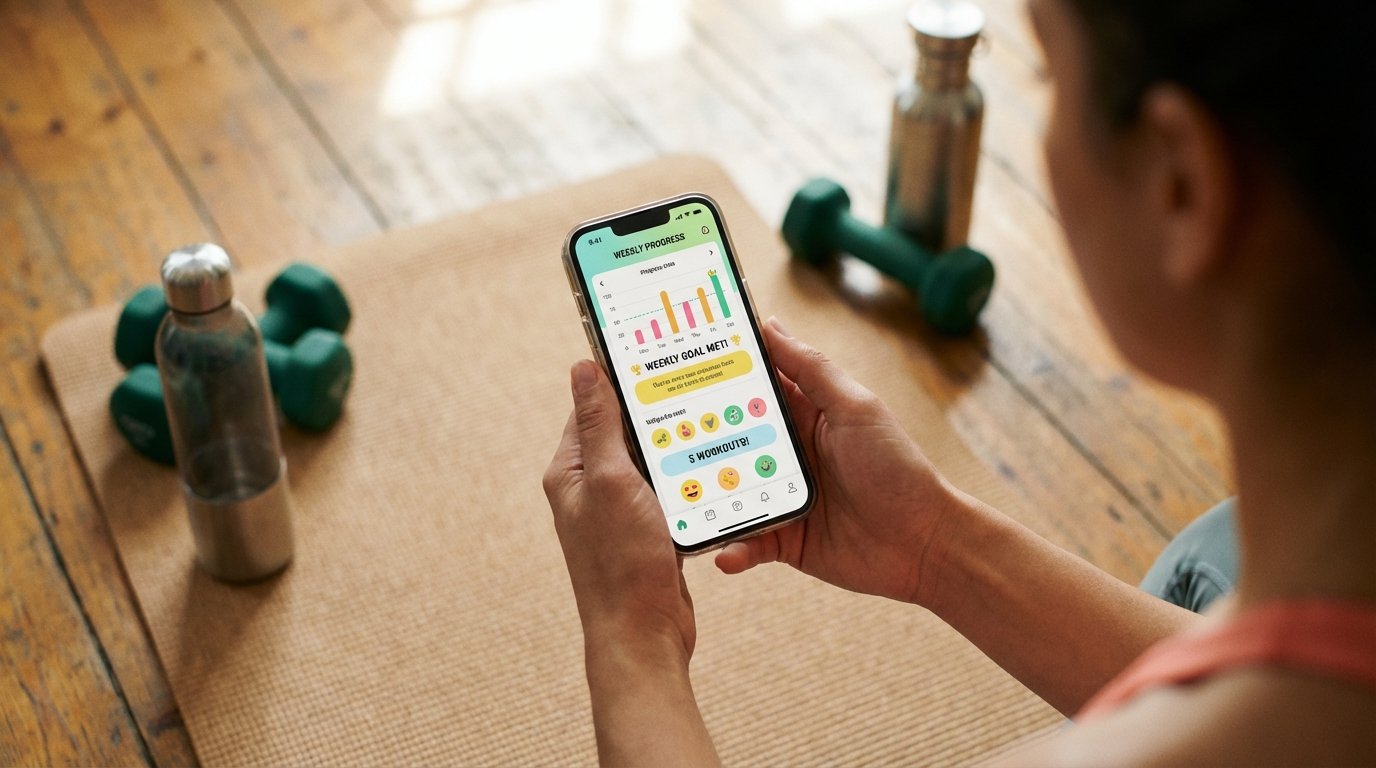
Most fitness apps were designed for people with predictable energy, stable hormones, and a functioning internal reward system. During perimenopause, you have none of those. That's why the app that worked in your 30s might stop working now, not because you've lost discipline, but because your biology has genuinely changed.
This isn't a guide that names specific apps or ranks them against each other. It's about understanding which features actually work during perimenopause and which ones actively make things worse. The science behind this is clearer than most people realise.
Why most fitness apps stop working during perimenopause
The problems aren't random. They stem from three specific mismatches between how apps are designed and what perimenopause does to your body.
Streak-based motivation exploits dopamine, which you're running low on. Oestrogen maintains dopamine receptor sensitivity in the brain's reward system. As it declines during perimenopause, inhibitory dopamine receptors upregulate, putting a brake on the reward circuitry that used to make exercise feel worth doing.[1] The result: a 30-day streak that once felt genuinely satisfying starts to feel like a hollow obligation. And when a streak breaks, which it will because perimenopause makes energy unpredictable, the psychological cost is disproportionate. Woolley and Sharif's 2026 review on goal-setting technology found that missing streak targets "appeared to contribute to avoidant behaviours or complete disengagement" even when the break wasn't within the user's control.[2] The full story of how oestrogen affects dopamine and what that means for exercise motivation is in this post on perimenopause exercise motivation.
Fixed daily goals ignore your reality. A randomised controlled trial compared a fixed 10,000-step daily goal against a machine-learning system that adapted to each person's actual activity. The fixed-goal group saw their daily steps decline by 1,350 over 10 weeks. The adaptive group declined by only 390 steps, a difference of 960 steps per day in favour of personalised targets.[3] Fixed targets don't just fail to help. For people with variable energy, they actively backfire.
Calorie-burn tracking is flawed in two separate ways. First, the numbers are wrong. A systematic review found that every major wearable device showed mean absolute percentage errors exceeding 30% for energy expenditure. None of the tested devices proved accurate for this metric.[4] Second, even if the numbers were accurate, your body compensates. Research using doubly labelled water across five populations found that total daily energy expenditure plateaus beyond moderate activity levels, as the body adjusts other physiological processes to stay within a narrow energy range.[5] Chasing a calorie target is a losing game on both counts.
What to look for in a fitness app for perimenopause
Five features have meaningful research backing for people with variable energy and shifting hormones.
Weekly goals rather than daily streaks. Sharif and Shu's research on goal design found that people given a weekly target with built-in "emergency reserve" skip days showed 55% persistence after goal failures, compared to 37% for those on rigid daily goals.[6] Weekly targets accommodate bad days without breaking your momentum. Missing Tuesday doesn't wipe out Monday.
Adaptive targets that learn from your actual behaviour. The adaptive goals RCT above is the best direct evidence here. Goals calibrated to your real activity history are measurably more effective than any round number a product team decided sounds right. If your energy varies week to week because of sleep disruption, hot flushes, or a difficult work period, your targets should vary too.
Effort-based tracking rather than calorie-based. During perimenopause, the goal that matters is consistent movement, not hitting a specific energy expenditure that wearables can't accurately measure anyway. Research on body composition during the menopause transition consistently shows that showing up regularly produces measurable benefits (reduced visceral fat, preserved lean mass, better insulin sensitivity) that have nothing to do with calorie numbers. The perimenopause weight gain post covers this in detail.
Walking treated as real exercise. A poll of nearly 6,000 women by Dr Louise Newson found that 79% choose walking as their primary activity during perimenopause.[7] Any app that treats walking as a consolation prize for people not doing "real workouts" is ignoring both the evidence and the reality of how most women actually move. For the research on what walking does during perimenopause, see walking during perimenopause and how many steps matter.
Social accountability without social comparison. Social features in fitness apps work. A gamified social intervention (the STEP UP RCT) found that the competitive arm generated 920 additional daily steps compared to controls across a 24-week intervention.[8] But the design of the social feature matters. Comparing your absolute performance against someone else's creates anxiety. Comparing effort relative to your own baseline gives you accountability without the demoralisation of watching a fitter person lap you. You want the motivation, not the inadequacy.
Three red flags in a perimenopause fitness app
Some app features are not just unhelpful during perimenopause. They can actively make engagement worse.
Streak counters that reset to zero. If missing one day erases weeks of progress, the app is designed around a stable, dopamine-rich reward system. During perimenopause, your reward system doesn't work that way anymore. A broken streak is especially damaging when the break was caused by something outside your control, which, during perimenopause, happens regularly.
Weight loss as the primary metric. Body composition changes during perimenopause in ways the scales don't capture. A meta-analysis of 101 randomised controlled trials found exercise reduced fat mass and increased fat-free mass significantly, with minimal change in total body weight. An app anchored to weight loss is measuring the wrong thing and will make you feel like you're failing when you're not. The perimenopause weight gain post explains why waist circumference and energy levels are better markers than scale weight.
One-size-fits-all daily programmes. If Tuesday's workout is identical regardless of whether you slept well or barely at all, the app doesn't account for the hormonal fluctuation that defines perimenopause. Sleep disruption affects roughly 38% of perimenopausal women, and fatigue is a significant symptom for around two thirds.[9] A programme that ignores this isn't designed for your body. It's designed for a body you no longer have.
How Motion was built for this
The features described above aren't a wishlist. They're the design principles behind Motion.
Adaptive weekly goals are set using a rolling 12-week window of your actual activity. Bad week? Your target adjusts. Good week? It nudges up. There's no fixed daily number to miss and no streak to break. The goal is always calibrated to what you can realistically do right now, not what someone decided was a good round number two years ago.
Your Motmot (your digital fitness pet) is Motion's digital fitness companion, and it responds to consistency rather than performance. Research on virtual pets found they increase physical activity through companionship and visible progress, with the effect operating through improved self-efficacy rather than extrinsic reward.[10] Your Motmot doesn't care whether you walked 3,000 steps or ran 10 kilometres. It cares that you moved. It gets worried when you're inactive and happy when you show up, which is the external reward loop your dopamine system used to provide automatically.
Friend challenges are scored on effort relative to your own baseline, not on absolute numbers. Your 4,000 steps on a difficult day can beat someone else's 12,000 if you achieved a higher percentage of your personal goal. That's the accountability without the comparison anxiety, and it's the difference between social features that encourage and social features that demoralise.
Walking counts. Steps count. A gentle stretch on a hard day counts. Everything goes toward your weekly goal, and none of it is treated as a lesser version of real exercise. Motion works with Apple Watch, Garmin, Fitbit, Samsung Galaxy Watch, and most other trackers, as well as your phone alone if that's what you have.
No streaks. No calorie targets. No guilt mechanics. Just a system designed to keep moving with you rather than expecting you to keep up with it. More on the research behind this approach is at adaptive fitness goals.
Choosing the right fitness app for perimenopause
The app that works during perimenopause is the one that adapts to your body instead of expecting your body to adapt to it. That means weekly flexibility over daily rigidity, personalised targets over fixed numbers, effort over calorie output, and social accountability built on your own baseline rather than someone else's.
The body changes post covers what's happening physically during the transition. The best exercise for perimenopause covers what types of movement matter most. Once you have the right tool, the rest of the research is there when you need it.
Sources
- PMC: Kim & Park. Menopause, Physical Activity, and Dopamine Signaling. Iranian Journal of Public Health (2022)
- Woolley & Sharif. Digital Tracking, Gamification, Social Media, and AI: How Technology Influences Motivation. Consumer Psychology Review (2026)
- PubMed: Rabbi et al. Evaluating Machine Learning-Based Automated Personalized Daily Step Goals Delivered Through a Mobile Phone App: RCT. JMIR mHealth and uHealth (2018)
- PubMed: Shcherbina et al. Accuracy in Wearable Sensor Data for Energy Expenditure. JMIR mHealth and uHealth (2017)
- PubMed: Pontzer et al. Constrained Total Energy Expenditure and Metabolic Adaptation to Physical Activity in Adult Humans. Current Biology (2016)
- SAGE: Sharif & Shu. The Benefits of Emergency Reserves: Greater Preference and Persistence for Goals that Have Slack with a Cost. Journal of Marketing Research (2017)
- Newson Health: Exercising During Perimenopause and Menopause. Survey of nearly 6,000 women
- PubMed: Patel et al. Gamification to Improve Physical Activity. STEP UP RCT. JAMA Internal Medicine (2019)
- PMC: Cintron et al. Sleep Disorders During Menopause. Meta-analysis (2023)
- PubMed: Baranowski et al. Virtual Pet as a Tool to Increase Physical Activity in Children. Games for Health Journal (2015)


