
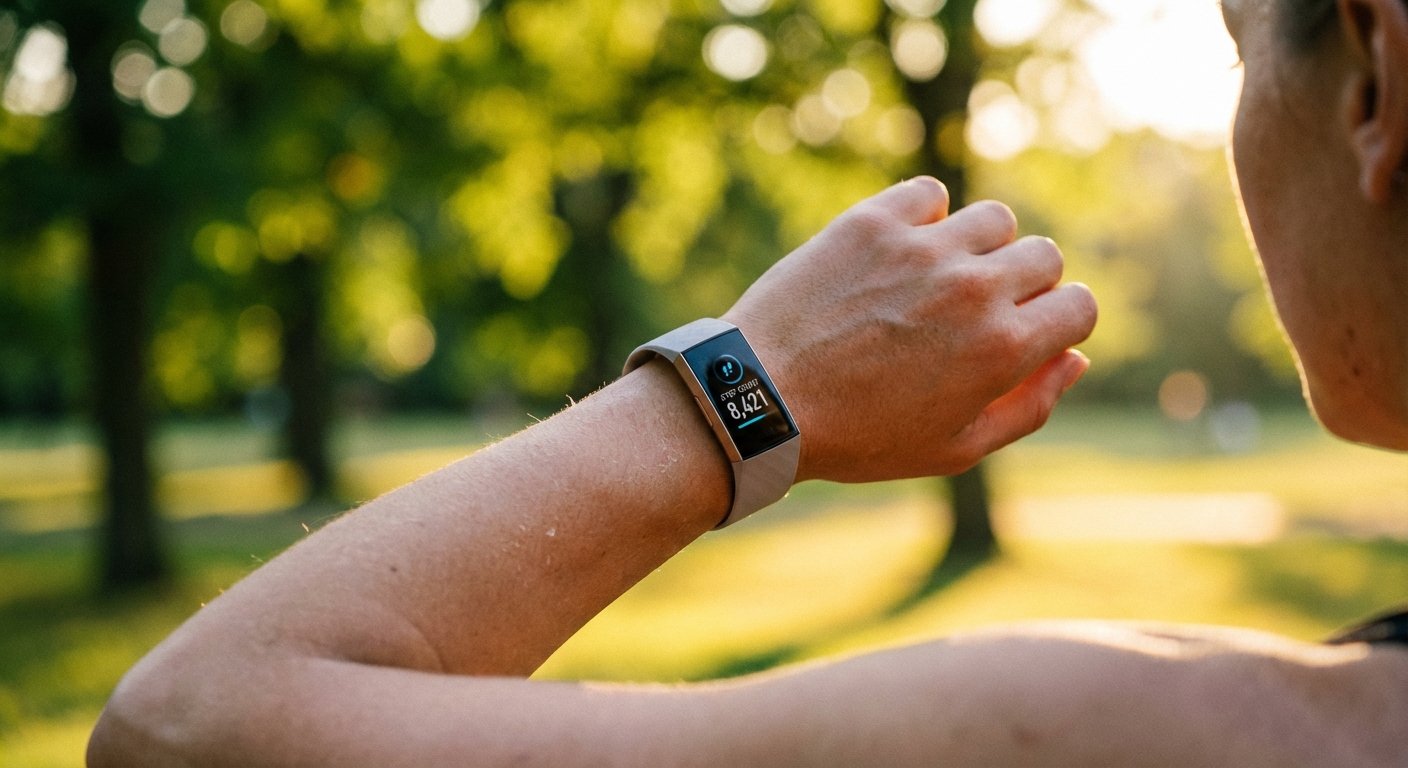
If you've ever felt guilty about not hitting 10,000 steps, you can stop. That number is not a scientific recommendation. It came from a 1960s Japanese marketing campaign for a pedometer called the Manpo-kei, which translates to "10,000-step meter." It was a brand name, not a research finding.
The actual research on step counts and health outcomes tells a very different story, and for perimenopausal women, the numbers are lower and more forgiving than you'd expect.
What the studies actually say
The Lancet: 47,471 adults, 15 countries
A 2022 meta-analysis in The Lancet Public Health analysed data from 47,471 adults across 15 international cohorts [1]. For adults aged 60 and over, the mortality benefits of walking plateaued at 6,000-8,000 steps per day. Going beyond that didn't add meaningful benefit. For younger adults, the plateau was higher (8,000-10,000), but the returns above 8,000 were small.
JAMA: 16,741 older women
A landmark study in JAMA Internal Medicine tracked 16,741 older women and found that as few as 4,400 steps per day was associated with significantly lower mortality compared to 2,700 steps [2]. Benefits levelled off at around 7,500 steps. The bigger finding: step intensity didn't matter. Once you accounted for total volume, walking speed made no difference to outcomes.
JAMA Network Open: middle-aged adults
For middle-aged adults (mean age 45, which maps closely to perimenopause), a study in JAMA Network Open found significant mortality reduction at 7,000 steps per day [3]. Again, intensity was not a significant factor. Volume is what counts.
The big meta-analysis: 227,000 people
A 2023 meta-analysis of 17 studies covering 227,000 participants found that every additional 1,000 steps per day was associated with a 15% reduction in all-cause mortality [4]. Every 500-step increase was associated with a 7% reduction in cardiovascular mortality. Benefits began at as low as 3,867 steps per day for all-cause mortality and 2,337 for cardiovascular mortality.
What this means for you
If you're currently doing 2,000-3,000 steps a day, getting to 5,000 is a bigger health gain than going from 8,000 to 15,000. The relationship between steps and health is not linear. The first few thousand extra steps deliver the most benefit. After about 7,500, you're in diminishing returns territory.
A realistic target for perimenopausal women: 6,000-8,000 steps per day. That's about 45-60 minutes of walking, which can be split across the whole day. A 15-minute walk in the morning, a 10-minute walk at lunch, and a 20-minute walk after dinner gets you there without a single "workout."
And on the days when that feels like too much? 4,000 steps still matters. The research is clear: some is dramatically better than none.
Speed doesn't matter (really)
This is one of the most consistent findings across the step-count research. Multiple studies confirm that step intensity does not independently predict health outcomes once total volume is accounted for [2] [3].
You do not need to power walk. You do not need to maintain a certain pace. A slow wander around the park counts the same as a brisk walk down the street, step for step.
This matters during perimenopause because energy fluctuates wildly. Some days you'll feel like striding. Other days you'll barely shuffle. The research says both count equally. That's not a consolation prize. It's what the data actually shows.
Steps vs. minutes vs. distance
There's confusion about which metric to track. Here's how they roughly translate:
- 1,000 steps = about 10 minutes of walking = roughly 0.8 km / 0.5 miles
- 5,000 steps = about 45-50 minutes = roughly 4 km / 2.5 miles
- 7,500 steps = about 60-75 minutes = roughly 6 km / 3.7 miles
Most health guidelines recommend 150 minutes of moderate-intensity activity per week. Brisk walking counts. That works out to roughly 30 minutes a day, five days a week, which translates to about 10,000-12,000 steps spread across those five days, or about 2,000-2,400 per walk.
Track whichever metric makes sense for you. If you wear a fitness tracker, steps are the easiest. If you prefer time-based goals, minutes work just as well. The research doesn't favour one metric over another. If you want to convert between them, our steps to miles calculator can help.
The problem with fixed targets
Whether it's 10,000 steps or 7,500, any fixed daily target has the same problem: it doesn't account for how you feel.
During perimenopause, your energy is unpredictable. Oestrogen affects sleep quality, inflammation, muscle recovery, and dopamine. A target that felt easy on Monday can feel impossible on Wednesday. And when you miss a daily target, most apps treat it as a failure. Streak broken. Red ring incomplete. Progress lost.
This is exactly the wrong approach for a body in hormonal transition. What you need is a system that tracks your effort across the week rather than punishing you for individual bad days.
How Motion handles this differently
Most step trackers give you a fixed daily goal and a streak to maintain. Miss a day and the streak resets. That works fine when your energy is predictable. During perimenopause, it isn't.
Motion takes a different approach. Instead of a fixed daily target, it sets an adaptive weekly goal based on your actual activity history. Your goal reflects what you've been doing, not what a marketing team decided was a good round number.
Had a 2,000-step day because you barely slept? That's fine. Make it up across the rest of the week, or don't. Motion adjusts. Had a great week and smashed your target? Next week's goal nudges up. The system learns your rhythm and works with it.
If you want accountability, Motion's friend challenges let you compete on weekly effort. Your 30,000-step week can beat someone else's 50,000 if you pushed harder relative to your own baseline. It's the only step challenge that's fair when one of you slept terribly and the other didn't.
And your Motmot (your digital fitness pet) thrives on consistency, not perfection. It doesn't care whether you walked 4,000 steps or 10,000. It cares that you showed up.
The research says 7,000 steps is a good target. Motion helps you get there on your terms.
Sources
- PubMed: Paluch et al. Daily steps and all-cause mortality. Meta-analysis of 15 cohorts. Lancet Public Health (2022)
- PubMed: Lee et al. Step volume and intensity with mortality in older women. JAMA Internal Medicine (2019)
- PubMed: Paluch et al. Steps per day and mortality in middle-aged adults. JAMA Network Open (2021)
- PubMed: Banach et al. Daily step count and all-cause and cardiovascular mortality. Meta-analysis (2023)


