
The exercise that worked in your 30s probably isn't what your body needs now. That's not a failure on your part. Perimenopause changes how your body responds to training, recovers from it, and benefits from it. The old playbook doesn't apply.
The research on what does work is clearer than ever. And it's not complicated. It just looks different.
Strength training: the non-negotiable
If there's one thing the research agrees on, it's this: resistance training during perimenopause isn't a nice-to-have. It's the single most important change most women can make.
The British Menopause Society puts it plainly: "Strength training is especially important in midlife and beyond, when our muscle mass starts to diminish as we're at increased risk of osteoporosis" [1]. NICE guidelines explicitly recommend maintaining muscle mass and strength through physical activity [2].
What the studies show
The University of Exeter study (2024) is one of the most encouraging pieces of research to come out of this space. 72 women across pre-, peri-, and postmenopausal stages completed a 12-week low-impact resistance programme using resistance bands, light hand weights, and bodyweight exercises. The results: hip strength improved by nearly 20%, flexibility by over 20%, balance by up to 13%, and lean body mass increased by 2% [3].
The critical finding? Improvements were comparable across all menopause stages. The hormonal decline did not reduce the body's ability to respond to training. If you're worried it's "too late," this study says otherwise.
For bone density specifically, the LIFTMOR trial (Watson et al., 2018) remains the gold standard. Postmenopausal women with low bone mass did twice-weekly, 30-minute sessions of supervised high-intensity resistance training. Lumbar spine bone mineral density improved by about 4%, with over 90% adherence and no fractures [4].
A 2023 review in Menopause found that training at 80% of one-rep max just twice a week was sufficient for bone density changes, suggesting that load matters more than frequency [5].
The perimenopause window
There's a timing element worth knowing about. A 20-week controlled trial found that muscle-building (hypertrophy) effects were strongest in pre-menopausal women with higher oestrogen. Strength gains were similar across all groups, but the ability to add new muscle tissue was better before menopause [5].
This doesn't mean postmenopausal women can't build muscle. They can, and the evidence proves it. But it does suggest that perimenopause is a window where starting (or continuing) strength training pays particularly high dividends.
How to do it
- Frequency: 2-3 times per week, targeting all major muscle groups. WHO and NHS both set 2 days as the minimum [6].
- Load: Progressive overload over time. Start with bodyweight or light resistance if you're new, and build up. For bone density, you'll eventually want to work with heavier loads.
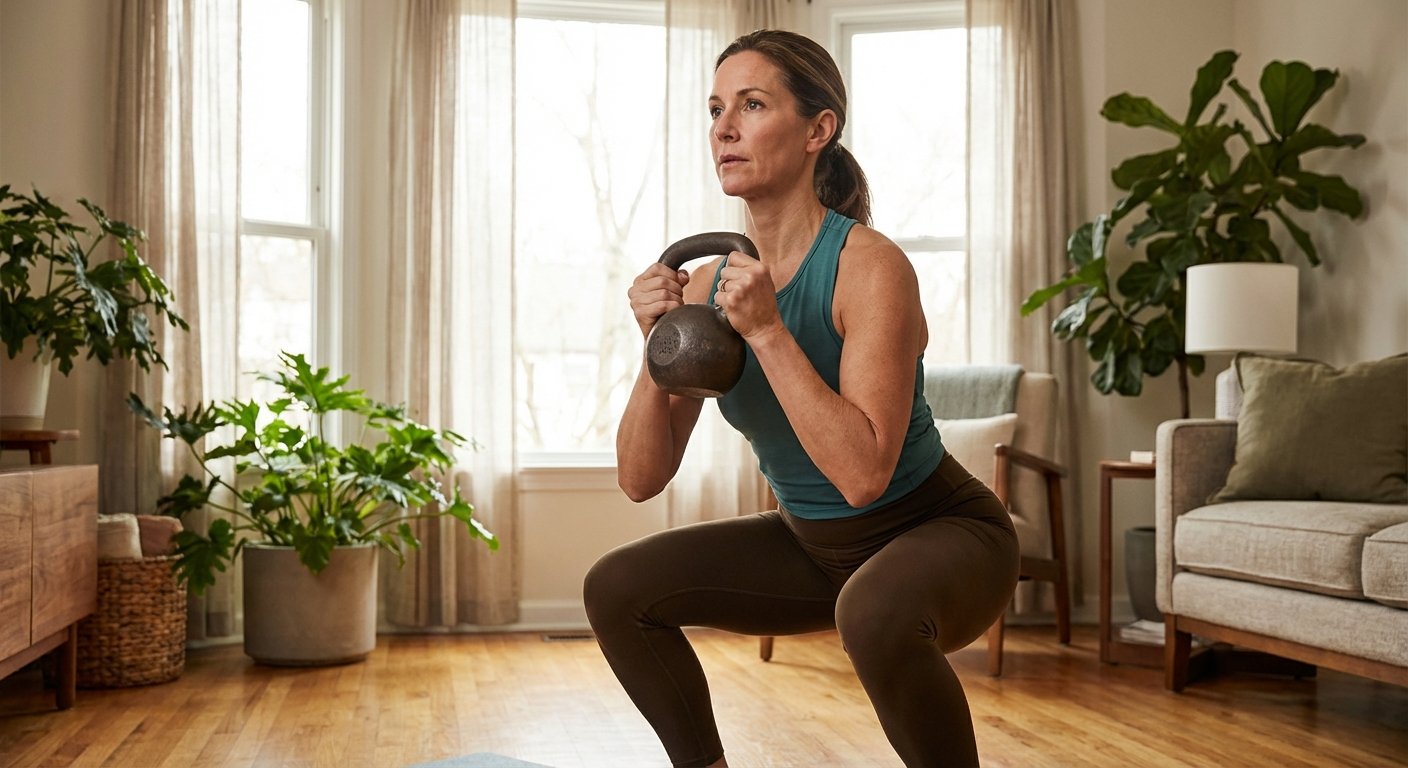
- Movements: Compound exercises (squats, deadlifts, rows, presses, lunges) give you the most return. The Exeter study used squats, lunges, planks, hip hinges, and single-leg balance work.
- Sessions: 30-50 minutes is plenty. Both the LIFTMOR trial and the Exeter study got meaningful results in that window.
- Equipment: Bodyweight, resistance bands, dumbbells, kettlebells, machines. A systematic review found comparable benefits across different equipment types [7]. Use whatever you have access to and will actually use.
We'll cover a specific strength routine in a companion post, but the principle is simple: start where you are, progress gradually, and keep showing up.
Walking: the secret weapon
Walking gets dismissed as "not real exercise." The research could not disagree more strongly.
In a survey of nearly 5,800 women by Newson Health, 75% named walking as the exercise that most benefited their physical and mental health during perimenopause [8]. And the science backs them up.
Why walking works so well during perimenopause
Cortisol management. Unlike high-intensity exercise, which spikes cortisol, low-to-moderate intensity movement like walking actually lowers circulating cortisol [9]. During perimenopause, when oestrogen's stress-buffering effect is fading, this matters. Your body is already dealing with an elevated baseline of cortisol. Walking brings it down rather than adding to it.
Cardiovascular protection. The Nurses' Health Study (72,488 women) found that brisk walking for at least three hours per week reduced coronary heart disease risk by 35% [10]. As oestrogen's cardioprotective effect declines, that matters more and more.
Blood sugar management. A 2022 meta-analysis in Sports Medicine found that walking after eating cut postprandial glucose spikes. A 2025 follow-up confirmed that just 10 minutes of walking immediately after a meal suppressed peak blood glucose [11]. With insulin sensitivity declining during perimenopause, post-meal walks are one of the simplest interventions available.
Brisk vs casual
Pace matters. Brisk walking (roughly 100 steps per minute or about 3 mph) qualifies as moderate-intensity exercise [12]. A stroll is better than sitting, but picking up the pace pushes you into the range where cardiovascular and metabolic benefits kick in.
How much is enough?
The 10,000-step target has no scientific basis (it came from a 1960s Japanese marketing campaign). The actual research is more forgiving. A Harvard study of older women found mortality benefits kicked in at just 4,400 steps per day, levelling off at around 7,500 [13]. A Lancet meta-analysis put the sweet spot at roughly 7,000-8,800 steps, with each additional 1,000 steps associated with lower all-cause mortality [14].
Exercise snacking
Can't fit a 30-minute walk in? Multiple short walks work too. A systematic review found that "exercise snacks" (brief bouts of activity spread through the day) improved cardiorespiratory fitness, with results comparable to or exceeding longer continuous sessions. Adherence was 91% [15].
Three 10-minute walks may actually fit your day better than one 30-minute block. The research says that's fine.
We go deeper into walking for perimenopause in a dedicated post.
Interval training: done right
HIIT during perimenopause gets a lot of contradictory advice online. "Avoid it completely!" says one camp. "It's essential!" says the other. It's more nuanced than either.
What the research says
Dr Stacy Sims, exercise physiologist and researcher specialising in women's health, argues that short, sharp intervals are not just safe but necessary for midlife women. Her rationale: women naturally have more endurance-type muscle fibres, so steady-state cardio alone doesn't provide enough stimulus to drive continued adaptation. HIIT and sprint interval training (SIT) fill that gap [16].
A meta-analysis of 38 studies (959 subjects) found HIIT effective for improving body composition in menopausal women, with cycling-based intervals showing better results than running [17].
There are brain benefits too. HIIT increases BDNF (brain-derived neurotrophic factor) and improves executive function and working memory, with cognitive gains more pronounced in perimenopausal women than postmenopausal [18].
The cortisol question
The fear around HIIT and cortisol is understandable but oversimplified. Acute cortisol spikes from a short workout are normal and healthy. The problem is chronic elevation from overtraining, poor sleep, and life stress all compounding.
Here's the interesting part: regular moderate-intensity endurance exercise can actually increase circulating cortisol over time, while regular HIIT has been shown to lower basal cortisol concentrations [19]. Duration matters more than intensity for cortisol accumulation. A 25-minute HIIT session is likely less stressful than a 90-minute steady-state jog.
How to do it
- Frequency: 1-2 sessions per week, maximum. No more.
- Duration: Keep it short. 20-30 minutes total including warm-up and cool-down.
- Format: 30 seconds hard effort, 2-3 minutes recovery (SIT), or 2 minutes at 85-90% effort, 2 minutes easy (tempo intervals).
- Modality: Cycling, rowing, walking hills, or swimming are all lower-impact than burpees or box jumps. Your joints will thank you.
- Recovery: At least 48 hours between HIIT sessions. If you slept badly or you're running on fumes, swap it for a walk. No guilt.
Yoga and Pilates: flexibility, balance, calm
These are often framed as "nice to have" additions. The evidence says they're more than that.
Yoga
A 2024 meta-analysis of 24 randomised controlled trials (2,028 participants) found yoga had significant beneficial effects on psychological symptoms, somatic symptoms, urogenital symptoms, sleep quality, anxiety, and depression in menopausal women [20]. A separate RCT found yoga significantly improved sleep quality in both perimenopausal and postmenopausal women [21].
One honest caveat: the evidence for yoga reducing hot flushes specifically is weak. It helps with nearly everything else, but if hot flushes are your primary concern, resistance training has stronger evidence on that front.
Pilates
Pilates has become the most-booked workout globally (ClassPass 2024 data), with UK bookings up 84% year-on-year. And there's substance behind the trend.
A 2024 meta-analysis found Pilates improved health-related quality of life in postmenopausal women, with the strongest effects when performed for at least 48 sessions [22]. A separate RCT found that Pilates was as effective as dedicated pelvic floor muscle training for managing stress urinary incontinence, a common perimenopause complaint [23].
Balance: the investment you'll thank yourself for later
Fall prevention is usually framed as something for people in their 70s. The evidence suggests that's 20 years too late. Research from the International Osteoporosis Foundation found that exercising before age 40 is associated with lower fall risk in later life [24]. Combined resistance, impact, and balance training has the most consistent benefits for bone density at the spine and femoral neck [25].
Single-leg stands, step-ups, yoga balances, and Pilates stability work all count. The Exeter study included single-leg balance exercises and saw 12-13% improvement in balance scores across all menopause stages.
Swimming and cold water
Swimming deserves a mention, especially given its popularity among midlife women in the UK.
A UCL study published in Post Reproductive Health surveyed 1,114 women (93% UK-based) about cold water swimming and menopause symptoms. The results were notable: 47% reported reduced anxiety, 35% fewer mood swings, 31% improved mood, and 30% fewer hot flushes. 63% of menopausal women said they specifically swam to relieve symptoms [26].
This is self-reported data without a control group, so it needs to be taken with appropriate caution. But with an estimated 1 million regular outdoor swimmers in the UK, 87% of whom are over 40 and 65% of whom are women, there's clearly something happening that warrants further study.
Beyond cold water, swimming in general is joint-friendly and works well for women dealing with the musculoskeletal symptoms of perimenopause. If running or impact exercise has started hurting, the pool is a legitimate alternative.
What to ease off on
This isn't about doing less. It's about doing the right things.
Long steady-state cardio
The 60-minute treadmill jog that felt productive in your 30s may now be counterproductive. Research shows a marked difference in cortisol accumulation between 45-minute and 120-minute endurance sessions. During perimenopause, when your stress-buffering hormones are already depleted, long cardio sessions can push cortisol higher and keep it there [27].
This doesn't mean all cardio is bad. Short, brisk walks and brief interval sessions are beneficial. The problem is extended, moderate-intensity grinding that drains your recovery capacity without delivering proportional returns.
"Calories burned" as a goal
Research on constrained energy expenditure (Pontzer et al.) shows that total daily energy expenditure plateaus at higher activity levels as the body compensates by reducing energy spent elsewhere [28]. During perimenopause, your body is already burning 200-300 fewer calories daily due to declining oestrogen and muscle mass. Chasing calories through exercise is a losing game. Focus on what exercise does for your muscles, bones, mood, and metabolic health instead.
Pushing through on bad days
When recovery capacity is reduced (and it is, because oestrogen has anti-inflammatory properties that help muscles recover), the risk of overtraining goes up. Chronically elevated cortisol from overtraining is linked to poor sleep, increased visceral fat, and insulin resistance. On days when energy is low, scaling back intensity or swapping a gym session for a walk isn't giving up. It's training smart.
Building your week
The NHS and WHO recommend 150 minutes of moderate aerobic activity per week (or 75 minutes vigorous) plus strength training on at least 2 days [6]. Those are minimums, and they're achievable.
Here's what an evidence-based perimenopause week might look like:
Monday: Strength training (30-40 min, compound movements) Tuesday: Brisk walk (30 min) + post-dinner stroll (10 min) Wednesday: Yoga or Pilates (45 min) Thursday: Strength training (30-40 min) Friday: Short HIIT session (20 min on bike or rowing machine) Saturday: Longer walk, swim, or active hobby Sunday: Rest or gentle stretching
This hits the guidelines: two strength sessions, one HIIT, plenty of walking, one flexibility/balance session, and built-in recovery.
What matters more than any schedule: this is a template, not a contract. Some weeks you'll have energy for all of it. Some weeks you'll manage three sessions and a few walks. Both are fine. The research consistently shows that the biggest health gains come from moving from "nothing" to "something," not from optimising an already-good routine.
During perimenopause, your energy fluctuates in ways that don't follow a predictable pattern. Dr Stacy Sims advises training by how you feel rather than sticking rigidly to a plan [18]. If Thursday's strength session feels impossible, take a walk instead and shift it to Friday. Flexibility in your approach is what makes it sustainable over years.
The bottom line
The best exercise for perimenopause is a mix: strength training as the foundation, walking as the daily constant, short intervals for metabolic and brain health, and yoga or Pilates for flexibility, balance, and calm. Swimming if you enjoy it. Rest when you need it.
What matters less is the specific plan. What matters more is that you keep moving, in ways that work for your body as it is now, not as it was five years ago.
Motion tracks all of these activities and adjusts to your effort, not arbitrary targets. When Tuesday is a 30-minute walk and Thursday is a gym session, both count toward your weekly goals. Your Motmot doesn't judge. It just celebrates that you moved.
Sources
- BMS/Women's Health Concern: Exercise in Menopause Factsheet (June 2023)
- NICE Guideline NG23: Menopause — diagnosis and management (updated 2024)
- PMC: University of Exeter/Pvolve Resistance Training Study Across Menopause Stages (2024)
- PubMed: Watson et al. — LIFTMOR Trial — High-Intensity Resistance Training and Bone Density (2018)
- PMC: Body Composition and Resistance Training Responses Across Menopause Stages (2023)
- NHS: Physical Activity Guidelines for Adults Aged 19 to 64
- PMC: Efficacy of Strength Exercises for Postmenopausal Women — Systematic Review (2023)
- Dr Louise Newson: Exercising During Perimenopause and Menopause — Survey Data
- PubMed: Low-Intensity Exercise Reduces Circulating Cortisol (2008)
- PubMed: Nurses' Health Study — Walking and Coronary Heart Disease in Women (1999)
- Scientific Reports: Post-Meal Walking and Blood Glucose Suppression (2025)
- PMC: Brisk Walking Cadence and Moderate Intensity Threshold (2016)
- Harvard Gazette: For Older Women, Just 7,500 Steps a Day Lowers Mortality (2019)
- Lancet Public Health: Steps Per Day and All-Cause Mortality Meta-Analysis (2022)
- PMC: Exercise Snacks and Cardiorespiratory Fitness — Systematic Review (2025)
- Dr Stacy Sims: Why HIIT Is Essential for Women — Body and Brain Benefits
- PubMed: HIIT and Body Composition in Menopausal Women — Meta-Analysis (2020)
- Dr Stacy Sims: Perimenopause vs Postmenopause Training and Nutrition Guide
- ACE Fitness: The Connection Between Exercise and Menopause (2018)
- PubMed: Yoga and Menopausal Symptoms — Meta-Analysis of 24 RCTs (2024)
- PubMed: Yoga and Sleep Quality in Perimenopausal and Postmenopausal Women (2022)
- PubMed: Pilates and Quality of Life in Postmenopausal Women — Meta-Analysis (2024)
- PubMed: Pilates vs Pelvic Floor Training for Urinary Incontinence (2024)
- International Osteoporosis Foundation: Exercise Depending on Age
- PMC: Combined Resistance, Impact, and Balance Training for Bone Density (2023)
- PMC: UCL Cold Water Swimming and Menopause Symptoms Study (2024)
- Flipping Fifty: Cortisol and Exercise in Menopause
- PMC: Pontzer et al. — Constrained Total Energy Expenditure Model (2016)


